My Message close
GAME JOBS
Latest Jobs
spacer View All     Post a Job     RSS spacer
 
May 26, 2013
 
Treyarch / Activision
Technical Animator
 
Treyarch / Activision
Game Systems Designer
 
Infinity Ward / Activision
Senior Tools Engineer
 
Airtight Games
Environment Artist
 
App Minis LLC
Senior Unity Game Programmer
 
Gameloft
Game Designer
spacer
Blogs

  The Importance of Setting (With Respect to Gameplay)
by Eric Schwarz on 08/06/12 03:46:00 pm   Expert Blogs   Featured Blogs
5 comments Share on Twitter Share on Facebook RSS
 
 
The following blog was, unless otherwise noted, independently written by a member of Gamasutra's game development community. The thoughts and opinions expressed here are not necessarily those of Gamasutra or its parent company.

Want to write your own blog post on Gamasutra? It's easy! Click here to get started. Your post could be featured on Gamasutra's home page, right alongside our award-winning articles and news stories.
 

Have you ever been playing an open-world title like Grand Theft Auto IV, and been amazed about how natural and reactive much of the world is?  Bump into someone the wrong way, and they might do anything from shrug it off, to yell at you, to start a fistfight... they might even pull a gun on you and start shooting if they're high-strung enough.  Yet how many times have you also performed an equally plausible action, like driving a car across Liberty Island's parks, before flinging that car into the ocean, only to see absolutely no reaction from anyone around you?  As much as some titles are able to create plausible and interesting mechanics out of natural player actions, it's just as, if not more common to see a game simply shrug its shoulders and say, "nope, got nothing, move along."

Generally speaking, when discussing settings in videogames, we tend to think of it in terms of storytelling, and, to a degree, marketing; namely, what does a given setting offer plot- and character-wise, or how cool is it, or how many people does it appeal to compared with another setting?  We rarely stop to think, however, about how setting can actively influence the game mechanics of a title, either opening up new possibilities, or covering up flaws that would otherwise cause problems in another setting.  While setting often isn't something that developers are always fully in control of, it is an exceptionally valuable tool in creating gameplay that is plausible and feels natural to players, and informs the possibilities games have to offer.

World Design

Game developers, and for that matter, just about all artists, tend to take a couple of approaches when it comes to building settings.  The first of these methods is bottom-up world-building: where the fundamentals of a given game world, or society, are understood from the lowest possible level and worked up.  Taken to extremes, building from the bottom-up includes questions like "what are the geographic conditions of this planet?", and each new "tier" of questions is an answer to the previous one.  This is common in science fiction and fantasy outside of gaming, but not so common in videogames because often the gameplay comes before the setting.

The second method of world-building, top-down, is far more common in videogames because gameplay and genre are usually the most important parts of a title and what determine everything from who a game is marketed to, to whether it even gets made or not.  Top-down world-building simply goes in the opposite direction: setting and theme are created with the gameplay goals in mind.  If a title is a first-person shooter, a wartime setting makes a lot of sense because the violence of that kind of world allows us to be comfortable with shooting other things, or people.

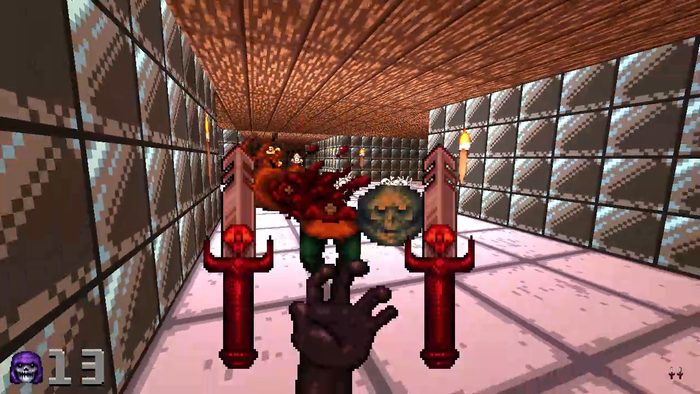
Even Duke Nukem has a surprisingly believable world because its cheesy B-movie themes match the B-movie violence on display.

Top-down world design is exemplified by the Siege series, originally developed by Gas Powered Games.  The first Dungeon Siege was set in a typical fantasy environment, while the sequel expanded the setting considerably and included a much larger and more layered world.  The third, developed by Obsidian Entertainment, took on a more steampunk flair than the previous two titles, and Space Siege, a literal "in space!" spin-off, kept many of the same gameplay themes but put them in a new context.  Despite the significant changes in setting, Dungeon Siege's gameplay has remained very constant.  The goal of the series is "hack and slash RPG fun", and not "immersing the player in the world of Ehb."

I'm running through all this mostly just to demonstrate that setting in videogames is usually, to a degree, incidental.  While settings are used to sell games and are often what players connect to when playing them - I suspect Fallout wouldn't be nearly as well-remembered if it hadn't had such a compelling post-nuclear setting - they're generally a secondary concern when creating a game, and only fleshed out once the gameplay itself is defined.  My goal isn't to advocate one approach or the other, only to provide some context for why settings can clash with gameplay.

Suspension of Disbelief

That scenario in Grand Theft Auto where you run your car over a pedestrian's body multiple times and nobody seems to care, or that moment in Skyrim where you steal a shopkeeper's entire inventory while standing right in the middle of her store, or when your character mows down hundreds upon hundreds of enemies with a machine gun but then surrenders during a cutscene - all of these situations are jarring enough for players that they often border in breaking the fourth wall.  We build up a tolerance for them, we learn to accept that games can't be wholly reactive to everything that we do, but ultimately it comes back to that simple justification: I'm playing a videogame.

Setting is one of the primary ways to reduce or eliminate these problems.  As setting is effectively the context of the gameplay that players partake in, it informs the possibilities of gameplay in a very fundamental way.  If a game is able to either create gameplay scenarios that fit its setting effectively, or alternately builds a setting that reflects the gameplay itself, the result is verisimilitude - the lack of thematic conflict produces a work that is wholly believable within its own context.  Conversely, when a game breaks its own rules, it sucks players out of the experience; when the rules are broken often enough, the logical conclusion players reach is that the world has no rules, and therefore shouldn't be taken seriously at all - thus all effort put into creating stories, characters, and so on is wasted, because the game itself has stated they are meaningless.

I certainly don't lay claim to these thoughts, as they're much older than I am, but it can be quite jarring just how often games which take their settings very seriously and demand suspension of disbelief, will nevertheless bend and break their own rules time and time again.

Contrary to popular belief, placing buckets on one's head is not a sacred Nord ritual to purge the body of all impure thoughts.  I know, I was surprised too.

Skyrim, for instance, offers up players a massive world of opportunity for experimentation and free-form gameplay, yet it's also liable to crash and burn over some of the smallest things.  In trying to craft a fully simulated world populated by human (or near-human) characters, suddenly every detail is open to scrutiny, and the developers can't possibly account for all this.  This is an issue which existed even in Morrowind, which had reams and reams of more text to explain its settings; however, as it didn't include, say, simulated physics, there was no way to break the game's AI by putting pots on heads.

Similarly, the classic case of bodies rotting in the streets of the Imperial City, a common sight in Oblivion for many players, could be improved through coding more and more reactive and specific AI, which shortly becomes a bottomless downward spiral... or, it can be explained as part of the setting.  Instead of a lawful city at the heart of the empire, Oblivion's limitations in gameplay could have been radically improved through a change in setting; for instance, perhaps the largely unexplored, foreign Black Marsh, populated by the decidedly non-human Argonian race, and organized in a more primitive, tribal manner, would have made many of the AI's flaws much easier to swallow.

Setting Informing Gameplay

Setting isn't just a tool for hiding the flaws in existing gameplay, of course - often, the challenges posed by a setting can create interesting new gameplay dynamics.  The Elder Scrolls series, as much as it's likely to fall apart if prodded and poked just the wrong way, also has lots of game mechanics which stem organically from the setting.  The civil war backdrop for Skyrim allowed for an interesting, if ultimately somewhat under-developed faction combat mechanic where players can conquer and lose forts across the game world, for instance - something which really wouldn't be possible if the story and setting said otherwise.  Dragon shouts are an entertaining addition that make sense in the context of the lore.  And the setting certainly inspires interesting gameplay ideas - Skyrim's harsh frozen wastes could have been the perfect place to make survival-oriented skills relevant, everything from dressing warmly to building igloos to keep the weather out. 

There are plenty of other examples one could turn to, however.  Strategy games, for instance, have long been built in the mold of Command & Conquer, where individual units move across a level fighting others, where success is usually a matter of economic efficiency rather than tactics, and where things like unit positioning are less important than sheer quantity of forces.  This lack of "realism" in C&C never really bothered anyone because the setting itself was fictitious and campy.

Command & Conquer plays almost identically in every iteration.  Even the aliens introduced in the third installment aren't that different, almost all of them having direct human analogues. 

When it came time for Relic Entertainment's Company of Heroes to adopt a more genuine depiction of warfare, simple things like being able to garrison units in buildings, or using cover to dodge enemy fire, or having morale be a central part of squad effectiveness, suddenly made a real-time strategy game unlike any other.  These innovations in gameplay, which later informed the even more tactics-oriented Dawn of War II, may never have happened if the decision to go for a more realistic setting hadn't occurred.

Of course, my favourite game of all time, Deus Ex, is also no stranger to this.  Despite being, on the surface, a pretty simple shooter with fairly straightforward goals, there is a huge impact to it being set 45 years in the future from when it was released.  The near-future setting was familiar enough to allow players to believe the world and the characters, and the addition of cyberpunk staples like robotics and cybernetics were all the more plausible because we could see our own world looking like that in the future.  The game's augmentation system, though effectively just a standard power-up delivery vessel, meant that many special powers, like super strength or immunity to poison or radiation, could be justified.

Now consider how Deus Ex would look if it took place in the popular realistic World War II setting that was so common at the time thanks to Medal of Honor.  Robots wouldn't make sense, so some of the game's more iconic enemies would be out.  Augmentations could at best be explained as magic powers, or mutations, so a core theme of the game, post-humanism through technological development, would be difficult to explore, and the seriousness of the game's setting and social commentary would be called into question.  Weaponry would be more limited - no plasma guns for you.  It's not that a game couldn't be built in the Deus Ex mold, using World War II as a backdrop - but it would lack so much of the game's thematic resonance and would rule out certain gameplay elements and mechanics.

Closing Thoughts

In the future, I'd like to see developers consider more closely how setting affects their titles - not just because everyone likes a cool fictional world, but because being sensitive to the particulars of setting helps create more believable games, and in the best cases, leads to new mechanics that add layers of gameplay depth and thematic meaning to the experience.  That's not to say that every game needs to have a serious, consistent, well-considered setting, but as it's one of the key factors in the current industry's obsession with detail and quote-unquote realism, it's also something that only becomes more and more apparent with every year.


Comments

Charles Geringer
profile image
Eric, do you have an opinion about the way Dwarf Fortress handles World Generation?

I find it is specially interesting that in adventure mode, you can explore a ruin, that is not just a random dungeon, or a place made for dungeon crawling, but an old fortress that actually has a documented history that can be uncovered(and may even be the result of another's play).

Congratulations on being recognized as "an expert", I always liked your posts.

Eric Schwarz
profile image
Awh, I'm an expert? I didn't notice until now. Thanks, Gamasutra!

I haven't played Dwarf Fortress, unfortunately, but I have heard a lot about it. I'll check it out when I have time later tonight and see about giving my thoughts. If it does as you say, though, in the context of a randomly generated roguelike-style world, then that's a very impressive feat.

Speaking generally about randomly generated worlds and lore, though, I'd have to say I'm happy with it so long as there is a degree of consistency. I don't think a "Mad Libs" approach to lore and backstory would work at all, if only because then you'd just have a random mishmash of pieces fused together, and thus no real established canon... but, to have, say, specific landmarks or events in the world of which the *details* might be random, I think that's a pretty neat idea. Only trouble is, is it worth the effort when you can just write straight text and achieve more or less the same effect.

Charles Geringer
profile image
It uses random elements, but rather than just randomly create soemthing, it tries itīs best to actually siulate the world history trough given parameters.

As for using adventure mode n someone else's save game, the closest comparation I can think of: it is akin to playing an rpg, where the world is someoneīs civilization game after game over.

Bart Stewart
profile image
There are actually a couple of good things that can happen when you pay serious attention to developing content that animates the world of a game.

One is the plausibility factor, which is pretty well described above. For those who enjoy emotional and intellectual believability, creating assets whose form and function fits the game's story makes the game more fun.

Another example of this would be the tape recorders containing personal diary entries in BioShock, which themselves were a reworking of the log canisters in System Shock... the Looking Glass game that was precursor to both BioShock and Deus Ex. Having a way to tell the story through personal logs, and rendering those logs in a visual metaphor that was consistent with the imagined world of those games, helped pull players into that world both emotionally (it felt right) and intellectually (it made logical sense). That kind of attention to detail makes the whole game more satisfying and memorable.

But another reason to care about this setting stuff is that it can be used to feed back into and improve the actual gameplay. By building the core gameplay, then the core world/setting content, you can then use that world content to focus your core gameplay and to add new things to do that fit the world you've imagined.

A trivial example would be ATMs in Deus Ex. Hacking is a typical element in cyberpunk, so just having newspapers talking about it could have communicated that bit of lore. But Ion Storm chose to extend it into an actual gameplay element, where finding passwords let you obtain money for buying supplies. And DX:HR took it even further, applying the hacking minigame itself to this element of cyberpunk fiction.

Maybe a better example yet would be the "schematics" of Fallout 3/NV. The post-apocalyptic world is full of junk in order to convey the sense of a destroyed world that is *the* core aspect of the setting of the Fallout games. Cleverly, Bethesda allowed players to take some kinds of scavenged junk and build useful weapons out of them, such as the radscorpion-poison dartgun.

With this one system, the setting of Fallout and the gameplay were more tightly linked. Making weapons out of the remains of a shattered civilization was a perfect metaphor for the Fallout experience.

Other games can do the same kind of thing. Not specifically making weapons from world objects, but looking for ways to enhance the gameplay that flow from the core vibe of the imagined world in which the gameplay happens. And you can go even further, letting those new gameplay systems inspire deeper meanings of other parts of the gameworld, fueling more gameplay improvements, and so on limited only by time and money.

For both of those reasons, I (as usual) think Eric gets it exactly right: the setting of a game is too valuable a design tool to do it last or as an afterthought.

Eric Schwarz
profile image
Thanks for your post. You know, as much as I've attacked Fallout 3 in the past for how it changed the Fallout franchise, that bit about the weapon schematics never occurred to me - but you're absolutely right. It's not just a metaphor for the state of the world, it's also a game mechanic that contributes pretty significantly to the experience. The rest of the game gets this all right as well, especially New Vegas - scavenging for food and items to keep hunger and thirst at bay, for instance. Maybe I just never noticed these as much because, personally, I'm not the biggest crafting junkie.

I've been playing a few games lately, including SWTOR, and I've noticed with it that the setting feels dead - not because of a lack of players or NPCs, but because none of the quests feel particular to Star Wars. Go kill some monsters. Go collect the data logs. Go ferry one item from X to Y. Star Wars is about high adventure and excitement; The Old Republic feels more like a day in the life of a Republic courier. All the cinematics, voice acting, etc. in the world can't help the fact that nothing about the gameplay communicates the core themes of the Star Wars universe.

Compare that to a game like Arkham City, which "just feels Batman" through its detective work, melee combat and platform/stealth gameplay - all core tenets of the character and universe, and all worked into gameplay effortlessly.


none
 
Comment:


UBM Tech