Using
the Hero's Journey in Games
By
Troy
Dunniway
Gamasutra
November
27 , 2000
URL: http://www.gamasutra.com/features/20001127.htm/dunniway_01.htm
Not
every game out there needs a strong story, but many do. Not every game out there
has a great story, but many should. The problem that many game designers face
is that they've come from other jobs in game development -- and typically still
need additional help when it comes to some areas of design. There are some good
books on game design, but few of them really tell you how to start with an idea
and turn it into a design. This article examines my approach to making strategy,
adventure and role playing games, but many of these techniques apply to any
game that relies on a strong story. I'll show you how to create an outline for
your game and break it down into a linear series of events which will help you
to develop both the game's story and level flow more quickly and easily. For
some people, this outline may be only the roughest of starting points, but for
others it may provide everything needed to create a compelling game and story.
One of the hardest jobs a game designer has is to take an initial idea or concept
and turn it into a game. Trying to decide how to flush out a story and fit it
to a game layout, or how to take an existing story (like a novel or screenplay)
and adapt it to a game can be very challenging. Many books and screenplays use
what is called a nine act story structure; basically a story with a twist or
a reversal in the plot. This is in contrast to the very linear, more traditional
three-act story structure (beginning, middle, end) that shorter TV shows and
movies often use.
A Story's Structure
The nine act story structure isn't anything new, but many people either still
haven't heard about it or don't understand it's applicability. Since it has
already been fairly well explained by many other authors, I suggest you read
a great synopsis article by David
Siegal. The nine acts are designed as an outline for your story rather than
a law or rule. In a nutshell however, the nine act structure allows the story
to progress from it's beginning through the body of the story, then to a reversal
and finally a climactic ending. The best reason to use a story structure is
to develop good pacing in the game.
The different acts in a story are designed to draw a person in and keep them
interested. Like any good action movie or book, a game needs to hook the player
immediately, keep them interested and finish with a bang. Pacing your story
is what creating an outline is about.
The problem with many game designs, however, is that designers try to create
a completely open ended and nonlinear game. It is extremely difficult to correctly
develop a compelling nonlinear story because skipping from place to place in
a story makes it very hard to pace. This article focuses on a more linear story
progression where the player is expected to pass through most of the major story
plot points and is not able to bypass certain events. It is for this reason
that it is very difficult to adapt an existing story and equally as hard to
adapt a new story written by a writer without considerable input from a game
designer. I worked on a game years ago which had an incredible original script
written by Orson Scott Card (who wrote the best selling Enders Game),
but the script was written before most of the gameplay was finished and most
of it was ultimately unusable. I find that it is very important for a game designer
to write the first pass, or first few passes, of a story. Then, if needed, bring
in a seasoned writer to polish it and write dialog.
Conflict and
Pacing
A good story and game needs conflict (yes
there are games that don't need
conflict, but this article deals with the type of games that are built on action
and combat). It's not good enough to just have pure conflict if you're trying
to create a very compelling game. Games that just have nonstop action are fun
for a while, but often get boring. This is because of the lack of intrigue,
suspense, and drama. How many action movies have you seen where the hero of
the story shoots his gun every few seconds and is always on the run? People
loose interest watching this kind movie. Playing a game is a bit different,
but the fact is the brain becomes over stimulated after too much nonstop action.
For this reason, you need to develop some kind of plan to keep players interested.
The pacing of the game should change through the various acts. The first few
acts are often done within the initial cut scenes, before game play begins.
In some instances, the player may get to play through some of the backstory.
It may be possible to structure the initial training and learning parts of the
game within the context of the first two acts, so that once the player jumps
right into the third act after learning how to play. A few games may choose
to start their game play during the fourth act when the story is already fully
going, but with careful planning it should be possible to get the player into
the story from the first act. The pace of the game will change several times
through the story until it reaches its final climax at the end. The game should
hit at least one low point, where the player feels the odds are stacked against
him, before the climax .
Some of the best conflict comes from troubles between two characters that began
many years before the beginning of a story. Batman got his start because the
Joker killed his parents when he was little, but they didn't meet and have direct
conflict for almost 20 years. The history of the conflict heightens it. A good
central conflict should be like two trains on the same track speeding towards
one another. Just the fact that they are on a collision course is enough to
heighten the tension and create fear, and as the story progresses they grow
closer and closer until it's inevitable that they will collide. It is simply
not realistic that two people meet, instantly hate each other, pull out guns
and start shooting -- there should reasons and backgrounds for conflict. This
doesn't mean adding a long, involved cut scene at the beginning of the game
explaining the last 20 years, but it does mean using some creativity to put
in references and minor explanations throughout the game explaining the source
of the conflict
If you think about the pacing of the story during the early game design phase
you will probably be able to come up with other interesting ways to follow your
outline with game play elements and mechanics. This can be done by introducing
a new character or enemy into the story that forces the player to change his
outlook, or by introducing a new weapon or ability to the player. Constantly
rewarding the player with new items and abilities keeps the game interesting,
but the rewards should be integrated into the story and the game play mechanics.
I prefer adding more intrigue and story elements into the middle of the game.
By the end of the game most people just want to finish it, and at the beginning
people can get tired of too much story or background. Even in an action game
you can add a healthy mix of mystery, plot reversals, and intrigue to keep the
player interested. Most movies have at least one plot reversal in a two hour
running time, so don't be afraid to throw in a couple of them in a 20+ hour
game. One of the best examples of how to integrate a story into an action game
is Half-Life. If that's not reason enough to do it, then nothing is.
Half-Life is a perfect example of how a deep story added to an action
game can create a thrilling experience.
Choosing the nine-act story structure in your game is only the beginning of
the design process. The story structure has everything to do with pacing, but
nothing to do with theme. The true challenge comes in figuring out how to create
a theme for your story and apply it to your story's structure. The oldest theme
in literature and many ancient stories revolve around what is called the hero's
journey, and it can help you write a great game design.
The
Hero's Journey
The first thing that comes to mind when you think of a classic hero's journey
is a story like Jason and the Argonauts, Homer's Odyssey, or the story
of Perseus. The most famous modern hero's journey is Star Wars. I recently
just saw Mel Gibson in The Patriot and marveled at how well it followed
the classic journey. A hero's journey doesn't have to be about saving the world;
it can take a lot of different forms. In a game, however, most stories will
take the form of a more classic or traditional hero's journey since those are
the kind that offer the most conflict, action and suspense. In the most basic
sense, a hero's journey is a trip that a central character goes on in order
to resolve a problem.
One of the best reasons to utilize the classic hero's journey into your game
is its simplicity. Everyone grows up listening to, reading about or watching
stories about heroes. As a game designer it allows us to utilize a known mechanism
or formula within our games that people will understand and associate with easily.
This allows us the ability to spend less time explaining ourselves and more
time developing the story. The formula for a hero's journey has been refined
over thousands of years, so there is no reason to try and improve it. Instead
you should spend your time trying to figure out how to make it new and interesting.
Most people will probably not even consciously know they are involved in a hero's
journey until the end, and if they do, they probably won't care.
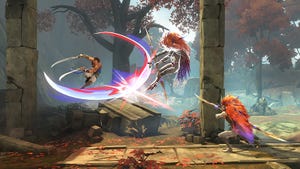
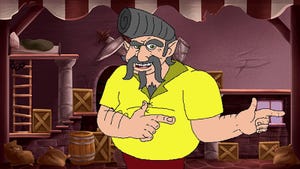
![]() |
|
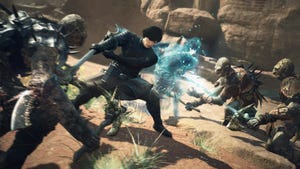
Screen
shot from Blademasters, a game that uses the Hero's journey
|
There are several kinds of hero's that can be used in a game. I won't go into
elaborate details about them here because books are written on the subject,
but knowing about the different kinds of hero archetypes can help you decide
early on what kind of a hero fits your story and what kind of actions they will
be taking. There is your classic heroic hero, willing and unwilling heroes,
group orientated and loner heroes, anti-heroes, tragic heroes, and trickster
heroes. Some heroes may combine several of the archetypes into one complex personality.
Other heroes may only wear the illusion of another kind of hero for a while
until something happens to reveal their true self.
Sometimes the main character in a game is actually a group of people. Usually
you want one character in the group to be the leader, but it is possible to
switch the role of hero from one person to the next in the game. Several members
of the group may fall into a hero's archetype as well. In a movie like Beverly
Hills Cop, Axel Foley is a static hero archetype who doesn't change much
throughout the story, whereas the other main character Rosewood is arguably
the real hero of the movie since his personal journey is much more complete.
In this way several main characters can coexist during a game without conflicting
the story too much.
The Benefits
of the Journey
Since many games involve playing as a specific character (typically in first
or third person viewpoint) during the game, it makes a lot of sense to play
as the central character of the story. Usually the point of view of the story
is also written from the player's character's point of view, so a hero's journey
works well. The character in the game would also be very boring if they weren't
somewhat heroic in their deeds and efforts. The hero and player may be reluctant
in accepting their mission, but events should always force them into a no turning
back scenario early in the game so that no matter how they feel about the story
they know that they must move forward.
Since using a classical hero's journey allows you to work with established story
structures and character archetypes when starting your story, you should be
able to flush out your initial story much faster. I find that I typically have
to write a minimum of four or five completely different stories before I land
on one that most of the team likes. Because a designer rarely has the time to
rewrite their story as many times as they need to in order to get it right,
it is important to be able to iterate the story as quickly as possible. Starting
with an initial outline or formula will help you to design your game's initial
story much more quickly.
Variations
There are some slightly different variations on the journey, presented in books
by Joseph Campbell, Christopher Vogler or others, but I'll try to put it into
a summary form. Both Vogler's and Campbell's books go into incredible depth
about the subject. Vogler has a great short summary and tends to put a more
modern and practical approach onto the hero's journey, whereas Campbell adopts
a more classical approach. It is interesting to compare and contrast their differences,
but I would recommend reading Vogler's book, largely because it is a summary
and modern analysis of Campbell's work (which is in turn a summary and modernization
of ancient mythology and stories). I have used Vogler's outline as the basis
for my work, because of its simplicity and practicality.
|
Vogler's
Outline
|
Campbell's
Outline
|
| The Ordinary World | The Call to Adventure |
| The Call to Adventure | Threshold Guardians |
| The Reluctant Hero | Wise and Helpful old man & the Magic talisman |
| The Wise Old Man | Refusal of the Call |
| Into the Special Fantasy World | Passing the First Threshold |
| Tests, Allies, & Enemies | Hero Partners |
| The Inmost Cave - Second Threshold | Mystical Insight |
| The Supreme Ordeal | The Labyrinth & the Princess |
| Seizing the Sword - Reward | Loosing the Guide |
| The Road Back | Hero Deeds & Dragon Slayers |
| Resurrection | The Dark road of the Trials |
| Return - Ending | The Hunt |
| Into the Belly of the Beast | |
| They Mystical Marriage | |
| The Sacred Grove | |
| Sacrifice & Betrayal | |
| The Hero's Return | |
| Resurrection | |
| Monster Combat | |
| The Resurgence of Evil | |
| The Enchanted Forest & Helpful Animals | |
| Decent into the Underworld | |
| Atonement with the Father | |
| Unmasking | |
| Final Victory |
How
Do I Design With It?
Creating an outline that combines a nine act story structure, the hero's journey
and a game level layout is the first step in figuring out what you need to do.
Each step of the hero's journey can fit into the nine-act story structure, but
there is a lot of room for interpretation. Once you have a rough idea of how
the different stages of the hero's journey fit into the nine act story structure
you can then begin to figure out how your levels fit into this structure. I
have used this same structure to develop everyting from a small 10 level game
to a fairly large 50 level game, but I find it works the best with a 15-25 level
game. Listing One provides a sample structure.
This is a generic breakdown I use to help me begin laying out levels and story
ideas. It is possible that your story isn't really a true hero's journey, but
you may be surprised to find out that it is in many ways. The goal of this breakdown
is to draw out a rough guide to follow as I write. While I usually write out
a few paragraphs of general ideas before starting with this outline it is good
to spend some time filling in the blanks before you start writing the first
draft, especially if you only have a very vague story in mind.
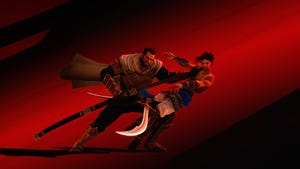
![]() |
|
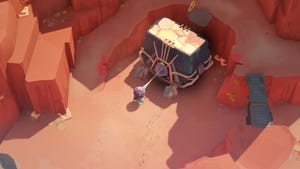
Screen
shot from Blademasters
|
The most important thing is to figure out how many levels you have, and which ones already need to have a particular story line within them. The fewer levels you have, the more elements you must try to squeeze into a level. It is possible to move levels into different acts or parts of the hero's journey in order to lengthen or shorten different areas. It is also possible to cut out a chunk of levels to shorten the game -- or to add levels to lengthen the game. The general concept of what constitutes a level can be fairly vague and misleading, so make sure early on that you have a clear understanding of how large your levels will be and what will be included in each level. Some games have levels that last five minutes while some last five hours. A RPG may be one large seamless world without any true levels. If you have a large, open ended or seamless transitioning game, you'll generally still be breaking it down into regions, areas, or tasks which can still be represented just like a level. In the case of a game with really large levels, a single level may encompass many different acts of the story or different stages of the journey. Regardless, it must be fairly clear to the player which part of the story they are in, what they are trying to accomplish and why.
Game Length
One of the most important things I use in terms of structure in the early stages
is an estimation of the game's length. You may be lucky enought to be able to
make a game of any length, but it's important to know the scale of your game
early on -- and if that scale is in line with your budget.
This chart help determine the desired amounts of game play. I use it to add up (bottom to top) to the total gameplay time desired. Your game may have other things in it to take into consideration, so think about everything the player will be doing in the course of the game.
|
Time
|
Event
|
Example
|
| Total Time of Game play | 25 hours | |
| Length of Non-Interactive elements in the game (cut scenes) | 1 hour | |
| Number of Levels | 25 | |
| Length of Level (times # levels) | 1 hour | |
| Amount of time spent fighting in level | 20 minutes | |
| Amoung of time spent exploring in level | 10 minutes | |
| Amount of time spent problem solving in level | 10 minutes | |
| Amount of time spent traveling in level | 10 miuntes | |
| Amount of time waiting for something to happen (hopefully this is zero). | ||
| Amount of time spend "doing other stuff" in level | 10 minutes | |
|
Additional
Things to Calculate
|
||
| Number of Main Characters | 5 | |
| Number of Secondary Characters | 75 | |
| Number of enemies in typical level | 75 |
Usually, you must also take into account things like replay ability. You may
want a person to finish a game in 25 hours the first time they play it, or maybe
in just ten but with additional multiplayer aspects and a unique second pass
adding up to 25 hours. Many role-playing games can easily take 50-75 hours to
complete. Breaking down the time it takes to do each task in the game will go
a long way in telling you how large a level must be, how much interaction should
be included and how many events must take place.
This chart will also help you start thinking about how often enemy characters
will be faced in the game. Typically a major villian will involve a long climactic
fight or experience while a secondary enemy rates only a short fight. Most of
the time the player will face many of the secondary characters over and over
in the game. Getting an idea early on about how many characters you want in
a level it will help you determine the length of your game. Also, as you get
farther into your story, this chart also becomes a great place to begin laying
out the location of key cut scenes and events in the game.
Using the Hero's Journey
Begin using the outline of the hero's journey by filling in the known blanks, my example is available in Listing One. Start with how little or how much you know and then use the guidelines for a hero's journey to fill in the blanks. The outline will often tell you what should go into your blank spots, it also is another good initial guide to get you thinking about different characters and how they fit into the story. I find it useful to add additional lines that say "Introduce Good Character #1" or "Fight Bad Character #2", when you know that you need to have an additional character, and then you can later decide which character fits into that spot. A great place to introduce characters is during the beginning of the fourth act (link #3) when the main character often finds some new ally to help him.
The
initial story concept doesn't have to be precise or perfect, but it gives you
something on which to build. Sometimes using this outline as a brainstorming
tool is very helpful. You may know that the hero has to start somewhere and
get to somewhere else, so now you have the beginning and the end (hey, it's
a start!). As you think about the different stages of the journey and how they
relate to the different acts of the story, you'll begin to realize that certain
things can only happen in certain places. This makes it much easier to start
filling in the blanks because you know that there are points in the story where
conflict must exist, and that the conflict is generated for a reason. Your job
is just to figure out how to make it fun and interesting.
Keep in mind that much of this is not meant to be taken literally, but metaphorically.
There are many kinds of heroes and many kinds of ways to explain how to use
this outline, but with a little imagination and some hard thinking you should
be able to come up with a very interesting and compelling story.
As you fill in story details by act or by the hero's journey, the levels must
also begin to fit into this rough shell. In this way you know that levels five
(link#2) and six fall into the third act as
part of the hero's journey "Into the Special Fantasy World". These
levels are typically about the player entering into the new world, perhaps by
trying to sneak into a castle or by flying their spaceship safely into the enemy's
universe undetected.
Having the story take place in a single location throughout the game can be very boring. Take a look at any good James Bond movie, and you'll notice that he almost always travels to several locations, usually three, throughout the movie. If the game travels to a really wide variety of locations then you'll find that it becomes hard to come up with reasons why the player is constantly on the move. A few types of games, like a space combat or exploration games, might use this to their advantage, but it has to be done carefully. Having three different locations in the game will add enough variety to the game to keep it interesting, but not so much as to make it more difficult to produce. The point of having a new location in the game is to add interest and variety for the player. When you're laying out your game structure, think about having it progress to several different locations, this will also help you think of some new ideas on some levels because you are either having to transition to a new area or are exploring one.
It's really hard
to write a story or design a game without taking into effect all the other potential
problems, restrictions, needs and requirements that your game will have. If
you spend tons of time writing a great story that takes places on twenty different
planets, over the course of a hundred years, and meets hundreds of characters
without taking into consideration all of your limitations, then you will have
to spend a lot of time reworking your story or figuring out how to limit it
in some way. If you've read the entire Dune series of books, and you
were given the task of making a game based on this license (Westwood did a great
job with Dune II but the story is very minimal), you would know how difficult
it would be to make a game encompassing that entire universe. It's better to
start off with a simple story and refine it slowly over time. Start with events
that relate to the levels, and then progressively refine the rest of the events
in the story. There is room to polish the story and the dialog later, so the
most important thing in the beginning is to make your story fit the game play
and vice versa.
I find it critical to design into the game a few extra levels that can be cut
if time becomes a problem. If you have 20-25 levels in a game, it is not important
to have critical story elements in each level. So if you design 15-20% of your
levels as non-plot specific, it will save you a great amount of headache down
the road when your producer comes to you and says that you have to cut five
levels from the game because it is taking too long to make. As a writer and
a designer, this can be a horrible experience because every level is usually
somehow important. Inevitably, games tend to be overly ambitious and get scaled
back. The best way to do this is by using sub-plots. A sub-plot should be a
short diversion for the character to go on for awhile, that may have little
to no ramifications for the whole story, but allows the character to explore
the world some more or accomplish some additional tasks to fill some time.
There is no set way to create a new game and story, but hopefully this technique
can help you apply what mankind has learned in other mediums over a long periods
of time to your game designs and make a more successful game. Just make sure
that your journey to create the game is a heroic one.
Additional References
I would highly recommend reading these three books and articles, and any additional
books and material by these authors.
"Hero with a thousand faces" Joseph Campbell - http://www.jcf.org/27wm.htm
The Writers Journey Christopher Vogler - http://writerscomputer.com/cgi-bin/SoftCart.exe/store/info/writers_journey.htm?E+writers
Conflict Action and Suspense William Noble, ISBN: 0898799074
"Nine Act Story Structure" by David Siegal - http://www.dsiegel.com/film/Film_home.html
Mythic Structure in Role-Playing Games J. Patrick McDonald - http://www.interink.com/~jpm/myth.html
Other Articles on story structure and the hero's journey:
http://www.dailyobjectivist.com/Spir/mythology.asp
http://www.swin.edu.au/lib/melinda/mine/herojour.htm
http://tech-head.com/story3.htm
Listing #1. The Nine Acts of a Hero's Journey Example
Notes: The text in red is what I use for my own reference, but I always delete it out before giving it to others to read. I'll eventually also delete the blue text as well, but I tend to keep this in until most of my story and levels are locked down.
Act
0 - Back-story
Cut Scene #1 - Back-story and Introduction (Sometimes shown before the front
end menu screen first comes up). This scene usually introduces very important
background information about the world or universe.
Act
I - Introduction
It's important to show the player in their normal world, before taking them
into the fantasy world. The normal world is usually where the player comes from
and exists prior to the game beginning.
1.) The Ordinary World
- Plant seed of the special world. Show them briefly
how incredible or interesting the other world can be.
- Separation of Ordinary & Special World. Shows
them that the world they come from and the world they need to go to are very
different places.
- Show the theme and premise early on in the game. Make
the player know what they're going to be doing.
Introduce Good Character #1 - The player's character
Location #1 - The hero's home (The Normal World)
Cut Scene #2 - This cutscene usually shows the events just preceding
the beginning of the game. It sets the players up, so that they know what is
happening to them as they start the game.
Level 1
The Hook. Something in this level must
hook the player so that they want to keep playing. This can come from great
gameplay, graphics and technology, but should also come from the story.
2.) The Call to Adventure
- It is usually brought by an Archetype Character. It
could also be a force, event or power.
- Establish what would happen if the player doesn't
take the journey -- He'd probably die or something terrible will happen.
- It should be shown that the completion of the journey
is critical to restoring the order of the universe.
- The call to adventure can also be a wrong imposed
on the player that must be set right.
Introduce Good Character #2 - Messenger #1
Level 2
This level should setup all of the events to come and set
the player on his journey.
Act
II - Something bad happens
In this act the player must be faced with an event that makes them know there
is no turning back.
3.) The Reluctant Hero
- Possible Refusal of the call.
Players can choose either path, but either way gets them sucked back into it.
- Descent - "Going into the Underworld". The
player's journey starts becoming bleak, as the odds of winning stack up against
them. The player must wonder a bit about how the could possibly win against
such insurmountable odds.
Level 3
4.) The Wise Old Man
- Have a meeting with the hero's mentor. Relationship
of teacher and student.
- This person must teach the hero something - possibly
about how to fight, or how to find himself.
- Giving the hero something - this may be where he gets
his initial special weapon and is taught how to use it.
Introduce Good Character #3 - Mentor #1
Level 4
Act
III - Commitment
5.) Into the Special Fantasy World
- The hero makes a leap of faith
into the unknown. The hero needs a change in scenery.
- Here the hero must face his fears and overcome them.
- This is where the story really
gets going fast.
Cut Scene #3 - Player travels to a new location.
Location #2 - The fantasy world. Sometimes the story might need to jump
the player into the fantasy world (one different from where they normally reside)
much sooner. This new world might then be a second location within the fantasy
world. It's best, however, for this world to be dramatically different than
the last.
Level 5
Level 6 - (Optional #1)
Act
IV - Go for the Wrong Goal
6.) Tests, Allies & Enemies
- The hero often gathers information about the enemy.
- The hero must be tested in small skills.
- Here the hero often goes to a bar for more info and
help.
- Here the hero often develops alliances or enemies.
The hero's morality is tested and questioned.
- The worlds customs, rules, laws, and polarity often
all change.
- The player must learn the rules of the new world.
What applies to him, and what doesn't?
Introduce Good Character #4 - Ally #1
Level 7
Level 8
Level 9 - (Optional #2) The plot may go around a few times here, as
the player may need to encounter several main henchmen or do several tasks in
order to make it to the final stage. This section especially doesn't need to
be a linear transition. Levels 7-9 often are repeated several times.
7.) The Inner Cave - Second Threshold
- The hero is approach by a mysterious
force. The force can be physical, psychological, emotional, or spiritual.
- This is where the object of the quest is hidden. Often
the enemies headquarters.
- It's a place for reconnaissance, rehearsal, training,
and practice - before the big battle.
- Start adding some additional intrigue, comedy, and
suspense. Slow down the pace a bit.
- New discoveries about the hero's personality surface
or someone else close to him/her.
Level 10
Level 11
8.) The Supreme Ordeal
- Confrontation with Death and
the hero's greatest fear must occur.
- Here the Hero hits bottom and must climb out of the
pit in order to regain all that has been lost.
- A scenario with no way out is presented to the player,
and all hope must be lost.
- What's the one thing that can't happen? Make it happen
to the player.
- Usually happens in a tight place, heavily protected.
- Player gets a taste of death to themselves or someone
close to them.
- Introduce a new sub plot that can take the players
attention away from their main goal for a short time.
Level 12
Level 13
Level 14
Level 15
Level 16 - (Optional #3)
Level 17 - (Optional #4)
Act
V - Reversal
It's often important to throw a twist into the story here.
Whatever the player has been doing is shown to be wrong, and now the player
must begin doing something different. These levels are often about figuring
out what the reversal is.
For instance, some dangerous weapon is stolen and the
player is supposed to save the world. The player assumes that recovering the
weapon is what they need to do, so up until this time the player is looking
for the weapon and trying to recover it, but at this point they realize that
it's too late to recover the weapon and now the only way to stop it's use is
to stop the villain by taking him out.
9.) Seizing the Sword - Reward
- Player gets a better idea of
who they (the hero) are.
- The hero is reborn into something different. Something
changes within the hero, and makes them become a little or a lot different.
- There's now often an opportunity for romance or comedy.
- Also a new insight into the hero or the story is often
given.
- A new force, ability or weapon is often gained.
- It also is a time for a pause for self-reflection.
- Often takes places around the campfire.
- This is also a time for rest and recuperation before
the final battle.
Cut Scene #4
- Player travels to a new location.
Location #3 - This is the final location for the game, usually the location
of the villain or the home of the hero.
Level 18
Level 19
Act
VI - Go for the new Goal
10.) The Road Back
- Acceleration moment. They're
now gaining energy to get out of the fantasy world.
- The deadline draws near, and the time draws to an
end. Chase scenes are common.
- Hero commits to finish the game and heads for it.
- A rescue is common.
- Crossing back into the ordinary world often happens
here as the hero returns home to stop the villain in one last desperate attempt.
Level 20
Level 21
Level 22 - (Optional #5)
Act
VII - Resolution
11.) Resurrection
- Replay of the ordeal. Another
test. The final exam.
- The hero is tested in all their skills.
- Most suspenseful moment. The climax of the game.
- Hero is purified by some kind of sacrifice.
- The hero must give something up and pay some kind
of price to win the final battle.
- The hero should be transformed or changed in some
way. The hero must learn a lesson.
- The hero's appearance may even physically change.
The change should be shown in action.
- The moral of the story is given.
Level 23
12.) Return - Ending
- The player must get home.
- Player makes it home with the item to save the world.
- Brings something back to share with their culture.
- Gives you the aftermath.
Introduce Bad
Character #1 - Main Bad Guy
Level 24
Level 25
Cut Scene #5 - Final Cutscene & Resolution
This outline is only one possibility of many. You may need to change it a lot to fit your needs, but it should act as a good place to start thinking about your game's layout.
Copyright © 2003 CMP Media Inc. All rights reserved.