The
Birth of a Game Studio Part Two: Goin' Places, Meetin' People
By
Daniel
Sanchez-Crespo
Gamasutra
June
6, 2001
URL: http://www.gamasutra.com/features/20010606/crespo_01.htm
In this second entry of my column on creating an indie studio I will be covering the important subject of industry events, trying to explain when, why and how you should go to these places, what to prepare, who to talk to, etc. As we will see, events can provide young companies with a wealth of info and, if well prepared beforehand, very interesting contacts. As with my prior article (which by the way can be browsed clicking here if you missed it), this article is basically collected from our own experiences, the most recent being GDC 2001. So, do not take anything you read here as an immutable law, but rather as advice which may or may not apply to you.
Event Types
Industry events come in two essential flavors. First, there are shows meant to be developer meeting-points. This would include places such as the Game Developer's Conference, Siggraph, and many others. On the other side of the spectrum, there are business-oriented events, such as E3 in the USA and ECTS in Europe. Although the two types are blending lately, there are differences between the two conference types. This article will examine how each type of conference can benefit a newborn studio, and offer some advice to help you make the most of your conference experience.
Essentially, attending a meeting-point will help you improve your skills, both on the technology and business side, and make useful contacts that can help you make better products in the future. Business events, on the other hand, concentrate on the developer-publisher-investor relationship, and focus on the consumer part of the industry. Because each serves a different aspect of the game-development community, each conference offers a particular type of content to its attendees. Generally speaking, developers attend business events like E3 to make deals and see new games or systems. The few conferences offered with the pass are usually a secondary objective. Meeting-point conferences like the GDC focus on educational and contact-building activities. Both offer opportunities to meet the people and accquire the skills you need to get your game off the ground.
Industry Meeting-Points
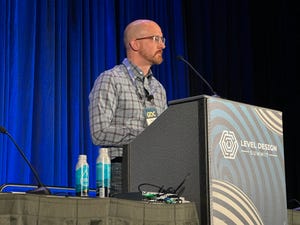
In a meeting-point event, there are a wide range of activities happening simultaneously. To begin with, there are conferences all the time where you can pick up the latest scoop straight from the leading people in the industry. These are usually long, deep sessions (generally mid-day and full-day) dealing with very specific subjects, and really provide great info: conferences all alone justify a visit to a big event.
![]() |
||
|
In a meeting-point event, there are usually long, deep sessions dealing with very specific subjects. |
Conferences are usually organized in groups or "tracks" related to the various areas of the game-making science: programming, design, business, etc. In a regular event, about 50-100 conferences might be available (spread over five days), divided into panels, sessions, roundtables, etc. So, it is going to be impossible to go to all of them. Thus, it is very important to build your schedule beforehand to make sure you select the ones you are really interested in. Luckily, both Siggraph and GDC have excellent web-based schedule builders that will help you make up your mind.
When you attend a conference, it is a good idea to try to collect any physical course notes, or even the presentation file, from the speaker. Written course notes are available at Siggraph's store for an additional $20 (per course), and are included in most pass options at the GDC, so getting your copy should be no problem. Some conference speakers give little or no written information, and perform their sessions without any aid, so you will have to go back to your school days and keep written notes in a notebook. Keep in mind that these sessions are usually worthwhile, so being able to review any materials afterwards (and even get in touch with the speaker in a follow-up email) is essential. Having a written copy of the course notes also ensures that, even if you are the only one in your company attending a specific session, everyone will be able to benefit from it.
Still, there's more to meeting-point events than conferences. The second activity you will be interested in are the expo floors, where you can see all the new equipment, toolkits, etc. As a technology-based industry, getting the new equipment (or, at least, knowing all about it) will make you more competitive. Still, the expo floors are really not that big: reserve half to a full day to be able to examine everything, talk to people, etc. and that will be usually enough. If you plan to make a purchasing decision while at the show, then assume the visit will take you longer.
Finally, there are side-events and parties. These are usually very fun and entertaining, but should be carefully planned, as they provide an excellent atmosphere to make contacts. Having attended Siggraph four times, GDC two times and ECTS two times, I have made most of my contacts at parties (maybe being Spanish helps there too). The relaxed, friendly context makes it easy to have casual conversations about important subjects, so do not underestimate their value. Try to attend all the parties you can (as if you didn't plan to do that already ha!), and be prepared for any interesting situation or opportunity that can arise.
Business Events
The core of business events is deal-making and establishing commercial relationships. These are the places to go if you want to showcase a new product or make an announcement, and you want to maximize your exposure. Some of these events (E3 leading the way) are beginning to include conferences, and others provide exhibition parks to locate software providers and contractors. Still, the basic activity at these events is quite different to what you would do at GDC or Siggraph.
The main activity is usually organized in an exhibition floor where companies show their products (either to investors, publishers or, sometimes, the consumers themselves). From the developer's standpoint, walking these floors can be a little like exploring an unknown territory, as they are quite consumer-oriented: huge multimedia extravaganzas full of noise and people playing new games. Still, they are great places to detect new trends, and also examine the consumer's reactions to the different types of products. Any game developer should pay close attention to anyone playing games. There are always great lessons to be extracted from their behavior: what they like and reject, what kind of games different people play, etc.
The exhibition floors are mainly occupied by dozens of colorful and noisy open booths, where you can see the new products shining in full glory. A separate area, usually at the back of the show floor, is occupied by rows of smaller meeting rooms, where other companies are showing their products privately, usually to potential business partners. If you plan to attend a business event it can be a good idea to use one of these rooms, as they are available at a relatively low cost. An alternative can be renting a hotel suite right beside the exhibition floor. Some companies decide to do that to keep their products secret, or simply as a way to build up expectations. Keep in mind that getting people to leave the exhibition floor to get to your suite will be tricky, so you may attract fewer people if you choose this option.
Another reason to try keep things private is that the audience of these shows is sometimes a rather heterogeneous one. Theorically, business events are supposed to be trade-only, so everyone attending them is meant to be working in the games industry. Still, you will soon discover that a significant part of the audience are end-users, who somehow get a free pass to sneak a peek to the new stuff coming. As a game developer and publisher, you may not want consumers getting early access to the products you have been working on.
![]() |
||
|
The exhibition floor is a huge multimedia extravaganza full of noise and people playing new games. |
What to Pack
If you plan to attend an industry event to promote your indie studio, take some time before the event to make sure you can collect everything required to maximize your stay's potential. Here is a checklist extracted from our past experience, which has proven to be very handy:
Demos - pack all you have been working on, to show it if the time comes. Pack both the final product and the sources, and also grab a copy of your compiler of choice. It is quite frequent to meet people and hear them say "looks good, but could you tweak it so that .". Thus, having all the sources and tools with you can be provide additional flexibility. If you are showing to publishers, bring several copies of the demos on CD, along with other relevant material (screenshots of the game, concept art, modeling screenshots, in-game editors and tools, etc.). Publishers usually analyze the game at their headquarters after trade shows. Before signing anything, they will certainly want to take a close look at all the materials you can provide them.
As for the machine to run the demos on, usually these are on the high-end, and sport the most powerful processors and graphics cards around. Future games will have futuristic hardware requirements, and hence the need for horsepower. If you are a new developer, you can either bring you own, or hire one on-site. Bringing your machine is, contrary as it may seem, quite frequent in trade shows such as ECTS (and also cost-effective). You can spot an ECTS attendee at London-Heathrow airport as they tow their CPU boxes around the terminals.
Bringing your own equipment is, if you can arrange it, the best option, because you can be certain that the environment for the execution of the demo will be perfect. Keep in mind that different countries have different voltage standards, which can fry your blazing demo machine if you do not have the right converter.
![]() |
||
|
Laptops may be a good alternative to desktop systems, allowing you to make presentations anywhere. |
You may want to consider renting the demo hardware on-site. This way the logistics of the trip become simpler. Renting may be a good choice if you are traveling far away (towing a desktop from our headquarters in Barcelona, Spain to the GDC in San Jose isn't exactly my definition of "fun"), or if you simply do not own such powerful hardware. Still, keep in mind that hardware rental companies do not think much about game developers, so expect the equipment you will rent to be quite mainstream. This does not really apply to the CPU, as you can get quite recent ones (for a high fee, that is), but graphics cards found in most rental equipment tend to be quite substandard, so play safe and carry at least your graphics unit of choice and a screwdriver with you.
Renting a laptop may be a good alternative to desktop systems. The main benefit is that you can make presentations anywhere, without the mess of having to set up a desktop system. On the other hand, laptops are slower in general, and especially suffer strong disadvantages in terms of graphics power. This trend is really going to fade away in the near future, with the launch of "serious" units sporting chips such as the nvidia GeForce 2 Go and the ATI mobility chips, but expect performance to be a little slower than a high-end desktop. Still, you can change bad news into good news, which is the philosophy we followed at GDC. We rented a laptop and, because of our ability to execute our demo at decent speeds (16 fps) on it, we proved our ability as coders.
Project Documentation - all written (or digital) information you can collect about your project should also make it to the show somehow. This includes (but is not limited to) the design bible, a shorter, treatment document (this can even be a powerpoint document), concept art, screenshots (handy if the demo suddenly freezes), scripts, music files, 3D models, etc.
Additionally, if you are in a tech or playable demo stage, also bring a press pack. This should be a CD on which you put all the public information about the project. This should include such items as: a script description, the demo itself, screens for media publishing, a corporate overview file, and company logos. This way you can give the CD to any media representative and be sure they have all they need to ensure proper media coverage for your product. (We'll talk about the media in a second.)
Corporate Documentation - Finally, your package should include some corporate
documents aimed at publishers and investors. You should at least prepare a corporate
overview and a detailed business plan, which contains all the relevant information
for doing business with your newborn company.
The corporate overview document (many times in the form of a powerpoint presentation) should explain who you are and what you want to do. This document should be brief but thorough, and give details on:
Obviously, you can choose to be very open and give away lots of information, or play safe and give only parts of it. A good example is the financial structure: you can go all the way and depict the shareholder structure, capital rounds, etc. or decide to be brief and say "the company is privately funded and held." Remember that you can always throw in some details during a conversation if an investor requests them. Whatever you put in the presentation is, on the other hand, fixed, so many times it is better to say little (and add verbally whatever you think is useful) than to lament giving away too much on a printed copy.
Another document you should bring is your business plan. This document must detail each cost and benefit derived from your project. On the costs side, it should clearly depict how much you have invested so far, and how much will be required to complete the product. Be detailed here, subdividing the costs into small pieces so the whole budget analysis is easy to understand. Additionally, you should predict sales from your title, and from this number calculate the expected return on investment. The best way to do this is by looking at similar games or genres, and making a tentative forecast of how much you game will sell. Obviously, it is only a rough estimate, but proper research can yield useful numbers. When doing the business plan, keep in mind that an investor does not expect to see optimistic projections here-stick to the naked truth and try to be as realistic as possible. Business plans should present the facts clearly, so using a spreadsheet file (annotated maybe to define each concept) is the best option.
A good idea when making a believable business plans is to concentrate on the costs, which are predictable, and spend less time looking at how much you plan to make. A business plan which concentrates on "how rich you are going to be" without worrying about how much will it cost you to get there will appear unprofessional. Besides, publishers have their own methods to estimate game sales, so make sure costs are under strict control, and let them help you get the sales figures right.
Last, but not least, you should carry your own NDA (Non-Disclosure Agreement) so you can give information to potential partners without worrying. An NDA is a written contract which restricts the use of certain confidential information. It can be as short as a couple pages, and should clearly express:
Many times (especially with publishers) you will be offered a mutual NDA provided by their lawyers. Although these are usually very well written, they are often geared toward protecting the publisher's rights more so than the developer's. Therefore, it is a good idea to request them that they sign your own NDA, to make sure both parties are equally covered. You should find no problem in this respect, as the use of NDA's is a common practice in this industry. Finding a partner who rejects to sign an NDA is uncommon, and definitely not a good start.
As you can see, a rule of thumb is to pack for disaster: think of everything that can go wrong while at the show, and pack it. Bring written copies of everything in case the computer collapses. Be sure to bring an extra copy of all written materials in case you lose something. This way no disgusting surprises will spoil your experience. As a corollary to the rule, it is a good idea to have someone at your headquarters checking for e-mails each hour or so during the conference: this way your company can e-mail you any additional resource you might need in an emergency situation.
Who to Talk to
There are two answers to that question. The fast answer is: "everybody!" Still, there are specific strategies when approaching different types of people. Here, I will try to expose some of them, so you can put your best foot forward and make a good contacts.
Publishers and Investors
Planning your talks to publishers or investors is of extreme importance, as they are the ones willing to put your title on the store shelves if they believe in you. Although each has their own unique style, there are some general guidelines to follow which apply to all of them. First of all, it is not a good idea to speak a lot: it is much wiser to speak well. Publishers are a bit like the genie in the Aladdin story: they will grant you a certain number of wishes (or minutes, usually), so you better use them well. Plan the message you want to convey, and make sure it gets through.
![]() |
||
|
Industry parties offer a wonderful opportunity to make contacts. |
As a starting point, it is a good idea to prepare your talk beforehand, even if it is going to be a casual, five minute meeting. First of all, try to put in writing what the objective of your talk is going to be. Try to narrow it down to a single concept or idea, or prioritize the objectives if you think there is more than one. Then, write a checklist of the facts you feel you should present in order ot achieve your objective. Make sure you include those facts that make your company or game unique, and expose why the publisher should be interested in doing business with you. Then, assign priorities to the different concepts, and re-do the list putting those in order. As an example, let's imagine you are going to be at a party (a very good place to meet people), and you believe it is likely that you will be introduced to some publishers. A good plan could be as follows:
Objective: arrange a meeting at your booth
Top priority facts:
- Playable demo ready
- Currently seeking publisher
- Directions to your booth
- Subobjective: Give & get business cards (this way you can remind them)
Mid-priority:
- Game type and features
- Team composition
- Schedule
Low priority:
- Financing needs
- Studio location
Notice I put "financing needs" as low priority. You have to talk about the right subjects at the right moment. In this case, discussing that subject at a party can be seen as an unprofessional move. You should reserve that for a later moment in time. Making the checklist and then being able to build an interesting conversation (while touching on all the relevant subjects) takes time and practice, but it is definitely a good way of having succesful conversations with investors.
A different story comes when you have made a contact, and the time comes to talk about contracts and money. In this situation, the rule is to remain extremely calm, and never, under any circumstance, let emotions betray you. Deal making is a time consuming and complex science: each term of the contract will be talked over again and again, until things settle to a final version. To give you an example, in a past project (not game related) I had to go through the process of making a deal for a capital round for a company. The contracts were about one hundred pages long, and were revised for two weeks, dedicating about ten hours a day to re-reading them and making changes. In the end, we agreed upon the eleventh version of the agreements. Patience and hard work will always help you make a better deal. Those papers you sign are going to determine your company's future, so you better take some time to really understand them thoroughly.
Obviously, it is of extreme importance to have a lawyer backing you up and guiding the company through the process at all times. These can either be agents specialized in representing studios, or lawyers with experience in the electronic entertainment field. There are many firms who can provide you with those services, and they will be addressed later in this article.
Contractors and Consultants
Gamemaking is a complex science, often involving in excess of forty people during two or more years. Still, some time and trouble can be saved by using contractors who can provide you with some product or service you require, but do not want to develop in-house. By outsourcing parts of your development, you can create great games with smaller structural costs for your company, or in less time. Here I will tell you the different kinds of contractors, and the key items you should look for when talking with them.
To begin with, there are software contractors, who can work along with you and license some code or application for a fee. This includes both full-engine licensing (Quake, Unreal, NetImmerse, Renderware and many others would good examples here) and toolkit licensing (such as RAD GameTools popular Miles Sound System, Bink, and many more). The reason to buy these packages is obvious: you can start your project with a full-blown engine (or part of it) from day one, thus saving time and, sometimes, money. Still, these options always boil down to a cost vs. benefit comparison: how much does the package cost and how much would it cost to develop the same functionality internally? Think not only in the man-hours, but also the equipment required to achieve the results. Music outsourcing is a good example here: having one in-house musician may not seem that expensive, but purchasing all the synthesizers, sequencers, and other tools he will definitely need can be a huge investment. So, when evaluating a potential software contractor, it is a good idea to make sure the fee vs. features curve is reasonable.
As a side note, make sure you understand all the terms of the licensing: some engines require paying a fixed fee only, while others add a variable, royalty-based remuneration to be paid to the original developer. Royalty-based structures allow you to begin working at a low cost, while in the long run you can end up paying more if your game is succesful. Also, keep an eye on the duration of the contracts: is the software package license valid forever, or does it cover one title only? The latter is the most common option available today, but make sure you go over these issues with your provider before signing anything. Most software contractors are very open, and payment terms are usually quite negotiable to suit your needs.
Another type of contractors you are certainly going to find in industry events (more likely in places like GDC) are art service providers. This includes companies you can use to outsource all or part of the 3D modeling, music, sound, texturing, etc. for your game. These contractors usually have big teams which will allow you to ship the game faster, and stick to tight schedules. On the downside, make sure you understand the fee structure, and make sure you get what you paid for. Negotiate payment terms to ensure you can check the quality of the results. Additionally, it is a good idea to write an exhaustive specifications document and ensure both parts understand and agree to stick to it. Developers will often complain that the results are worse (or, simply, different) than what was expected, and the contractors will reply that the specs were diffuse or changed in the middle of the project.
The third breed of contractors you will find are consultants. Imagine you could have some of the best professionals in the business in your team. Well, sometimes, you can. Experienced people are available to do specialized work for young companies for a fee as consultants. These can be game designers, coders, artists, lawyers or any other position you can think of. Usually, they have very solid backgrounds, with several projects shipped, so their advice can be very valuable. Thus, having consultants in your team can be a significant "power-up" to your team, and will also help build confidence from publishers, as their names are easily recognized and respected.
You can find consultants who can help you cover most positions in your company. Still, as they are going to work outside your studio, make sure you assign them tasks that do not require continuous contact with the rest of your team, or the relationship will simply not work. Lawyers and agents, who can provide all the legal assistance you would ever need, are one type of contractor that can be particularly helpful. There are many firms providing quality assistance in these matters, which are especially important when the time comes to talk to publishers.
Make sure the consultants you hire have a background relevant to their area of expertise. Most consultants out there are great people with impressive resumes-including many hit games. Unfortunately, some (just a few) others approach young companies desiring only to make some money selling consulting services backed up with insufficient or simply nonexistent experience. Just dedicate one minute to check the candidate's references. This will suffice to ensure that they provides the added value and publisher appeal you paid for.
Finally, a global rule for all contractor and consultant work: remember to make sure you state who retains the intellectual property rights for the work. Some contractors will usually have two fees: a lower one they apply to projects where they get to keep the IP rights, and another (significantly higher) if the IP is to be kept by the client. Choose whichever contract type suits you best, but think in the long term, and do not underestimate the future brand value of the work you have created. Maybe in the future your characters, music or sound effects will end up in a big movie (think Tomb Raider, for example), so having taken some time to discuss IP rights ownership will be useful.
Media
Among the people you will meet at the events, the ones to watch for are media representatives (easy to spot as they usually carry distinctive badges). These are more abundant in business events, where the consumer side of the industry is exploited. Most media representatives belong to written or web-based publications, with only a small part coming from TV shows.
When talking to the media, make sure to emphasize what makes your project unique: explore your background, team composition or current projects to find facts which can make you an interesting cover story. Finding these interesting facts is easy for indie studios with promising projects, as the media are quite responsive to "David vs. Goliath" stories. Many people are trying to predict what is going to be the "next big thing", so media usually pay close attention to rookies.
A good idea is to prepare a media pack just in case you talk with journalists. This can be a physical, written package, or a digital pack in a CD (the latter being simpler and cheaper to make). It should include a working, simple to install demo and, for those journalists with little or no time, some pre-grabbed screenshots ready to publish. Keep in mind that magazines (especially written ones) work in very high-resolution formats. For example, a regular written page can be composed in resolutions as high as 300 dots per inch, so putting a 6x4 inch image requires a source image 1800x1200 pixels. Remember to encode those files using lossless formats, such as TIFF, which is the standard in the desktop publishing industry. This way they will look crystal-clear. Additionally, make sure you throw in some corporate logos for printing in any article related to your projects or company. Encapsulated Postscript (EPS) or TIFF are the formats of choice here.
Images aside, a press pack should also include a shorter version of the treatment document, which highlights the main functionality and features of your game. This document should help media professionals write any article, preview, review, etc. about your title, so read some of those and try to understand the kind of information they present. Naming the different technologies you have developed can be a good idea, but going into a lot of detail about them will be worthless, except if you are planning to appear in a publication like Game Developer Magazine.
Finally, it is important to provide the media people with a contact in case they need to discuss anything at a later date. In an ideal situation, that role would be carried out by a public relations agency (there are several of them specializing in the games industry). Still, most indie studios will decide to cover that themselves, as PR services can be costly. Designate someone in you team to act as the media contact person, and this way you can ensure a long-lasting relationship with the media representatives can be established.
In Closing
Industry events are definitely essential for the success of a indie studio. As a living proof, we dediced to make a game company in Siggraph 96, started working right after attending GDC 2000, and have used GDC 2001 to launch a tech demo. Attending this year's GDC has provided contacts with several major publishers interested in our work, and we have discovered some great contractors which will be working along with us in the future. We have attended about eight conferences, where we have learned everything from ultimate graphics techniques to effective budget planning. We are still far from being ready to release any game to the market. Still, the GDC experience has proven extremely valuable, and we hope to be able to attend the show once again in 2002.
![]() |
||
|
Conferences can help a studio learn everything from ultimate graphics techniques to effective budget planning. |
Now, it is time for us to get back to work in our game: tech demo is ready, and now the time comes to really move to the real thing, and have a playable demo soon (September sounds like a good idea). There is a lot of design & programming to be done, and long hours of teamwork which will hopefully transform our tiny little demo into a full blown game. In my next column (titled "Executing the Masterplan") I will try to show you some details of the process.

http://www.gamasutra.com/features/20010606/crespo_01.htm
Copyright © 2003 CMP Media Inc. All rights reserved.