|
Features

The
Case For Game Design Patterns
A
Pattern Template
Pattern
templates typically contain these four essential elements:
- Name.
"Naming a pattern immediately increases our design vocabulary.
It lets us design at a higher level of abstraction". Names have
to be mnemonic and evocative, but the connotations also pose problems.
"Also Known As", frequently part of pattern templates, is
actually an indication of a naming problem: "Finding good names
has been one of the hardest parts of developing our catalog" (again,
Erich Gamma et al.).
- Problem.
This describes the problem, including its inherent trade-offs and the
context in which the problem occurs. The description of the problem
implies a goal that we want to accomplish, and the obstacles we encounter
when we attempt to do so.
- Solution.
A description of a general arrangement of entities and mechanisms that
can be used to solve the problem. This is not a particular design or
concrete implementation, but an abstract structure that describes an
entire family of solutions that are essentially the same.
- Consequences.
Each solution has its own trade offs and consequences. Solutions can,
in turn, cause or amplify other problems. The costs and benefits of
a solution should be understood and compared against those of alternatives
before making a design decision. Around this essential core, pattern
templates often add other elements, or subdivide a core element.
Gamma et.al. uses Name - Intent - Aliases - Motivation
- Applicability - Structure - Participants - Collaborations - Consequences
- Implementation - Sample - Known Uses - Related Patterns . Meszaros
and Doble describe pattern writing itself in patterns organized as Title
- Problem - Context - Forces - Solution - Indications - Resulting Context
- Related Patterns - Examples - Samples - Rationale - Aliases - Acknowledgements
[25]. Alexander et. al. use Name - Example as Picture - Context within
larger patterns - Problem - Solution - Solution as Diagram - Relation
to smaller patterns [3]. Ultimately, the details of the format chosen
do not matter as much as the fact that one format has been elected and
is used consistently (for more details on how to write patterns, see
[31,34,5]).
Pattern Examples
To show
the method in action, let's look at some pattern candidates. The following
examples are admittedly very simple, and weren't selected necessarily
for their particular relevance to game design.
|
PROXY
Problem:
It might not be possible or desirable to require that a game action
is applied to the target object directly. In other words, we have
to avoid proximity to or collision with the ultimate target of
a given action.
Solution:
Introduce another entity (object) that is used as a proxy,
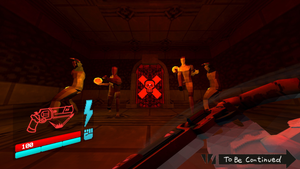
standing in for the target object. The proxy can be placed and
moved independently of the target object or objects. The restrictions
that apply to the target(s) do not by default apply to the proxy.
Multiple proxies can be used for the same target or targets.
Consequence:
The link between the proxy and the actual target has to be
communicated to the player, if the player is supposed to exploit
this connection and indirection. Restrictions on placement of
proxy and target with respect to player field of view, and restrictions
on player view control might apply, to ensure that the player
perceives the effect on the target.
Examples:
Munch's Oddyssee has several proxies for the player characters:
the possession orb which enables Abe to take over other game characters
(thus turning them into proxies), and the Snoozer robot and H-Crane,
which served as proxies for Munch. One benefit of player character
proxies is that of a safe death: loosing a proxy does not end
the game. Buttons/Switches/Levers that open doors or start/stop
machinery are often placed in different locations, instead of
being part of the target object. In these cases, the designer
wants to separate trigger from target to permit more elaborate
puzzles. Half-Life's final boss had a vulnerable location inside
its head. That vulnerable spot could be considered a proxy for
the entire (invulnerable) boss. As a second order vulnerability,
the boss was dependent on three crystals that supplied energy
for healing and attack. Attacking the crystals destroyed them,
thus permitting effective attacks on the boss monster itself.
|
PROXY was
chosen to illustrate potential problems in using the same name for different
patterns existing in different contexts. There is a software engineering
pattern with the same name, introduced by Gamma et al. However, there
is no meaningful connection between the two concepts. On the other hand,
in some cases a given pattern language might translate into a sensible
OOP implementation hierarchy, if there is a correspondence between the
purpose of a given game design entity within the design context, and its
implementation in the software that constitutes the game engine.
|
PREDICTABLE
CONSEQUENCE
Problem:
The player has to perceive failure as a consequence of her
mistakes, not as a random or predestined event unrelated to, and
unavoidable by, any reasonable choice of actions on her part.
Solution:
The player cannot take a meaningful decision to act (or not
to act) if the result of a possible action can not be anticipated.
A meaningful player decision is an informed decision: she has
to be able to guess the result of her action before she ever takes
it. Choose game mechanisms that communicate predictable behavior
by visual appearance relying on knowledge the player already has
(either from real world experience, or from experience with other
games, or from experience with preceding parts of your game).
Do not break consistency of your visual language, i.e. make sure
that objects that behave identical look identical.
Consequence:
It is no longer possible to implement surprises that are impossible
to anticipate. The player might rely on the out-of-context assurance
to anticipate the designer's ambush, and either outwit the designer,
or find herself locked into performing an action against her better
judgment as the designer has prevented alternative courses of
action. Ultimately, the designer might arrange for actions that
the informed player will never perform, as they are predictably
to her disadvantage. The designer might have to go to considerable
length to communicate the rules that govern the outcome of actions,
to the player. The design might be biased towards using mechanisms
resembling real world objects, to minimize the need for explanations.
A lack of uncertainty on the player's side makes the game more
transparent, potentially removing the need for exploration and
experimentation. Ultimately, the need for Predictable Consequence
is determined by the need for backtracking (severity of failure)
and costs of backtracking (latency between choice and consequence,
see also behavioral science on timing issues). Another possible
consequence is that the design might have to restrict itself to
a smaller set of player actions, in order to be able to enable
them consistently throughout the game world. Actions only available
once or in a very few locations do not amortize the costs of communication
and teaching/learning on the designer's/player's part. The design
might also have to exaggerate the differences between distinct
objects to avoid ambiguities. Any kind of variation or range has
to follow rules that can easily be observed and complied with.
Examples:
Doug Church's article relied on Mario 64 as the textbook
example [11] of predictable consequence. This pattern could be
applied to any game with a consistent physics approximation, such
those exhibited by bouncing grenades in FPS games. Other examples
include crates and barrels that are marked as explosive actually
explode, fireballs that hurt a player when they hit, burning fire,
water that drowns if you do not swim, and lava which kills. Counter-examples
are plentiful: switches and buttons that say "Push Me"
to unleash a necessary ambush (an ambush that also opens the only
way to move on) anticipated only as such. Openings in which to
jump without knowing what is on the other side such as those found
in Opposing Force and Ico. This is often a necessity
imposed by the level partition/transition mechanism the engine
uses.
References:
Doug Church introduced the concept of perceived/perceivable
consequence [11], which he uses also do
describe predictable outcomes. There is a difference between the
requirement for immediate feedback that the player can connect
to her actions, and the requirement that the player has to have
a chance to anticipate the likely outcome of her action. This
pattern was derived from the latter, the former would require
another pattern.
|
PREDICTABLE
CONSEQUENCE is my rewrite of FADT "Perceivable Consequence"
introduced by Doug Church (see [11] for the original
description). Aside from changes to the description itself to refine its
meaning (as I perceived it), this pattern candidate illustrates that FADTs
can expressed as patterns.
|
PAPER-ROCK-SCISSORS
Problem:
Avoid a dominant strategy that makes player decisions a trivial
choice.
Solution:
Introduce nontransitive relationships within a set of alternatives,
as in the game of paper-rock-scissors.
Consequence:
The player is no longer able to find a single strategy that
will be optimal in all situations and under all circumstances.
She has to revisit her decisions, and, depending on the constraints
imposed by the game, adjust to changing situations, or suffer
the consequences of an earlier decision.
Examples:
The example given by Andrew Rollings is the set of warrior-barbarian-archer
from the Dave and Barry Murray game The Ancient Art of War
(Broderbund 1984). He also describes Quake's weapon/monster
relations in similar terms: Nailgun beats shambler, shambler beats
rocket launcher, rocket launcher beats zombie, zombie beats nailgun
[28].
References:
Chris Crawford (see "Triangularity" in [15])
provided the first explicit description of the use of nontransitive
relationships. Andrew Rollings' discussion of examples uses game
theory including detailed payoff, as well as informal fictional
designer dialogs.
|
PAPER-ROCK-SCISSORS
is a recurring game design device that may have been the very first to
be semi-formally described. It can also be presented as a pattern. There
is no new information in this rewrite; the existing knowledge has merely
been reorganized to match the other examples. The pattern could be extended
to include a description of payoff matrices and examples for sets larger
than three (see [28] for such a discussion), but
even the minimal description captures its essence.
|
PRIVILEGED
MOVE
Problem:
Sometimes a given game entity cannot be permitted to interfere
with others, or other entities cannot be permitted to interfere
with it.
Solution:
Introducing exclusive moves and locations separates and protects
game entities. These exclusive moves and locations cannot be entered
or left without being able to perform the respective privileged
move. By introducing different, separate spaces or media, the
game environment is broken down into distinct areas, which can
serve e.g. as safe zones or safe passages.
Consequence:
Depending on the implementation, this can be a very heavy-handed
way to ensure protection. Unless protection is implemented in
a way that is at the player's disposal (a door that only she can
open and close), the player might perceive the constraint as annoyance
and disappointment. If the restriction is meant to be temporary,
the mechanism to allow it to be lifted has to be communicated
to the player, and initiated by her.
Examples:
In DOOM, monsters could traverse acid pools, but the
player could only at the expense of damage that quickly turned
to be lethal. In Half-Life and Halo, enemy soldiers
can be dropped from flying vehicles, a transportation mechanism
not available to the player, and impossible to interfere with.
Half-Life also had a spider-like boss that was capable
of breaking through its own nets, which blocked the player's way
until she forced the monster to retreat. In Thief, the
player traverses rooftops in relative safety, permitting preview
and outlook on the level bottom. In Ico, the ghostly opponents
traverse the world in a different dimension, and emerge from portals
without apparent restriction. In Munch's Oddyssee, water
was inaccessible to enemies, providing one player character a
privileged swim move and safe passage (in the absence of snipers
and mines). In many games, water enemies are in turn restricted
to that medium (e.g. Quake, Half-Life). In many
games flying opponents (e.g. the harpies in Heretic 2)
can perform moves the player cannot, and thus enjoy some amount
of safety.
|
PRIVILEGED
MOVE is a pattern proposal for a mechanism rarely discussed, but frequently
used for a multitude of purposes. A single solution can solve or address
multiple problems; a situation that is not clearly addressed in Alexandrian
pattern languages that emphasize the problem-oriented aspect of pattern
use. PRIVILEGED MOVE is also a very close relative of FILTER. This example
set is by no means comprehensive. As Gamma et al. wistfully remark: "Finding
patterns is much easier than describing them."
|
FILTER
Problem:
If the player is given means to create new game objects, and/or
new combination of existing objects, and/or move game objects
arbitrarily, the resulting complexity might become overwhelming
for the designer.
Solution:
Limit local complexity by filtering, thus creating smaller,
clearly defined subsets that can be dealt with.
Consequence:
Player freedom is restricted by implicit or explicit means.
Accidental filtering can lead to game situations that the player
cannot solve. Ideally, the filtering is obvious to the player,
and inherent part of the game world. FILTER can be an intended
consequence or unintended side effect of PRIVILEGED MOVE.
Examples:
FILTER as a means of dealing with combinatorial complexity
of possible game states is extracted from Jon Blossom's postmortem
of DroidWorks ([9]). Quote: "Our
level designers [..] could never be entirely sure what kind of
droid would be walking into their rooms [...] In many cases, they
created ingenious physical filtering mechanisms that would guarantee
only certain types of droids went beyond certain points in the
level: A steep hill would weed out biped droids in favor of droids
with tractor treads, a chasm would weed out wheeled droids that
couldn't jump, a narrow canyon would weed out wide droids, and
a short door would weed out tall droids. The designers used the
terrain leading up to key puzzles to reduce the complexity of
the puzzle itself [...]"
|
|
WEENIE
Problem:
Players might loose their sense of direction with respect
to how the game world unfolds. This is a particular problem with
player-driven scripting proceeding in lockstep with player actions.
Solution:
The game has to establish clear leads that communicate to
the player where to go, and what actions to attempt once there.
Consequence:
The player will over time come to depend on the level of guidance,
and will be confused if this guidance is dropped or omitted, which
introduces a bias towards WEENIE CHAIN. Depending on the rigidity
of the guidance mechanisms, players might become aware the out-of-game
agenda behind the in-game setups.
Examples:
On occasion this has been called the "carrot on a stick"
approach to level design [8]. Stephen Clarke-Wilson
[13] explains: "This somewhat bizarre
term was coined by Walt Disney, who suggested that when designing
massive 3D environments (theme parks), it was necessary to lead
visitors through the environment the same way one trains a dog-by
holding a wiener and leading the dog by the nose. Obvious weenies
at Disneyland are Sleeping Beauty's Castle, which encourages guests
to travel from the main entrance to the central hub; the former
Rocket Jets, which encourage guests to explore Tomorrowland; the
Mark Twain Steamship and dock, which encourage guests to explore
Frontierland; and the King Arthur Carousel, which encourages guests
to walk over the castle moat and into Fantasyland. [...] Your
3D VR environment needs to have standout landmarks so that it's
easy to navigate without a map. The best games, which have typically
been designed with very limited graphics, always save a few graphics
to denote special and interesting things that should be investigated."
Alternative means to communicate to the player the next proposed
or mandatory step are explicit messages delivered by NPCs, or
brief camera cuts that draw attention to doors opening in nearby
locations, like that used in Munch's Oddyssee. Cliff Bleszinksi
describes as the most subtle and always present WEENIE the incentive
of seeing a new area: the player is always inclined to move from
"been here, done this" into unknown territory
[8].
|
|
WEENIE CHAIN
Problem:
The player can lose sense of direction in the absence of clear
indicators of where to go next. This is particularly a problem
in games with large or non-linear environments that do not rely
on rails or cut-offs to constrain player movement, or employ "revisiting"
of areas [8].
Solution:
Create an uninterrupted chain of WEENIEs, with each link of
the chain clearly perceivable from its predecessor, guiding the
player from start to finish.
Consequence:
WEENIE CHAIN might be limited in employing branches or otherwise
introduce ambiguity or player choice. Enforced, WEENIE CHAIN might
resemble a rail.
Examples:
Noah Falstein refers to Indiana Jones and the Fate of Atlantis
as an example of how to establish a chain of clear player goals
using messenger NPCs [18]. His other examples
are Super Mario 64 and its use of signs and NPCs, as well
as Halo. Munch's Oddyssee also uses signs, as well as a
Shaman NPC for initial guidance.
|
Pattern
candidates can be harvested from many sources. For example, the pattern
FILTER is taken verbatim from a game postmortem. WEENIE is taken from
a discussion of theme parks and techniques of environmental storytelling,
and has been presented under a different name in lectures on level design.
WEENIE also is the foundation of WEENIE CHAIN, illustrating pattern dependency,
composition, and hierarchy.
Once you
start looking for patterns, you start noticing them everywhere. Erich
Gamma et al. point out that whether they are aware of it or not, novelists
and playwrights already use patterns. Many "narrative devices"
(see e.g. [32]) could also be described using a
pattern template.
Sometimes
the need to differentiate patterns on distinct levels of abstraction leads
to different labels: "One person's pattern can be another person's
primitive building block" (from [19]). Alexander
et al. present a total of 253 patterns, subdivided into three sets for
"Towns, Buildings and Construction" [3].
Preferences regarding the virtues of a given purpose might apply: pattern
are just recipes, means not ends, and disagreement on the ends is beyond
the scope of a pattern. Designers might also have different views on the
quality of a given solution: one person's pattern might well be another's
"anti-pattern" -- a recurring example of a bad design decision.
Ideally, the pattern description itself is just a candid summary of cause
and effect, describing one way to reach a given objective.
Alexandrian
patterns are not unknown to game developers. Many programmers are familiar
with Gamma's concept of software design patterns. Will Wright of Maxis
credits the same book as the original inspiration for The Sims, and refers
to Christopher Alexander's works (namely [1]).
Steven Chen and Duncan Brown, former level designers at LucasArts, refer
level designers to the 253 Alexandrian patterns merely as a guideline
to create "meaningful environments" [10].
Instead,
game developers strive to develop their own forms and templates. The Formal
Abstract Design Tools (FADTs) proposed by Doug Church can easily be rewritten
to fit the canonical pattern template. Another recent attempt to document
game design knowledge in semi-formal ways is "The 400 Project"
by Hal Barwood and Noah Falstein, is a project to collect proven game
design rules and techniques. This 400 Project dates back to a GDC 2001
lecture by Hal Barwood, in which he also presented four examples.
Their effort
has now spawned a column in Game Developer magazine, in which Noah
Falstein introduced the rule "Provide clear short-term goals"
as the opening example. The 400 Project uses a five-part template: Imperative
Statement - Domain of Application - Dominated Rules - Dominating Rules
- Examples Aliases (see [18] for details). The
concept of dominance (that some rules take precedence over others, and
might in turn be trumped themselves) is absent from Alexandrian patterns.
An Alexandrian pattern simply lists one possible solution to a given problem,
acknowledging that other solutions might exist. Alexander sees each pattern
as a recipe that strives to balance competing imperatives and conflicting
forces in order to achieve the best possible results with respect to a
specific objective. The decision to use a given pattern will also depend
on whether there are multiple objectives to fulfill or when aside effects
of applying a given solution, influence the. Falstein's rules appear more
rigid, implying that all games have the same goals, and the same concerns.
The names of the rules in the 400 Project are imperative statements, like
Provide clear short-term goals, and their description contains only the
solution part of a pattern. The problem to be solved by the pattern is
merely implied or presumed obvious in this revision of the rules. WEENIE,
as well as WEENIE CHAIN, capture parts of Provide clear short-term goals
but also explicitly state the role of the pattern. Like rules, pattern
names typically name the solution, not the problem: a matching pattern
might just be called SHORT-TERM GOALS.
______________________________________________________
|