Latest News
spacer View All spacer
 
November 22, 2009
 
Video Game Watchdog National Institute On Media And The Family Shutting Down [11]
 
Modern Warfare 2 Infinity Ward's 'Most Successful PC Version' Yet [13]
 
New Tech, Design Details Of Project Natal To Emerge At Gamefest In February
spacer
Latest Features
spacer View All spacer
 
November 22, 2009
 
arrow Upping The Craft: Susan O'Connor On Games Writing [6]
 
arrow Small Developers: Minimizing Risks in Large Productions - Part II [7]
 
arrow iPhone Piracy: The Inside Story [49]
spacer
Latest Blogs
spacer View All     Post     RSS spacer
 
November 22, 2009
 
Time Fcuk [2]
 
Accepting the Inherent Value of Games
 
Planckogenesis, Part II: Song Structure & Gravy Train [1]
spacer
Latest Jobs
spacer View All     Post a Job     RSS spacer
 
November 22, 2009
 
Trion Redwood City
Sr. Environment Artist
 
Trion Redwood City
Sr. Evnironment Modeler
 
Sucker Punch Productions
3D Environment Artist
 
Sucker Punch Productions
Network Programmer
 
Sucker Punch Productions
Texture Artist
 
Sucker Punch Productions
Character Artist
 
Crystal Dynamics
Sr. Level Designer
 
Monolith Productions
Sr. Software Engineer, Engine - Monolith Productions - #113767
spacer
About
spacer News Director:
Leigh Alexander
Features Director:
Christian Nutt
Editor At Large:
Chris Remo
Advertising:
John 'Malik' Watson
Recruitment/Education:
Gina Gross
 
News

  GDC: Square-Enix's Honeywood Talks Problems With The Locals
by Chris Woodard
0 comments
Share RSS
 
 
March 9, 2007
 
GDC: Square-Enix's Honeywood Talks Problems With The Locals
Advertisement

GDC 2009 Coverage Sponsor:

Based in China with over 400 staff, Virtuos is one of the largest providers of outsourced production services to the games industry, specializing in 3D Art, Animation, Co-development, Engineering and QA.

Its international management team is led by Gilles Langourieux former Founder and Managing Director of Ubisoft China Studios and backed by Legend, the number one IT group in China.

Since its creation in late 2004, Virtuos’ clients include leading developers as well as 14 of the top 20 games publishers worldwide.

Website: http://www.virtuosgames.com

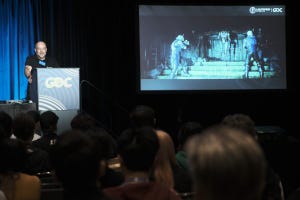
A talk was held this morning by Richard Mark Honeywood, a translator, localization director, and programmer on many Square-Enix titles. By his side was fellow translator Colin Williamson, and they spent their hour focusing on the difficulties and tricks to localizing a Japanese produced game for other territories.

The first problem – as fans of their games will attest – is Square-Enix games “are so damn complex” and there is never enough time. As Honeywood put it, everyone on the localization staff are “either artists or perfectionists,” something that could be improved upon.

There is also never enough money. Some of the more interesting ways for the team to save money is “instead of flying everyone to Tokyo, we’ll go to places like Austria,” due to the cheaper airfare and accommodations. Additionally, members of the localization team will provide voices for some of the minor roles. Williamson then demonstrated his rather impressive Slime voice.

There is also never enough space on Square-Enix games. The eternal problem of Kanji to English did not go away with the 16 bit era. An example of a more inventive solution was shown with Final Fantasy VIII, in which a menu of statistics using Chinese characters in the Japanese version was replaced in the localized version with icons instead of words.

With Final Fantasy XI, Square-Enix’s MMORPG, keeping the English translation up to date with the scripts being produced by Japanese development team was described by Honeywood as “a war of attrition”.

After being on the project for four years, Honeywood went to work on other games, leaving behind a game script the size of the Bible, currently over 1,000,000 words in length. Keeping up with the languages across multiple platforms and expansion packs, Honeywood said “If we weren’t so close with the development team, we would probably have killed each other by now.”

And of course, there are never enough translators for all projects. “We lack direct Japanese to FIGS (French, Italian, German, Spanish) translators, so we have to resort to Japanese to English, then English to FIGS.”

The main challenge in localizing these games was, said Honeywood, was, “How am I expected to translate all this text into English when they don’t have basic grammar!” or what can be seen as the “You got a 5 sword(s)” translation problem. Honeywood said that “for small games you can branch the source code,” but European languages can have up to 16 grammatical variations making it impossible to hard code.

The solution for them was a custom built macro system that handles articles, singular/plurals and masculine/feminine/neutral text branching. In addition, Square-Enix now work with the development teams to implement singular/plural item distinction in the design phase.

Important to Honeywood was product differentiation, or to make each game unique. While most Final Fantasy games have gone for Americanized English for its translation - Final Fantasy XII being a recent exception - for Dragon Quest VIII they decided to go for British English.

To this end, they employed a British recording studio and used classical stage actors and a theatrical director for all voice directions, giving it a unique “flavour” from other Square Enix games.

Where Honeywood saw room for improvement in the future included more simultaneous multi-language development, format standardization across teams, improved tools, better lip-synching methods and better market research concerning what to release.


Comments

none
 
Comment:


Submit Comment