Latest News
spacer View All spacer
 
February 9, 2010
 
Analysts: EA On The Right Track At Last
 
GamesBeat@GDC Confirms OnLive, GameStop, PlayStation Home Speakers
 
Ubisoft Q3 Sales Edge Down, As It Ramps Up Big Franchises
spacer
Latest Features
spacer View All spacer
 
February 9, 2010
 
arrow Television, Meet Games
 
arrow Two Halves, Together: Patrick Gilmore On Double Helix [1]
 
arrow The Road To Hell: The Creative Direction of Dante's Inferno [20]
spacer
Latest Blogs
spacer View All     Post     RSS spacer
 
February 9, 2010
 
Lineage 2 Interview - 'Freya Update Is Just a Beginning' - Pt.2
 
Fixing the GDC 2010 Schedule Builder [3]
 
Swashbuckling for Landlubbers: Why you may already be encouraging piracy! [19]
spacer
Latest Jobs
spacer View All     Post a Job     RSS spacer
 
February 9, 2010
 
Telltale Games
Game Designer
 
Telltale Games
Senior Software Engineer - Core Technology
 
Airtight Games
IT System Administrator
 
Roblox
Apple Game Engineer - Kids' Virtual World
 
Roblox
Senior Web Engineer (front-end)
 
Ubisoft San Francisco
Core Engineer
 
Ubisoft San Francisco
Gameplay Engineer
 
Vicarious Visions / Activision
Audio Programmer
spacer
About
spacer News Director:
Leigh Alexander
Features Director:
Christian Nutt
Editor At Large:
Chris Remo
Advertising:
John 'Malik' Watson
Recruitment/Education:
Gina Gross
 
Feature Submissions
About
spacer If you enjoy reading this site, you might also want to check out these Think Services sites:

Game Career Guide (for student game developers.)

Indie Games (for independent game players/developers.)

Finger Gaming (news, reviews, and analysis on iPhone and iPod Touch games.)

GamerBytes (for the latest console digital download news.)

Worlds In Motion (discussing the business of online worlds.)

Game Set Watch (the Group's alt.game weblog.)
News

  In-Depth: Valve On Team Fortress 2 - Devs As Service Providers
by Chris Remo
7 comments
Share RSS
 
 
June 5, 2008
 
In-Depth: Valve On  Team Fortress 2  - Devs As Service Providers
Advertisement
During a recent small-scale Gamasutra-attended press event held at Valve's offices in Bellevue, Washington, designer Robin Walker spoke on the importance of communication between players and developers of modern PC games.

He also discussed how the unique advantages of the PC platform provide the most fertile ground for keeping a multiplayer game community robust and active.

Though Valve shies away from titles amongst its staff, Walker is certainly the most visible designer on the company's hit class-based shooter Team Fortress 2.

In his presentation, he described Valve's plan for the game and how the Steam distribution service facilitated it, as well as how continuous content updates have allowed the team to refine its design sense.

"You Are Providing A Service"

Said Walker, "Being close to your customers - being able to talk directly to your customers - is valuable." That lack of barriers between developers and consumers was a theme to which Walker returned often.

"We've been making multiplayer game titles for about a decade now, and we've noticed a couple of key components to a successful multiplayer title," he continued. "One, that it innovates in gameplay both on release, but also over time post-release, and that those innovations are significant and of interest to customers."

"Secondly," he continued, "that they provide continuous content updates post-release, so the game is a living thing. It never gets boring, it keeps growing. The way to define this is you are providing a service to your customers. You're not providing them with a product and then saying, 'I'm done with you.' You are fundamentally viewing them as someone you are a service provider to."
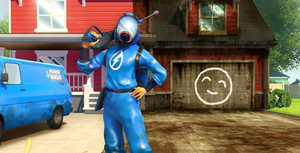
Shipping a game doesn't mark a development endpoint, said Walker, but rather the start of a back-and-forth in which players provide input with gameplay behavior and verbal feedback, and developers respond with design and content updates.

"Instead of us thinking our job is to talk to them through press releases, we think shipping them content is the way we talk to them," he said. "We listen to what they say, we make changes to our design, we ship those changes."

Avenues Of Feedback

Drawing a contrast to what would be practical on consoles, Walker said Valve has shipped 53 updates to Team Fortress 2 via Steam's auto-updating system since the game shipped last October.

"On a closed console system," he explained, "certification costs would prohibit that off the bat, then the amount of time it would take to cert 53 updates would be further prohibitive."

The TF2 team has used a variety of methods to analyze player behavior and reactions to game changes. That includes examining the vast amount of gameplay data recorded by Steam, but also keeping up with more traditional communication such as forums and email - Valve is well known among hardcore gamers for being uncommonly responsive to emails sent directly to employees.

"It's not just us talking to them, they talk to us, and the closer we are to them, the more effectively they can talk to us," he said.

Walker stressed how important it is to use as many types of responses as possible when shipping class updates, new maps or map changes, and Achievements, because those new updates and changes will lead to further refinements, making it crucially important to fix misjudgments before they reverberate into larger problems.

"We're going to make a bunch of compound decisions downstream of those, and I need to know that these are the right decisions," he elaborated. "The closer I am to my customers, the more effectively they can talk to me, the better my future decisions are going to be."

Refining Team Fortress 2

Bringing the focus of the talk more towards Team Fortress 2 itself, Walker described the three major long-term goals Valve had for the game: it shouldn't get boring even over long periods of time, customers should continue to get content indefinitely after release, and players should be rewarded for their time investment in the game.

Since it is impossible to conclusively predict the behavior of hundreds of thousands of players over months, there isn't any way to conceive the practical points of the post-ship plan beforehand. Said Walker, "Steam, or any system like Steam, allows me to iteratively get there, step by step, and measure effectively, and make sure my decisions are being influenced by what my customers are telling me, and that I haven't gone too far off target each step of the way."

As an example, Walker pointed to the recently-released Medic pack, which added a slew of class-specific items and Achievements alongside the new Goldrush map. The update was conceived when Valve realized that, as an inherently support-oriented role, Medic was among the least-played classes - even though gameplay data shows that when players choose Medic, the whole team scores better. "So if I can get more medics playing, everybody wins," the designer said.

Valve's update added items intended to change gameplay, encourage Medic usage, and reward those who play the game. It also added a variety of Achievements - some of which, it should be noted, have been criticized for encouraging players to engage in behavior that is unhelpful to their teams.

When this criticism was raised, Robin acknowledged that Valve took something of a buckshot approach with that first round of class-specific Achievements, in order to gauge player reaction to various extremes and provide a framework of data with which to design further Achievements.

"Achievement design, in particular in the multiplayer space, is still the realm of assumptions," he admitted. "It's not terribly specific. We don't, as designers, yet understand how to build the perfect achievement."

Walker said one of his goals is to ensure Achievements are not simply score-oriented, but also contribute to the overall player-designer feedback loop. "We think achievements can be much more than that," he said. "They're a way for us to talk to our customers about what the game design is about, and what kind of behaviors we would like them to exhibit in multiplayer games. So we have a strong vested achievements in learning to build good achievements."

Boosting The Player Base

Unsurprisingly, when the update was released, Medic usage hit an inflated peak usage of 32 percent of all players in all games - and team scores shot through the roof. What was more important however, was what happened in the weeks that followed; Medic has now settled into a position as the third most popular class.

A corresponding free play weekend doubled the number of people playing TF2 for the weekend's duration, but - again, more indicatively - that increase tapered off into a persistent improvement. After the free weekend ended, average simultaneous players increased by 22 pecent.

Walker said the lessons the company learned about achievement design, will be rolled into the next pack, for the Pyro. "In particular," he noted, "one of the interesting things we learned is that the degree to which an achievement is earnable through general play versus specifically trying to earn an achievement is a key component to how likely customers are to game it versus earn it legitimately. This exposes how we can learn specifically from our customers from having a conversation with them about game design."

"Things I Don't Spend Time Thinking About"

Walker moved onto a segment he called "Things I don't spend time thinking about," devoted to three major points that have long been thorns in the side of multiplayer game developers but which, he claims, are no longer difficulties for Valve: piracy, cheating, and updates.

On piracy: "Today, I don't worry about that at all. Steam - and if I were on some other PC system, it would probably have its own system - just takes care of this for me."

On cheating: "I don't have to worry about cheating. Steam takes care of that for me. If I see a cheater online, or my customers are hacking my game somewhere, I just send that to the Steam team, and they make sure that cheat is essentially banned."

On game updates: "I don't want to as a game designer be thinking about bandwidth when thinking about the kind of content I want to provide to customers... I don't want to think about how this update is going to disrupt my communities [due to version fragmentation]."

(It should be pointed out that Walker's dismissive attitude towards these three sticking points masks what is undoubtedly still a significant amount of effort elsewhere in Valve's offices by Steam developers to allow the individual game teams to pay those issues little heed themselves.)

Walker summed up the bottom line: "Many of these things I've described really come down to the fact that I don't want anyone between me and my customers. I want to be able to write code today, and I want all my customers running it tomorrow. That's the world I want to be in."

"Then," he continued, "I'm making game design decisions fundamentally about what my customers want most. I'm not trying to please some strange set of constraints or goal that some intermediate person has, who, by being there, almost by definition is not going to have the same goals as my customers."

Conclusion: Developers As Service Providers

Finishing up the talk, Walker returned to his initially-stated thesis that game developers must think of their roles in a community-oriented way.

"We believe that game designers need to start thinking about their games as services," he said. "Part of the reason for this is because, as I've described, in the multiplayer space, your ability to succeed as a product is a function of your ability to ship new content and your ability to measure that content and the success of it. Your ability to do both of those is fundamentally a function of how close you are to your customers."

"If you're not close to your customers," he concluded, "or there are other people between you and your customers -- who you have to run things by, OK design decisions, and then ask for the data -- instead of being able to view it raw and control what data you want and how rapidly, then you are going to cut down your ability to succeed as that service dramatically."


Comments

Tim Carter
profile image
I play TF2. It's a fun game. But its accomplishment isn't as some operational business - it's in its artistic vision; self-parody of the multiplayer FPS, realized through a tremendous dose of black humor that leverages images from old 60s and 70s pulp spy flicks. It's an little artistic triumph.

However, to drag games into this "business operations" model is to subjugate artistic vision - to put creativity under the shackles of the Almighty Buck. The ultimate destination of such a "move" is to make games into a kind of crack for the masses - a way for players to get their rocks off instead of a dialogue between designer(s) and players that contains intrinsic meaning. It is a dangerous road, basically a route of the drug pusher model of game development.

Anonymous
profile image
Grassroots, what on earth are you talking about? This isn't some industrial machine setup here where they grind every last buck out of a game untill it screams no more or something nor does it have anything to do with a 'drug pusher' approach. The article adresses the need for game designers to talk to the people they're planning to sell a game to both before and after dev so the game can evolve and become a better and more fun experience.

Sounds more like a competent and smart company to me than some drug pusher or something. Maybe you should reread the article. If it was a 'drug pusher' approach it'd be something more like the origional plan for the new Grand turismo where you need to buy all your cars and courses with real money through micro transactions. That has much more in common with getting your "fix" than a pay for once FPS that improves itself for the benifit of it's players.

Chris Remo
profile image
GG,

I'm not sure there's any actual evidence behind your statements. Valve charges nothing for its TF2 updates, and nothing for its additional TF2 content, so the analogy to drug pushing baffles me. Claiming that Valve--of all developers--is dragging games into "this 'business operations' model," as if games aren't already in this model, and as if Valve is somehow that model's exemplar, is an extraordinarily tenuous position to hold.

Valve is essentially saying that, once a game is released, developers should continue to attempt to improve it as much as possible. This builds community, it helps the team sharpen its design skills, it creates more loyal customers, and it exploits the strengths of the PC platform. I am hard-pressed to find anything devious here, or anything outside the interests of gamers.

Ashley Bennett
profile image
This is all well and good for the players, (yay) but are Valve making any more money doing this? Are they selling more copies of the game?
Since this isn't a micro-transaction based game, once you own it that's all the money Valve will be getting from you. So the more they keep adding, the longer you keep playing that game, the less time you are spending buying other games, (e.g. via Steam from which Valve get a cut.) And they also have to keep paying these staff while they work on this "old" game.
It obviously makes sense to do this if the team is kept small and you are just trying to please your audience so that they come back for TF3 which you are also working on at the same time.

Anonymous
profile image
Ashley, yeah that's kind of exactly what was stated in the article by the idea of making loyal customers and earning new ones through word of mouth and such.

Eric Lagel
profile image
Very good article. It definitely sums up everything that I think about online multiplayer games. Understanding that we are delivering a service more than a product is key.

Alexander Hofstädter
profile image
Of course I am no professional, but the way I see it, they still promote sales of the original TF2 by putting out those frequent updates. It's one year after release now and I just got 5 people to buy this game (for 10€ during christmas holidays)- two of whom I know for sure wouldn't have bought it if it were not for the payload-mode that was added after release.

They also gain a reputation of creating games worth your money by actually adding value to them later on. Which one are you going to buy: Call of Duty 6, that has a ton of stuff in it and comes with the occasional map update afterwards, or TF3 that is most likely to provide you with fresh content every other month?


none
 
Comment:


Submit Comment