Latest News
spacer View All spacer
 
November 21, 2009
 
Video Game Watchdog National Institute On Media And The Family Shutting Down [9]
 
Modern Warfare 2 Infinity Ward's 'Most Successful PC Version' Yet [6]
 
New Tech, Design Details Of Project Natal To Emerge At Gamefest In February
spacer
Latest Features
spacer View All spacer
 
November 21, 2009
 
arrow Upping The Craft: Susan O'Connor On Games Writing [5]
 
arrow Small Developers: Minimizing Risks in Large Productions - Part II [6]
 
arrow iPhone Piracy: The Inside Story [48]
spacer
Latest Blogs
spacer View All     Post     RSS spacer
 
November 21, 2009
 
Accepting the Inherent Value of Games
 
Planckogenesis, Part II: Song Structure & Gravy Train [1]
 
Designing Games Is About Matching Personalities [1]
spacer
Latest Jobs
spacer View All     Post a Job     RSS spacer
 
November 21, 2009
 
Sucker Punch Productions
Network Programmer
 
Sucker Punch Productions
Texture Artist
 
Sucker Punch Productions
3D Environment Artist
 
Sucker Punch Productions
Character Artist
 
Crystal Dynamics
Sr. Level Designer
 
Sony Online Entertainment
Brand Manager
 
Monolith Productions
Sr. Software Engineer, Engine - Monolith Productions - #113767
 
Gargantuan Studios
Technical Art Director
spacer
About
spacer News Director:
Leigh Alexander
Features Director:
Christian Nutt
Editor At Large:
Chris Remo
Advertising:
John 'Malik' Watson
Recruitment/Education:
Gina Gross
 
News

  Casual Connect: How Corpse Craft Turned Real-Time Strategy Casual
by Erin Bell
0 comments
Share RSS
 
 
July 23, 2009
 
Casual Connect: How  Corpse Craft  Turned Real-Time Strategy Casual
Advertisement
When Tim Conkling was asked to design something for his new employer Three Rings' casual MMO Whirled he pitched the basic concept for Corpse Craft, a free-to-play casual web browser RTS game that combines collapse match-3 gameplay with a real-time combat mechanic. The idea came out of a desire, as Conkling put it during a post-mortem at the Casual Connect conference in Seattle, to create a RTS that he could "actually beat people at."

During the six-month development cycle, Conkling identified key elements of real-time strategy games -- such as resource gathering, exploration, upgrading units and bases, and micromanaging large-scale combat between large number of units -- and narrowed the focus to appeal to a casual audience.

The finished product was something Conkling described as "Harry Potter meets Lord of the Flies meets Frankenstein." Set at the Weird Academy, a school for aspiring necromancers, players play a puzzle game to collect resources such as blood and flesh to re-animate corpses that fight on their behalf.

"Lack of unit micromanagement is Corpse Craft's most important feature, because micromanaging a huge group of units in real-time that all have different powers and formations requires a huge amount of dexterity that most people don't have," Conkling said. "It's what has killed me in every RTS I've attempted to play."

In a traditional RTS, resource gathering is largely automated (players send designated resource gathering units out to harvest materials and bring them back to base, and they do it until either they're killed or the game is won), and it's the combat that has to be managed. Conkling decided to invert this model in order to eliminate the need for unit micromanagement. In Corpse Craft, resource gathering is micromanaged through the match-3 game, and new units that are created behave autonomously based on a very simple set of rules.

In other words, players spend resources to create undead creatures but don't actually control them. There's no base to manage, and no map to explore; all of the action takes place on a single non-scrolling screen.

According to Conkling, traditional RTS games typically keep combat interesting with a simple unit ecosystem, and battles are most exciting when they're epic and unpredictable. Corpse Craft maintains that feel through a basic rock, paper, scissors relationship between units, where each unit has an obvious strength and a weakness that can be mitigated by sending the unit onto the battlefield along with other units that offset that weakness.
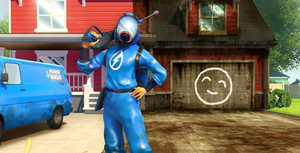
"Each unit behaves predictably, which is important because they're not under player control, but when you throw lots of units together into a battle, there are interesting and unpredictable things going on due to the huge variety of interactions between those units," Conkling said. "Battles are emergent in the sense that there are a few basic rules that drive the combat units, and from that you get chaos, unpredictability and interesting gameplay."

Conkling also made sure to incorporate built-in breaks into the gameplay so that players would never feel overwhelmed.

"Traditional RTS gameplay is balls to the walls all the time," Conkling said. "If you're not moving quickly all the time, you get crushed. It can be exhausting, and it's not always fun."
Conkling's solution was to split the game into day and night cycles. Players can't create units during the 30-second day cycle, so that time can be used to relax and just focus on resource gathering. Once night falls, anything goes for two minutes. The cycles also force players to strategize attacks accordingly, because if they send their creatures out right before daybreak they'll all die.

According to Conking, the puzzle game portion of Corpse Craft became a sort of "comfort food."
"The first thing that anyone who plays the game does is play the puzzle game. There are no consequences for not doing it well. Playing the puzzle is always good for your strategy, and if gets crazy on the battlefield you can always go back to the puzzle game."

[Gamasutra is presenting its Casual Connect 2009 coverage in association with Gamezebo (http://www.gamezebo.com), the leading editorial and community site for casual games across all platforms. The site features reviews, previews, news, and strategy guides for the latest and greatest in casual games.]


Comments

none
 
Comment:


Submit Comment