My Message close
GAME JOBS
Contents
Devil in the Blue Faceted Dress: Real Time Cloth Animation
 
 
Printer-Friendly VersionPrinter-Friendly Version
 
Latest Jobs
spacer View All     Post a Job     RSS spacer
 
May 23, 2013
 
2K Games
Tools Programmer - 2K Games
 
2K Games
Graphics Programmer - 2K Games
 
2K Games
Engine Programmer - 2K Games
 
GREE International
Senior Product Manager, Growth and Revenue
 
GREE International
Business Intelligence Data Analyst
 
Synergy Blue
3D Artist / Animator
spacer
Latest Blogs
spacer View All     Post     RSS spacer
 
May 23, 2013
 
Xbox One: a flawed plan, well executed
 
Letting the Player Find the Fun
 
Using Small Studios As Stepping Stones In Your Career [3]
 
Maturity, Challenge, Art and Games
 
Combat Analysis: Guacamelee [1]
spacer
About
spacer Editor-In-Chief:
Kris Graft
Blog Director:
Christian Nutt
Senior Contributing Editor:
Brandon Sheffield
News Editors:
Mike Rose, Kris Ligman
Editors-At-Large:
Leigh Alexander, Chris Morris
Advertising:
Jennifer Sulik
Recruitment:
Gina Gross
Education:
Gillian Crowley
 
Contact Gamasutra
 
Report a Problem
 
Submit News
 
Comment Guidelines
Sponsor
Features
  Devil in the Blue Faceted Dress: Real Time Cloth Animation
by Jeff Lander [Programming]
Post A Comment Share on Twitter Share on Facebook RSS
 
 
March 27, 2000 Article Start Page 1 of 3 Next


I’ve been describing methods of dynamic simulation using mass and spring systems for the past couple of months. These techniques dramatically increase the realism in your real-time graphic simulation. One of dynamic simulation’s key benefits is that it creates a scaleable game experience.


Users with more powerful systems get a more realistic experience, while users with less powerful systems are still provided with a complete experience. It’s a situation analogous to the use of levels of detail in your 3D models. Particularly in the PC market, where target systems can vary widely, these techniques have become a crucial weapon in the developer’s arsenal.

For a current project, I decided to maximize the use of dynamics to increase realism wherever possible. The project focuses on characters in moody interior environments. It occurred to me that the use of cloth animation in my scenes would be crucial to creating the mood I was trying to establish.

Traditional Cloth Animation in Games


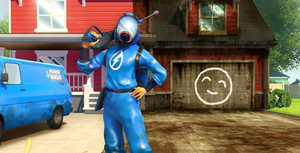
The devil wears an animated-cloth blue dress.


Cloth animation is tricky. Even in the world of high-end computer graphics, it’s difficult to get right. Most of the time, it’s wise to avoid the whole issue. Anyone who has ever created a female character in a skirt is familiar with the problem of the legs poking through the cloth mesh during animation. This is pretty difficult to fix, especially if animation requires a variety of motions. It’s particularly tricky if you are applying motion capture data to a character. Unfortunately, it’s also a really obvious animation problem that any end user can spot. These cloth animation problems are the reason why most digital characters are clothed in tight-fitting gear, such as skin hugging stretch pants.

Most loose clothing doesn’t look natural in digital art because it’s static. It doesn’t move along with the body. It’s possible to morph the shape of the skirt to match the motion of the character, but this requires quite a bit of detailed animation work. Likewise, deforming the skirt with a bone system can be effective, but not necessarily realistic.

For my work, I wanted to create realistic cloth in the environments and on the characters. My hardware accelerated graphics rasterization freed the processor power necessary to make this possible. So, I set about creating a real-time cloth simulation.

 
Article Start Page 1 of 3 Next
 
Top Stories

image
A Guacamelee! combat design analysis
image
Blog: I took my Ouya game to retail, and here's what happened
image
The anatomy of a memory manager
image
Xbox One is Microsoft's biggest play for living room domination
Comments


none
 
Comment:


UBM Tech