Contents
The Restless Vision Of Martin Hollis, The Man With The GoldenEye
 
 
Printer-Friendly VersionPrinter-Friendly Version
 
Latest News
spacer View All spacer
 
November 22, 2009
 
Video Game Watchdog National Institute On Media And The Family Shutting Down [11]
 
Modern Warfare 2 Infinity Ward's 'Most Successful PC Version' Yet [12]
 
New Tech, Design Details Of Project Natal To Emerge At Gamefest In February
spacer
Latest Jobs
spacer View All     Post a Job     RSS spacer
 
November 22, 2009
 
Sucker Punch Productions
Texture Artist
 
Sucker Punch Productions
3D Environment Artist
 
Sucker Punch Productions
Network Programmer
 
Sucker Punch Productions
Character Artist
 
Sony Online Entertainment
Brand Manager
 
Monolith Productions
Sr. Software Engineer, Engine - Monolith Productions - #113767
 
Crystal Dynamics
Sr. Level Designer
 
Gargantuan Studios
Technical Art Director
spacer
Latest Features
spacer View All spacer
 
November 22, 2009
 
arrow Upping The Craft: Susan O'Connor On Games Writing [6]
 
arrow Small Developers: Minimizing Risks in Large Productions - Part II [7]
 
arrow iPhone Piracy: The Inside Story [48]
 
arrow And Yet It Grows: Analyzing the Size and Growth of the European Game Market [5]
 
arrow NPD: Behind the Numbers, October 2009 [13]
 
arrow Reflecting On Uncharted 2: How They Did It [5]
 
arrow Sponsored Feature: Rasterization on Larrabee -- Adaptive Rasterization Helps Boost Efficiency
 
arrow Postmortem: Wadjet Eye's The Blackwell Convergence [2]
spacer
Latest Blogs
spacer View All     Post     RSS spacer
 
November 22, 2009
 
Time Fcuk
 
Accepting the Inherent Value of Games
 
Planckogenesis, Part II: Song Structure & Gravy Train [1]
spacer
About
spacer News Director:
Leigh Alexander
Features Director:
Christian Nutt
Editor At Large:
Chris Remo
Advertising:
John 'Malik' Watson
Recruitment/Education:
Gina Gross
 
Features
  The Restless Vision Of Martin Hollis, The Man With The GoldenEye
by Jon Jordan
0 comments
Share RSS
 
 
June 8, 2007 Article Start Previous Page 3 of 4 Next
 

How did Perfect Dark come about then?

MH: We were talking about what we wanted to do next and we had quite a few science fiction buffs on the team. I was really into Philip K Dick at the time, and the X-Files was big so it was a conglomeration of a lot of ideas. We thought, we can re-use the engine, we can do it in a year. One way or another that didn't happen. It was an exciting project, but I never saw it as a three year project, which is roughly speaking what it took in the end, although I personally wasn't there for the last 18 months.

Advertisement

Why did you decide to leave?

MH: My exit from Rare is a tangled story, I was head of software, but after almost six years, I couldn't see myself staying in Twycross [the small English village where Rare is still based]. I wanted to see more of the world - wanderlust I suppose. So I headed around South East Asia for six months. Then I went to Nintendo of America. It was working on GameCube and I'd always had a fascination with hardware and a good understanding of how things worked so I was hired as a consultant to try to make sure the machine was good for making games on. There was some ex-SGI people there I had close links with, so it was a lovely time.

But you always wanted to make games?

MH: My problem is there are so many games I could spend my life making. At Zoonami we don't have the philosophy this is my one idea for the year, so this is what we're going to do. We're trying to pick the best ideas we've got and develop them further. For most of our existence, we've been trying to balance out the aspects of potential products and develop them so they have fabulous gameplay, and so they are interesting in just the right way and have a commercial aspect. It's very difficult and challenging. We get offers to do conversions but we're not into that sort of work. We're about innovation and trying to do something different.

But isn't it a bit depressing only to have released one game in seven years?

MH: If some of your projects don't fail, that's evidence you're not taking chances. We are taking chances and a lot of our projects end up being cancelled or put on the shelf. I make the decision in most cases. Not every daring idea can be bought to fruition.

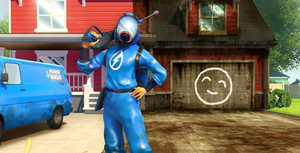
Still, we've only tried to pitch four projects to publishers, and the only one of those we failed to get a deal for was Funkydilla [a before-its-time music-based one-button rhythm game]. We haven't been able to get the deal we're looking for, and I'm not talking about the financial side. It's more to do with finding someone who can share the vision. We haven't been able to find that for Funkydilla, so it's on the shelf even though I believe in it very strongly. What we have done a lot of however is research work, and experimentation into prototyping and developing gameplay, graphics, marketing approaches. We're trying to develop the whole picture.

This sort of thing happens in movies and TV all the time, although they don't call it research. For every movie that comes out, there are hundreds of scripts. There's a lot of work goes on behind the scenes that no one ever hears about.

But in terms of games, if a company pays you to do research for them, how is ownership of the IP worked out?

MH: It varies from deal to deal. To be honest, there are only a few organisations who will pay for a company like Zoonami to make something that isn't a game. But there are a handful and that's the majority of our work. Zendoku is different of course. It's trying out a more conventional developer-publisher approach.

What was the inspiration for Zendoku?

MH: From the point of view of the consumer, it's Sudoku with a twist. From our point of view, the game design is a little bit of WarioWare mixed with a puzzle battler. It's a new kind of puzzle game. Obviously it's built on top of the core mechanics of Sudoku but there's innovation too. I don't know how the perception is going to pan out but that's our perspective on it.

The way it came about was we worked on a plain Sudoku prototype back in August 2005. But we thought, 'This isn't really interesting. There are going to be hundreds of these type of games,' so we left it alone until we had the idea for a fairly radical, quite crazy approach to what also could be described as a Sudoku game.

 
Article Start Previous Page 3 of 4 Next
 
Comments

none
 
Comment:


Submit Comment