Contents
The Chemistry Of Game Design
 
 
Printer-Friendly VersionPrinter-Friendly Version
 
Latest News
spacer View All spacer
 
November 22, 2009
 
Video Game Watchdog National Institute On Media And The Family Shutting Down [11]
 
Modern Warfare 2 Infinity Ward's 'Most Successful PC Version' Yet [12]
 
New Tech, Design Details Of Project Natal To Emerge At Gamefest In February
spacer
Latest Jobs
spacer View All     Post a Job     RSS spacer
 
November 22, 2009
 
Sucker Punch Productions
Texture Artist
 
Sucker Punch Productions
3D Environment Artist
 
Sucker Punch Productions
Network Programmer
 
Sucker Punch Productions
Character Artist
 
Sony Online Entertainment
Brand Manager
 
Monolith Productions
Sr. Software Engineer, Engine - Monolith Productions - #113767
 
Crystal Dynamics
Sr. Level Designer
 
Gargantuan Studios
Technical Art Director
spacer
Latest Features
spacer View All spacer
 
November 22, 2009
 
arrow Upping The Craft: Susan O'Connor On Games Writing [6]
 
arrow Small Developers: Minimizing Risks in Large Productions - Part II [6]
 
arrow iPhone Piracy: The Inside Story [48]
 
arrow And Yet It Grows: Analyzing the Size and Growth of the European Game Market [5]
 
arrow NPD: Behind the Numbers, October 2009 [13]
 
arrow Reflecting On Uncharted 2: How They Did It [5]
 
arrow Sponsored Feature: Rasterization on Larrabee -- Adaptive Rasterization Helps Boost Efficiency
 
arrow Postmortem: Wadjet Eye's The Blackwell Convergence [2]
spacer
Latest Blogs
spacer View All     Post     RSS spacer
 
November 22, 2009
 
Time Fcuk
 
Accepting the Inherent Value of Games
 
Planckogenesis, Part II: Song Structure & Gravy Train [1]
spacer
About
spacer News Director:
Leigh Alexander
Features Director:
Christian Nutt
Editor At Large:
Chris Remo
Advertising:
John 'Malik' Watson
Recruitment/Education:
Gina Gross
 
Features
  The Chemistry Of Game Design
by Daniel Cook
1 comments
Share RSS
 
 
July 19, 2007 Article Start Previous Page 2 of 7 Next
 

2. The Foundations Of A Model Of Game Design

Where chemistry separated itself from alchemy by building testable models of physical atoms, a science of game design concerns itself with testable models of human psychology.

Many of the attempts to define games have focused on the mechanistic elements of the game, such as the primitive actions that the system allows the player to perform or the tokens that the player manipulates. The approach has been to treat games as self contained logical system.

Advertisement

Mechanics and aesthetics are certainly important pieces of any model of game design, but in the end, such analysis provides little insight into what makes a game enjoyable. You end up with a set of fragmented pieces that tell you almost nothing about the meaningful interactions between the game as a simulation and the player as an active and evolving participant. Games are not mathematical systems. They are systems that always have a human being, full of desires, excitement and immense cleverness, sitting smack dab in the center. To accurately describe games, we need a working psychological model of the player.
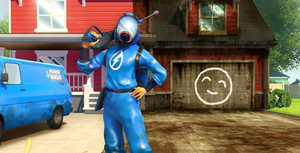
Player Model

Our player model is simple: The player is entity that is driven, consciously or subconsciously, to learn new skills high in perceived value. They gain pleasure from successfully acquiring skills.

Diagram 3: The player follows clues to the acquisition of a new skill

Let’s dig into three key concepts in our player model.

· Skills

· Driven to learn

· Perceived value

Skill

A skill is a behavior that the player uses to manipulate the world. Some skills are conceptual, such as navigating a map while others are quite physical, such as pounding in a nail with a hammer.

Driven To Learn

Play is instinctual. In low stimulation environments where we are not actively pursuing activities related to food and shelter, people will begin playing by default. Strong feedback mechanisms in the form boredom or frustration prod us into action. Given a spare moment, we throw ourselves into playing with blocks or dolls as children and more intricate hobbies as adults. It is a sign of our need for meaningful stimulation that solitary confinement remains a vicious punishment for the most hardened criminals.1

The flip side is that we are rewarded for learning. The sensation that gamers term ‘fun’ is derived from the act of mastering knowledge, skills and tools. When you learn something new, when you understand it so fully you can use that knowledge to manipulate your environment for the better, you experience joy.

There is a reasonable amount of neuroscience available to support this claim. Edward A Vessel, a cognitive neuroscientist at the NYU Center for Neural Science writes:

“These “aha” moments, when a concept or message is fully interpreted and understood, lead to a flood of chemicals in the brain and body that we experience as pleasurable. It feels good to “get” it. The deeper the concept is, the better it feels when we are finally able to wrap our head around it.”

Upon the click of comprehension, a natural opiate called endomorphin, a messaging chemical in the brain similar in structure to morphine, is released. As humans, we are wired to crave new information constantly. In some sense, what you and I term curiosity can be interpreted as our brain looking for its next fix of deliciously fascinating information.

As game designers, we deal with the fun, boredom and frustration on a regular basis. It is good to recognize that these are biological phenomena, not some mystical or mysterious sensation. For more thoughts on the topic, I encourage you to have a quick read through Raph Koster’s book “A Theory of Fun for Game Design”

 
Article Start Previous Page 2 of 7 Next
 
Comments

Stephen Dinehart
profile image
I found this thanks to a link from Stéphane Bura's July 29th article "Emotion Engineering", and I have to say your analysis using the skill chain and atom model is very compelling! I know utilizing similar approaches will help better my own game designs, and in collaborating and communicating with team members. Thank you.


none
 
Comment:


Submit Comment