|
Software
piracy is a thorny issue, with guesstimates putting its total cost to
the industry into the hundreds of millions, if not billions of dollars
annually. Actual financial loss is almost impossible to gauge, and the
subject provides fertile ground for debate on topics such as "Which
came first - the scurrilous pirate or the overpriced product?" Whether
you believe the actual loss is small or large, there is little doubt
that having product available at no cost at all reduces earned revenue.
This affects everyone: the retailers, the publishers, and - perhaps
most important of all - the developers. Arguments that turn the rich
corporate retail chains and huge publishers into an unpopular straw man
tend to evaporate when turned upon impecunious studios.
In
the midst of this, common knowledge asserts that one particular kind of
developer is a special case: the independent studio. These developers
do not exist in the lengthy chain of domain-experts, a chain driven by
business and able to profit healthily despite dismal failures, a chain
arguably uninterested in the aesthetic quality of the product.
Generally fighting for their own survival against the specialist
distributors and retailers, they don't have any choice but to price
aggressively, to undercut the competition. They can't take blame for
controlling pirate-encouraging monopolies, but their sales figures are
orders of magnitude smaller than their rivals, so that each lost sale
hurts them far more. Perhaps there is no-one that so loathes the
software-pirate as much as the indie developer...
But
what does it mean, exactly, to have your independent game be pirated?
There are two main channels for the distribution of pirate games, and
we'll look at each separately.
Retail
The
one most feared by the EAs of this world is the one that shifts product
fast, in bulk, and charges money along the way - these people are
actually stealing paying customers for no more effort than the price of
a blank CD. These are the market-stall pirates and the dodgy
high-street retailers buying product that "fell off the back of a
truck, no questions asked (...none answered)."
First
question, the most important of all: what is the actual financial loss
(AFL)? On a personal level, individuals will rightly get upset that
people who they hoped would love their product are instead stealing it
and depriving them of pay. However, the studio only counts money. If
piracy cost the studios nothing, there would be no problem. Let's think
about this for a second: "actual financial loss" is the difference in
profit between two situations, all aspects taken into account. For
instance, if a pirated game is bought for $1 by someone who would never
have paid for it anyway (perhaps a child with very little pocket
money), then there is no actual loss. Obviously, if we were to take
everything into account, we'd have to factor in whether this would
cause the child to be more inclined to piracy at a later age, when they
were in fact able to afford not to.
So,
what money could the indie have earned without the piracy, and how much
does it end up earning? The biggest challenge facing the indie studio
trying to sell their game is getting it in front of the buyer.
Retailers block-order from large distributors, who are in exclusive
partnership with large publishers. Indie studios that can only generate
one game's worth of revenue simply aren't worth it for the other
specialists to endanger their nice, fat, exclusive multi-title deals in
order to work with. As a result, independent games do not make it onto
shop shelves. They cannot get any in-store promotion, and usually can't
even get into the on-order catalogues - partners may be interested, but
they have their own backs to cover.
So,
any game sold at retail is a game sold where the developer couldn't
have been on sale anyway. They not only wouldn't have been in that
shop, they wouldn't have been in any shop in the whole mall; they
simply were not and could never have been in that "market". The AFL in
this case may well be insignificant.
(But
there's an upside - just because a dodgy shop is there doesn't mean
everyone nearby buys from it - on the whole, customers know when the
shop or stall is selling pirated games. Further, if the indie's dream
of getting into retail is for exposure to a much larger volume of
potential purchasers, and their networks of friends and families, a
free sale with no revenue and no supply cost, no distribution cost, no partnership maintenance cost, etc is free advertising to precisely the audience they cannot reach to start with.)
Now,
let's look at the audience gathered around the market-stall, wanting to
buy the latest and best pirated games at knock-down prices. These are
the cash-poor gamers, the students and part-time workers - the
time-rich hardcore gamers with an insatiable appetite for ploughing
through games fast, whose habit would cost them way beyond their means
should they ever pay full price. In short, these are the Early Adopters
- the people who, if they love your product, and know about it, will
each generate 5, 10, or more sales. They are each the center of their
own informal social network of advisees who know them as the go-to guys
for expert opinion on which single game they should buy this month:
"always ask the guy who buys 5 a week, he's the best placed to know".
Giving freebies to early adopters is a tried and tested marketing
tactic - this is what loss-leader campaigns are all about. So, again,
is the AFL here large enough to be significant? Or... is the studio
perhaps getting a net gain?
Supply-chains and Distribution Networks
The
other main distribution channel is the Internet, originally from warez
sites but increasingly via person-to-person now that so many people
have broadband. But that's a gross simplification: the modern software
pirate employs an advanced distribution network, using many of the best
practices in modern logistics management, distribution systems, etc.
Just as with legitimate software distribution, the pirate networks are
dominated by distribution chains, where each group in the chain is a
specialist and entirely reliant both upon the existence of other
specialists, and upon maintaining solid partnerships with them.
Arguably, the pirates are better at it than the mainstream groups: they
do digital distribution faster, more efficiently, and with fewer
mistakes than anyone.
Why?
Perhaps because they have no shareholders to answer to, and no profit
to make - they can even do it at a loss. The only thing they care about
is reputation and challenge, and the biggest challenge of all is to
provide the best of the newest games faster than anyone else. This is
especially true given that the source / supplier of product -
development studios - aren't entering into any agreements with anyone,
so the start of the chain is never blocked by exclusivity contracts;
any decent cracker can start up any time they like. So, as a pirate,
you have fewer legal blockades (you're ignoring all of them) to slow
you down, and no reward at all unless you can be faster than anyone
else. It's as if the publisher/distributor/retail chains were only
being paid if they were the first chain to sell 100k units of the
product - the pressure to perform would be much greater.
Independent
game developers cannot sign up with big publishers - they are unproven
teams producing low-budget games usually pitched at a new or niche
market. All in all they represent - on paper, at least - a massive
risk. Statistically speaking, the potential reward for a hit indie
game, discounted for probability of occurrence, just isn't big enough
to make the risk even close to worth it.
The
nature of retailers is such that the only way to get into a large
number of stores is through spending vast amounts of money, or by being
a primary partner of the retail chain. Quality and efficiency of
distributors varies wildly, and it's rarely worth their while to
distribute small-selling games - the constant overhead is too great.
So,
independent studios may have an excellent game, but realistically they
are usually shut-out of the retail process. They can't get a
distributor, they have no marketing, and no-one with the skills and
experience to do this is likely to choose to work with them. Even
online distribution is difficult and expensive: whereas 4Mbit home
broadband is cheap, and can download many files quickly, this just
makes the situation far more expensive for the distributor. In order to
service thousands of customers, the distributor nowadays needs a
multi-gigabit connection (all those home broadband accounts soak up
your pipe rather quickly), and the hardware and software capable of
maintaining such high sustained throughput.
This
is where the pirate networks come in - each one is a multi-level
distribution network where the costs are already paid for (legitimately
or not), filled with domain specialists who don't even need to partner
with you, who care more about being first than about how many units
your game may or may not sell. A better game will, of course, always
inspire more people to try cracking it, but in this widely varied and
non-rationalized market there's room for many different motivations.
There are plenty who will crack and distribute your game just "because
it's there", and plenty more for whom the challenge of cracking hard
copy protection is more of a motivator than the quality of the game
itself. In the mainstream world of legitimate distribution,
philanthropic distributors tend to be shut-out of the best chains for
not being profitable enough for their chain partners.
And,
where a publisher may well insist on particular corporate-approved
commercial copy-protection systems, the pirate networks are likely to
be more interested in the proprietary in-house system you came up with
yourself.
0-day Warez
Pirate
networks move very fast; the watchword is "0-day," referring to the
time between release and the crack appearing. The people who go to
warez sites are the impatient as much as they are poor, and know they
can get the latest and greatest any time they want from these sources.
Indeed, it is common for it to be faster to find a warez site and
download a pirated copy than it is to wait for stock to arrive in the
local shop and drive down to pick up a legitimate copy. There are even
people who claim to do both - they are happy to pay for a copy, but
aren't willing to wait, so will pirate it first, and in parallel order
a copy from a retailer to "make me legal (as soon as it arrives in the
post)."
How
does all this benefit the indie studio? Two benefits are self-evident:
simple visibility (being seen, gaining name-recognition, etc, but
without spending money on a marketing campaign), and exposure to a
wider market (through social networks demonstrating your game to
peers). But we should really be looking at what it is pirate networks
do best: distribution. Got a 2GB game to distribute? Use a pirate
network to get it onto 10 times as many desktops as your own marketing
and sales activities - including free downloadable demos - will ever
manage to colonize. And ... practically for free. Just as studios
making shareware games have found it is often easier to sell a game for
$10 than for $2.50 for myriad psychological reasons, the perceived
value of getting a $30 game for free is greater than of getting a
limited, official demo from the developer.
Clearly,
distribution is of no additional benefit beyond the two benefits
already cited unless it can also increase sales in ways that the others
do not. In this day and age it is common for a game to consist of two
games using mainly a common ruleset and engine - a single-player mode
and a multi-player online mode. It is impossible to make an offline
game uncrackable, mainly because the customer has full control of the
hardware it is running on. However, an online game can (and usually
should) be run mostly on the server (to prevent multiplayer cheating),
which fundamentally alters the possibility of cracking the copy
protection. Even a game sold as purely online is entirely vulnerable in
its offline components - it can be cracked so that whatever engine,
assets, etc were on the DVD can be played locally - but the cracker
will always remain locked out of the online play.
Shareware in the 21st Century
Make
your game with strong single-player and multiplayer aspects. Do not
skimp on either - make sure that someone who shells out the asking
price only intending to play the single-player parts will feel they got
a fair bang for their buck. Put on some good, strong, copy-protection.
Then, go out and tempt the pirates - get your game onto their networks,
making sure that someone with a cracked single-player version will keep
getting in-game reminders, from the subtle to the overt, that however
good this game is, it's even better when played online.
You could even tread in the footsteps of one of the greatest shareware successes of all time - Doom - and make overt references to the legality-or-otherwise of the copy being played:
"If
you are having trouble going online to take this game to the next level
of entertainment, it's probably because you stole the copy you're
playing. That's OK - you know, now would be an excellent time to decide
to buy a genuine copy. You got one over on us, took our hard work and
got a free ride - looks like you're enjoying it so far; glad you like
the game :) - but we really would appreciate it if you did us this
little favor, and helped us pay our employees for all their hard work."
______________________________________________________
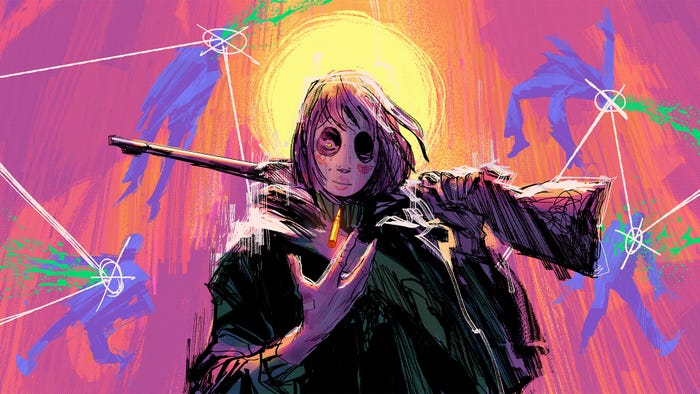
[Article illustration by Greg Brauch.]
|