|
GDC: Serious Games Summit: Behind the Game: ‘What's Wrong With Serious Games?'
Introduction
Framed
as an open, frank conversation, key advocates of the serious games
initiative met to discuss the problems surrounding the serious games
field. Clearly buzzing with responses to prior sessions in the Serious
Games Summit at the Game Developers Conference 2006 (GDC:06), Ben
Sawyer kicked off the session by emphasizing the importance of
self-examination: companies must face facts.
Sawyer,
Co-Founder of Digitalmill, is currently working on serious games and
games for health in particular. He warned that several people in the
game industry view the ideas behind serious games as jokes and
failures, or even want to see serious games fail. He equated the
accusations of failure with the assumptions of companies that feel it
is simple to develop a serious game and reminded the audience that
Gizmondo lost $250 million, which is more than the total amount of
funds in the serious games field.
Henry
Kelly, Ph.D., picked up on the issue of funds. Kelly has been the
president of the Federation of American Scientists since 2001. One of
his efforts includes negotiating and implementing administration
research partnerships in the area of learning technology. He identified
skepticism about the possibility for real improvements in serious games
as a core issue. As demands for evidence of improvements and success
increase, the idea of “success” becomes relative to sales and money.
The Office of Management and Budget (OMB) reviews use of funds, and
although there are 207 separate programs that are available to fund
innovative projects, funds depend on statistical proof of large scale
success in serious games. At this time, the proof is lacking.

Meanwhile,
serious games receive weak support from traditional education
lobbyists. Unfortunately, lobbyists have a limited amount of time to

address issues, and serious games often end up lower on the list. With
such a chronic budget crisis, culture wars over the use of games in
education prompts the question, “does discovery-based learning work?”
As there are both real and perceived weaknesses of the educational
research infrastructure, funding is clobbered.
Outside
forces are not entirely to blame. Kelly noted the stage of time when
serious games developers over-promised results, which led to the
edutainment fiasco and dot-bombs. “Get rich quick” investments produced
poor material in an industry without a tradition of systematic
development. Even today, there remains huge latitude in what game
techniques work, and even in what is called a game.
Kelly
hesitated to point out what's wrong in serious games without proposing
a path forward. First and foremost, he recommended developing
agreed-upon metrics of success. Developing successful games for
learning must be part of a systematic program to design and test
innovations in learning. Kelly called for creating an exciting, clearly
articulated research program combining gaming expertise, learning
science, and computational science. Developers should be prepared for
spiral development, to build it, try it, and try again. Finally, he
promoted building on proposals in play because of innovative
initiatives, such as DO IT and PACE.
James
Paul Gee, Ph.D., agreed that the industry needs a common interpretative
of what defines a game in order for development to move forward. Gee is
the Tashia Morgridge Professor of Reading at the University of
Wisconsin-Madison. He is the author of several books that address the
valuable roles of video games in learning, including What Video Games Have to Teach Us About Learning and Literacy, Situated Language and Learning, and Why Video Games Are Good for Your Soul.
Gee
stressed the importance for the serious games field to move to the next
stage before it collapses. Shared paradigms are essential to improve
development and explaining the concept of serious games for acquiring
funds and approval. Gee invited confronting central questions, even if
it means disagreeing and fighting over them, in order to reach
convergence. Gee asked, “What is the power of games?” In his opinion,
games put you inside a world that forces you to see that world from the
inside-out perspective while solving problems in that space. He
acknowledged that many people would probably disagree with him, but
continued that games are a media, and like all media, we respond to
them very emotionally. While games do trigger powerful emotions, their
key pleasure is cognitive and in solving problems.
By
elaborating on the problem of funds and common complaints from
developers such as getting access to graphics that can compete with
mainstream industry, Gee pointed out that the real focus is in the
content and getting game designers together with learning designers for
collaboration. Kelly offered up his input about needing reviews of what
is and is not necessary in a game, while Sawyer pulled back, “saying
[graphics] don't matter and aren't a solution.” To Sawyer, meeting the
technology in mainstream industry isn't just a concern on PC, but also
on mobile. He focused on deep gameplay features rather than the layer
of art.
“If
we think that the serious games business is about the game in the box,
then the industry will fail… the focus should be the social
interactions around the game, games augmented by reality, moving in and
out of the real world,” Gee explained. Essentially, whether in a
classroom environment, lab, or training session, the real learning is
derived from the social interaction in and out of the game by
participants in the same space. Only by promoting conversations and
project teams with both game designers and learning designers will
serious games become widely successful.
However,
that is easier said than done. Even though the industry requires a
bigger team, it will take the step of getting beyond industry
professionals judging academics and academics judging industry
professionals for different methods of thinking. Both must have share a
common language, or as Gee suggested, perhaps even be the same person.
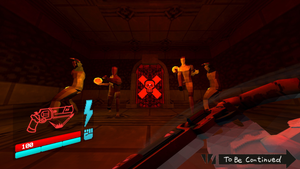
Finally, Gee referenced the need for killer apps in the serious games field. He used SWAT 4
(Sierra), a game of special weapons and tactics, as a representative of
a killer app, but recommended that future games should move away from
crime and killing. Sawyer joked that we “can't have a killer app
without a bullet point,” but drew attention to projects such as
PlayStation's EyeToy and remote health care devices that fall in the
serious games field.
|
|

|
 |
 |
 |
Serious game killer app SWAT 4
|
In
order to move forward, panelists concluded, paradigms must be
established, appropriate assessment methods must be developed, evidence
must be given to define what warrants claims of success, and developers
must navigate the current crisis in education and return to learning
traditional content while maintaining innovation and creativity.
Whether or not the serious games field will be able to accomplish these
immense tasks is uncertain, but it is clear that these needs must be
addressed while industry professionals and academics are present
together at GDC:06.
_____________________________________________________
|
Comments
Login to Comment