Our Properties: Gamasutra GameCareerGuide IndieGames Indie Royale GDC IGF Game Developer Magazine GAO
My Message close
Contents
Environmental Storytelling, Part II: Bringing Theme Park Environment Design Techniques to the Virtual World
 
 
Printer-Friendly VersionPrinter-Friendly Version
 
Latest News
spacer View All spacer
 
February 8, 2012
 
Zynga's in the black – but for how long? [3]
 
Bungie co-founder Alex Seropian leaves Disney [1]
 
Todd McFarlane brings a comic artist's eye to Kingdoms of Amalur: Reckoning
spacer
Latest Jobs
spacer View All     Post a Job     RSS spacer
 
February 8, 2012
 
THQ Montreal
Art Lead-THQ Montreal
 
THQ Montreal
Sr. Gameplay Programmer
 
THQ Montreal
Senior Technical Animator/Rigger
 
Airtight Games
Senior Game Designer
 
Lantern
3D Animator
 
Nintendo of America Inc.
Localization Writer/Editor
spacer
Latest Features
spacer View All spacer
 
February 8, 2012
 
arrow Jerked Around by the Magic Circle - Clearing the Air Ten Years Later [14]
 
arrow Building the World of Reckoning [3]
 
arrow SPONSORED FEATURE: TwitchTV - How to Build Community Around Your Game in 2012 [12]
 
arrow Happy Action, Happy Developer: Tim Schafer on Reimagining Double Fine [8]
 
arrow Building an iOS Hit: Phase 1 [11]
 
arrow Postmortem: Appy Entertainment's SpellCraft School of Magic [5]
 
arrow Talking Copycats with Zynga's Design Chief [82]
 
arrow Finnish Experiments, American Nightmare [12]
spacer
Latest Blogs
spacer View All     Post     RSS spacer
 
February 8, 2012
 
Merging Waterfall and SCRUM [2]
 
Business Post Mortem: Wolf Toss: Pre-launch Planning & Blended CAC
 
Minmaxing - Is turn-based fun anymore? [51]
 
PRICED TO DIE [4]
 
What happened with Shadow Physics: An Introduction [3]
spacer
About
spacer Editor-In-Chief/News Director:
Kris Graft
Features Director:
Christian Nutt
Senior Contributing Editor:
Brandon Sheffield
News Editors:
Frank Cifaldi, Tom Curtis, Mike Rose, Eric Caoili, Kris Graft
Editors-At-Large:
Leigh Alexander, Chris Morris
Advertising:
Jennifer Sulik
Recruitment:
Gina Gross
 
Feature Submissions
 
Comment Guidelines
Sponsor
Features
  Environmental Storytelling, Part II: Bringing Theme Park Environment Design Techniques to the Virtual World
by Don Carson [Game Design]
Post A Comment Share on Twitter Share on Facebook RSS
 
 
April 5, 2000 Article Start Page 1 of 4 Next
 

In the article "Environmental Storytelling Part I," I discussed the similarities and differences between the world of 3D computer games and that of theme parks such as Disneyland. In Part II, I would like to talk about some specific techniques used by the designers of physical "real world" spaces and how they might be used in the creation of immersive virtual environments.

Sub-Intuitive Elements in Design


Years ago, while studying Commercial Illustration in San Francisco, I had an instructor who discussed the use of "Arrows and Pathways" in illustration. Up to that point the concept was completely unknown to me. He used the works of N.C. Wyeth, specifically his paintings for Treasure Island, to demonstrate how, through the use of perspective, value, and color, the artist could force the viewer to look where he wanted him/her to look. Not only did N.C. Wyeth have draftsmanship and his ability to wield a brush in his favor, but he used an underlying structure that would draw his audience helplessly to the conclusion that he desired them to reach! In his example, my instructor used Wyeth's painting of Blind Pew (Figure 1).

Figure 1.
Wyeth's "Blind Pew."

In the painting the blind pirate is standing in the road just beyond the Admiral Benbow Inn where he has delivered the fateful "Black Spot" to Captain Billy Bones. In the story, Blind Pew is struck down by a carriage on the road outside the Inn. Wyeth's painting successfully captures the moment, immediately before Pew is hit by that same carriage. Although the carriage does not appear in the painting, you can sense the tension in the air. Your eye is drawn to the face of Pew and despite his murderous reputation you have sympathy for the man as he cries out in the night.

Looking at the illustration, it appears to break many of the rules of design. Pew's face is one of the smallest elements in the painting, so it's size does not draw your attention. It is not the brightest, or darkest element in the painting, so it is not contrast that makes you look into his face. Even the overall muted quality of the painting proves he has not used saturated color to draw you in. Deeper in the design of the painting lies the secret. If you look at the elements that surround the figure of Blind Pew, you notice that every line of perspective, every crack in the road, and every pitch in the roof of the inn points toward the face of Pew. Notice how the line of his cane stretches up through his arm, and points to his face. Even his tricorn hat, blown to the ground, acts as a giant arrow pointing to his head. Like a spiraling drain, your eye, no matter how much it may wander will be inevitably sucked right back to the one place the artist demands you to look.

Our class looked at other examples of Wyeth's work as well as pieces from other famous "Golden Age" illustrators. In every case, these artists grabbed you by the collar and dragged your attention to those elements that were most important to the telling of their story. Without knowing, the viewers have handed over their will to the artist's design, and allowed him to take them on a pre-orchestrated journey.

At that very moment my mind was completely blown apart. It was as though I had been introduced to color for the very first time. No longer was design a matter of creating pretty pictures. Now I understood it to be a marvelous tool, a slight of hand, a jujitsu trick, the power to draw an audience deep into my design, to work my will and bring my internal vision to an audience and let them live inside of it for awhile.
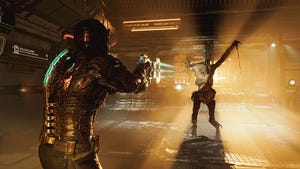
Although I might sound a little like the BBC's Sister Wendy discussing the finer points of art, that is not my goal. I wish to set the stage for a conversation about the very same concepts and techniques which are available to the designers of physical spaces, both real and virtual. Like the Arrows and Pathways in Wyeth's paintings, the world around us is filled with equally engaging tricks and traps that can help a designer draw his audience deep into the story he wishes to tell!

Architectural Archetypes

The trees outside Don Carson's studio.

Outside my Oregon studio is a gently rolling grass covered hill. Where the lawn meanders to the sidewalk of an adjoining street there are two tall trees, approximately eight feet apart, and leaning slightly away from each other. From time to time people will walk up the hill to reach our house from the back. When they do, they are confronted by these two trees. Although there is an expanse of several hundred feet to either side of the trees, many have admitted that they had a compulsion to walk between them. Others have said that they would purposely avoid walking through them. Either way, they were faced with a choice, and had to act upon deep emotional responses to the natural "threshold" created by the two trees. In many ways, they had to give into feelings that defied their common sense and make a decision based on a more primal part of themselves.

Like the example of the paintings, our every day world is filled with physical "archetypes" which force us to respond in predictable ways. These archetypes are powerful tools that can be used to draw your audience to experience certain "feelings" about the space you have designed, and weave them through the story you are trying to tell.

An undeniable mystery.

Imagine you have a pair of columns side by side, like our two trees, and have placed them in an open field. It is easy to predict that any passing hikers would find the sight of the two columns intriguing and potentially walk over to them. In the process of examining them, they might even walk around them several times. Now, Imagine that you add a lintel bridging the two columns, making an archway. Now the sight becomes more intriguing, and worthy of further investigation. Add a threshold stone to the base of the archway and you have created an irresistible mystery. With the addition of the threshold, you have created a door, and I defy any passersby to continue on without passing through it.... and once passing through, somehow feeling as though they have left one place behind and entered a new place all together. This occurs with the knowledge that they have not left or entered anywhere. They are still in the same field as before. If a passing person were to have the will power to avoid walking through the threshold, they might forever wonder what might have happened if they had.

This is powerful stuff. More than just a doorway, we have stumbled over a root relationship we all have with the physical world. We may feel in control of how we interact with our environment, but in truth we can be easily lead to a conclusion by having our primal understanding of the physical world played with. Now add a sign over the top of that threshold that reads "Entrance to Hell, " or simply "Forgiveness, " etc. and watch the needle go off the chart! You have discovered how even the simplest architectural element can be used as a vehicle to reinforce your story! You have added the first arrow pointing to your inevitable conclusion!

 
Article Start Page 1 of 4 Next
 
Comments


none
 
Comment:


UBM Techweb
Game Network
Game Developers Conference | GDC Europe | GDC Online | GDC China | Gamasutra | Game Developer Magazine | Game Advertising Online
Game Career Guide | Independent Games Festival | Indie Royale | IndieGames

Other UBM TechWeb Networks
Business Technology | Business Technology Events | Telecommunications & Communications Providers

Privacy Policy | Terms of Service | Contact Us | Copyright © UBM TechWeb, All Rights Reserved.