|
Game Culture Vultures: Parkour
Video games have long drawn
inspiration from real world activities. But more recently this has been
on the increase. Many games now entirely shape their structure and play
mechanic around some in-vogue reference material. Whether this is hip-hop
or skate culture the advantages are clear: they gain a ready-built cultural
language and grammar of interaction from the communities they emulate.
It is high time then for a
detailed look at some of these video-gaming culture adoptions. Firstly,
are the resulting experiences are successful games? Secondly, how authentic
these experiences are to their real world counterparts? First under
the hammer are the Parkour-informed games of Assassin's Creed
and Crackdown.
If you haven't come across
it before, Parkour (or "free running") is a physical activity
where participants attempt to traverse obstacles in their path in a
smooth and fluid motion. The aim is to turn a simple short journey between
two points into an artistic performance that draws influence as diverse
as gymnastic and ballet. As it is described on the American Parkour
website:
"Parkour is the art
of moving through your environment using only your body and the surroundings
to propel yourself. It can include running, jumping, climbing, even
crawling, if that is the most suitable movement for the situation. Parkour
could be grasped by imagining a race through an obstacle
course; the goal is to overcome obstacles quickly and efficiently, without
using extraneous movement.
Apply this line of thought to an urban environment,
or even a run through the woods, and you're on the right path. Because
individual movements could vary so greatly by the situation, it is better
to consider Parkour as defined by the intention instead of the movements
themselves. If the intention is to get somewhere using the most effective
movements with the least loss of momentum, then it could probably be
considered Parkour."
Free runners interact with
their environment using vaults, jumps, somersaults and other acrobatic
movements. They create an athletic and aesthetically pleasing journey
through their landscape (below picture courtesy Metroactive.com).
Recent TV documentaries such as 2003's Jump
London or the later Jump Britain have highlighted Parkour's ability
to re-connect proponents to their environment. This, combined with the
density of built structures, has led to the activity becoming popular
in European urban housing estates and other built-up areas, where it
provides a way to redeem these drab, dense urban living solutions.
Although not the central intent, this side-effect fits with the higher
aims of Parkour. The focus of practitioners has always been that of
satisfying individual performance rather than competition. They aim
to attain grace and precision rather than to travel the fastest or the
furthest. Free running is at bottom that strangest of animals, a non-competitive
sport. In the words of Erwan Hebertiste, "competition pushes people
to fight against others for the satisfaction of a crowd and/or the benefits
of a few business people by changing its mindset.
[Free running] is
unique and cannot be a competitive sport if it ignores its altruistic
core to self development." Much of this may be grabbing the minds
and bodies of today's urban youngsters, but its uncompetitive nature
means that this activity doesn't immediately lend itself to a video
game that needs to reward the player through rivalry.
Suitability to Games
But you may ask, what has all
this got to do with games? The first thing that strikes a developer
or gamer watching free running is an obvious synergy with a variety
of game genres.
Although it may not have been called free running back
then, its influence is clear in the character moves and abilities of
Tomb Raider and Ninja Gaiden. These characters may not draw
on Parkour culture or language specifically but their protagonists exhibit
the same desire to leap, balance and roll through their world.
In addition to these specifics
of movement, other games have more wholeheartedly adopted the wider
free running culture. These games provide players tactile urban environments
that offer an open playground in which they can try out their moves.
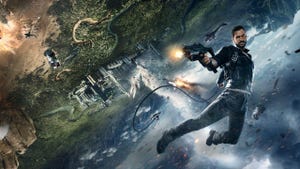
In particular, sandbox games such as Crackdown and Assassin's
Creed (as we shall go on to discuss) have not only culled free running
moves and movement but also its whole approach to interacting with an
environment. This has led both titles to not only create massive explorable
cities, but also to re-think how their players can interact in those
spaces. They reflect free running's desire to rediscover and re-imagine
their drab city environments, and find fun and play in these spaces.
|
Comments
But regardless, I myself perform parkour when I have time, and it is rather enjoyable to move through your environment free of the constraints of sidewalks and stairwells.
It is cool that you are given more freedom with your environment in many of these games. I always marveled at the acrobatics from Tomb Raider and Prince of Persia. I have yet to play Assassins Creed or Crackdown; and from what I've read of Prototype, it will have similar mechanics. This is all well and good, but I don't foresee games surviving on play mechanics alone. It's great that we are finally learning how to allow players freedom of movement through their environment, but what about freedom of expression through their character? Or freedom of exploration through human emotion? Or freedom of definition to write your own, personal, unique story in a game.
I'm going to stop before I start rambling. My initial comment was just supposed to be "it's cool that they are drawing on Parkour for inspiration in play mechanics. It's weird you didn't discuss the actual game, 'Free Running,' by Reef Entertainment and Rebellion, and how well they did or did not stay true to the spirit and nature of parkour."
So it's a little too familiar by now. Assassin's Creed, Mirror's Edge, Prototype... but you know what? It doesn't bother me: If a game benefits from usng parkour as inspiration, and as a reslt overcomes clunky, unflowing, amateurish movement systems, then it's a win for the player, no matter how "sold out" or "last year" parkour is considered.
It's great to see someone else notice how paedaic parkour is, and that the joy of it comes from the proprioception and creativity in path finding - there's an intrinsic joy in the flowing, un-interrupted movement, which some games capture better than others. Whether or not this intrinsic joy is a focus is, I feel, kind of unimportant (certainly, I'd personally prefer it that way, but games are a transcendental medium, and can't rest on one leg alone). Whether fluid motion is the target of the developer, or merely an means to an end, the game will still benefit when there is more thought put into avatar movement - typically one of the core verbs in any first/thrd person game, and thus a bridge for a player into the rest of the transcendental experience.

Whether or not a game perfectly captures the look *as well as* feel of parkour, also, feels irrelevant to me. To me, Quake 3 (noteably the defrag mod) captures the "spirit" of parkour with its model of continuous movement, strafe jmping, plasma climbing and rocket jumping, while Assassin's Creed merely attempts a faximilie of (some of) the moves used (and successfully so). Quake 3's simple, but complete verb set allows for expression, creativity, and skill to be channelled into gameplay. Assassin's Creed, with its well hidden animation states and discrete, contrived movement gives a different perspective - what's it like to have mastered movement to the point that one doesnt consciously think in order to traverse the scenery? Surely then, one is only concerned with the route - means become fairly irrelevant. The destination is all.
I guess my point is that one should be more concerned about how the movement system fits with the rest of the game, and how the level design promotes it, than whether or not it matches the varios splintered philosophies within the freerunning/parkour community. A parkour implementation can be as realistic as yo like, but if it's a pig from a useability stand point, what's the gain?
A quote under "Free Running" states: "You have to make the difference between what is useful and what is not in emergency situations. Then you'll know what is parkour and what is not. So if you do acrobatics things on the street with no other goal than showing off, please don't say it's parkour."
There is a subtle difference, I believe, between free running and parkour. By the above definition, Assassin's Creed is more parkour than free running.
First, congratulations for the article, like Joel said its a nice discussion. But my comment is mostly about calling "competitive" the way that Parkour is taken in Assassins Creed. (I will use the word Parkour, since Free Running for us means something with a totally different philosofy and I have no interest on it).
First, let me say that Parkour was created by a former firefighter and member of marine corps, David Belle.
It has been taught to him by his father, who fought on Vietnam and used his skills to survive. He had to be fast, he had to be efficient, he had to use whatever his body could do to survive.
I have played a bit of Assassins Creed, about 2-3 hours, and I must say that I was impressed on how techincal the "parkour moves" were represented in the game.
When Parkour is called a non-competitive activity, we actually mean that you should not train to be better than someone else. You should focus on yourself, the competition is with your own limits while training and evolving to be a better person (phisically and otherwise), and thus becoming strong to use your skills in a emergency situation.
That being said, I must say that parkour has been represented very good in this game. I have also played Crackdown and I did not like the way Parkour has been represented, not only because the limitations on the movement, but also the way its being seen as a "sport to jump from building to building".
And by the way, Erwans last name is "Le Corre", and Hebertiste is his nickname on the forums.
I hope you could understand my comment, english is not my first language.
You must have read entirely different article. :) This one doesn't mention Mirror's Edge (for valid reasons, but still). As for the other part: developers might have been inspired by parkour but that doesn't make Crackdown parkour game. "Willow" was inspired by "Hobbit". ;) Please play Crackdown or watch gameplay videos - urban environment + agility skill don't make it free runing experience (it's still great gameplay mechanics IMO). Just a thought. BTW: I still love Crackdown. :]
"This would substantially change Assassin's Creed, focusing it more authentically on true Parkour pursuits."
The game is about an Assassin and a great plot that unravels while you play. The developers were inspired by it and made playing with Altaïr a lot of fun by running through the city. However it's still a portion of the overall experience. It's *not* a parkour game in my oppinion, just inspired by the moves of it.
In any competitive FPS, you always need to greatly control your movements and tricks passing by a crouch jump to a rocket or grenade-jump.
Great point.
Parkour is all about optimizing your run. Become faster, more efficient by using your environment or developing your own body.
Parkour isn't a new philosophy in itself, but it's clearly a different life path that I like.
Login to Comment