|
How
early on did you decide on the look of the game?
NC: It was early on. We wanted to make a
statement in the fact that the game felt very different, and very unique. When
you see a screenshot of Mirror's Edge,
you know it's Mirror's Edge. It just
doesn't become another first person game.
There are a lot of great games out
there, but sometimes it's difficult to distinguish between them and us. That
was a statement that we wanted to make very early on, and we've really tried to
do that throughout the game. "How can we make this very different?"
How much has the game turned out to be the original pitch and
design concept, or evolved into something by necessity?
NC: I think the greatest thing in what we
did is that we spent a lot of time in white box, that we really proved out what
we were doing, very early. The levels were then built out from that. I think
had we built a level and then built mechanics around that, we probably would be
in a very different situation today than when we started.
I think the whole concept was to build a
game around movement, and that's still the same. We've created so many
different mechanics, with puzzling, exploration, speed. Also, then, we have
these chase mechanics, where you're being chased down by the cops, and you're
really trying to get away, and then there's obviously combat, as well.
So we
really wanted to build that variety. All the levels have that beat to them,
where it's changing the mechanics that you enjoy.
But I think, coming back to your question,
that the game has really been true to what we set out to do, and that's really
because we proved out the basics early on.
Did
you have to adjust your designers and development teams? It's pretty different from your past games;
not only in the fact that it's not really a shooter, but also in that most of
your past games have been multiplayer.
NC: Yeah. And I think that's a good
challenge for us; that was something that we wanted to do, and I think it's
great for everyone on the team to do something very different. So, yeah, we've
learned a lot.
You know, none of us would claim that it's
been easy. It's hard making something like this. It's hard doing new IP; there
are challenges along the way, completely. So we've learned a lot which will
help us, but I come back to the same point, which is: we were very specific at
the beginning to get the specifics right, and that's the one thing that we've
learned. That's the best thing that we did, to focus on that, and build a game
around the core mechanics.
This
is a pretty open question: Is there anything that you did carry from your past
games, in terms of things you learned from designing the Battlefield series?
NC: I think it's just looking at what
you've got, looking at where your strengths are in your game, and in your
mechanics, and building the levels out around it. And the fact that we could've
gone open world, we could've made a game that felt very open, but we went for a
more linear story, and we went for a more level-based game -- and the reason
for that was that we wanted to pack as much action in as we could.
As soon as we'd have gone open world, I
think that would've watered it down. So I think that was one learning, in the
fact that a lot of people think, nowadays, that open world's the way to go, and
it's the next-gen thing -- I don't think I believe it is.
It's clearly right
for some games, absolutely, but you can actually get a lot more in, at times, in
more of a level-based [game].
You have to give a choice; it can't be
just, "Do this, do this," you know. And that's what we've done: We've
built every level out to have lots of choice, and I think the thing that we're
really pleased about is that, actually, the amount of choice in every level is
just limited to your imagination. Which really plays in the movement, and the
parkour elements that we talked about.
|
Also so intersting to play! And the fact that when you seea screenshot of it and you know that it is it is also true and really intersting, I wish I had talent to do things like that!
But he's so dead on about being creative. I love DICE and EA for taking this chance. And it has paid off. It will catch on over Christmas season and into next year.
Simplicity is totally correct too. I feel like it's stupid to use half the moves in Ninja Gaiden when there's no real use for them. That's a waste of development time making those other moves people don't care about. By making the core controls as simple as possible while still giving them some modifiers (like lifting your legs mid-air) they've made something perfectly accessible for the mainstream yet refined enough for the core crowd.... This game works from so many angles. Game over
This attitude is consistent with what I've recently started hearing from many gamers. Especially after the success of EA/BioWare's Mass Effect, I've noticed many more people claiming that third-person perspective -- seeing their character in the gameworld as though from a flying camera -- is somehow more immersive than having the view of the gameworld presented to the player through the character's eyes. Indeed, as noted in a recent Gamasutra story (http://www.gamasutra.com/php-bin/news_index.php?story=20652), even EA CEO John Riccitiello tried to insist that Mirror's Edge be redesigned to be third-person, apparently because he too has accepted as conventional wisdom this notion that third-person perspective is "better" in some way.

Yet to me, this belief seems completely backwards. Why does anyone believe (much less insist on as though it were a fact) that having the gameworld presented to you as though you are in the body of your character is less immediate, less gut-wrenchingly visceral, than a presentation in which your character is just another object in the gameworld as seen from the perspective of a bodiless observer?
Because first-person perspective naturally seems to me more immersive than third-person, when I first heard about Mirror's Edge and DICE's decision to go first-person I didn't question that choice at all. It seemed like the obviously correct design direction for this highly motion-oriented game.
And that's why the expressions of surprise and repeated questions by the interviewer on this one facet of the design of Mirror's Edge struck me as strange. In fact, the emphasis on the first-person design even became annoying in that this meant fewer questions were asked about the truly unconventional design decisions by DICE, in particular the conscious choice to support and even reward non-combat play in a marketplace full of "kill it and take its stuff" games. That question did come up... but only in reference to how it deviates from the conventions of some other first-person games.
I'm not claiming that the interviewer was "wrong" in some way. What I'm trying to point out is that not everyone (gamer or game designer) always finds third-person perspective more satisfying than a first-person view. Game designers -- and game journalists -- should be careful not to assume that third-person is somehow the "right" or normative choice for all character-centered 3D games.
My line of questioning was not based around a personal preference, it was based around the perspective being an unusual choice for this genre of game. I in fact prefer the first-person perspective, and admire the usage of it in this game. I was asking those questions out of a sense of curiosity in the design process leading to that choice, not out of an implication that third person would be more fitting or correct.
My impression still stands that many developers and gamers have decided that third-person is the new norm for character-based 3D games, but I appreciate your pointing out that your numerous questions on the subject weren't driven by that assumption.
In some people's cases (such as mine, unfortunately), first person games are less immersive because they can cause motion sickness in people susceptible to it. Nothing quite ruins involvement and immersion when you've got to look away with the pause button on for extended periods or turn the game off after 5-10 minutes :/
I really hate the tendency towards motion sickness because I keep missing out on really amazing games because the design choices mean I can't play them. I mean, I love the concept of 'living' in your character's body like that and I desperately want to play this game -- they're *interesting* design choices -- but I also know they're ones that make me unable to play it, personally.
(Penny Arcade's most recent comic is exactly on that topic, IIRC.)
I think of hybrid systems like Gears of War where the controls are FPS-like but the viewpoint is third person to be a good compromise for me. In the future I hope we'll see most games let people choose which camera type they prefer.
Is there any research on videogame motion sickness? Some games are worse than others for people and I wonder why that is.
In my own experience, I've always appreciated third person views in their ability to connect and immerse me with the personality of the character, with first person views immersing me more into the world, feeling like I'm actually there and directly being the character. Max Payne is enjoyable because Max Payne is a ridiculous and awesome action hero. Doom is enjoyable because “you” are fighting against hellish demons in an eerie and abstract world that's gradually becoming corrupted. Games that have a blank slate character in the third person view, like Baldur's Gate, or a strongly established character in the first person view, like Half Life (more or less...) have always been more challenging to my enjoyment (even I have my own exceptions, though, like Planescape: Torment or Duke Nukem).
I'm sure both can be used together to more effectively tell a story. It's cool to see your character standing heroically over an impossibly high bridge looking into the sunset, but it's also cool to slowly creep up and look over the edge of that bridge. As mentioned, we can let the player switch between the two views themselves and discover such perfectly framed vistas themselves, but I think a games enjoyability could be greatly enhanced by building in such moments by design.
Once you have the ability to control the camera you really start to notice it. Playing EverQuest was probably my first time I really noticed how having different camera views available affected my immersion and attachment to the game. I played it almost exclusively in the first person, but that's because my character was a blank slate, the character was an avatar for myself, and the fun was being immersed in this fantasy world.
The only game I've played that used both first and third person cameras, and seemed to use them with a very focused intent behind the design for dramatic and emotional impact, was Shin Megami Tensei: Nocturne, where most of the exploring/combat was in third person, but most character interactions were in first. It's still a limited implementation, but it was blatant enough to intrigue.
All media seems to always toy around with breaking the established view point. Metroid Prime did this well with the subtle but frequent reflections of Samus's face in the visor. Resident Evil 4 and Gears of War as mentioned bringing in the camera and dropping the character off to the edge of the screen.
I wonder how much the third/first person interplay has been explored in books and movies. I've read and watched a fair number of books and movies, but can't recall any that regularly switched between first and third person views. Sometimes a line or a shot switching between one to the other (well, for film it's basically always third to first), but nothing that so explicitly or gratuitously utilized switching views.
as for the immersion aspect... i personally think it is true that one reason to choose 3rd over 1st is complex actions. not just because of motion sickness which can also occur in complex environments. but because of identification. pressing a button, i personally have an easier time imagining myself doing the action when i see the avater perform an animation rather than seeing my avatars arms swinging around in 1st person. this connection for me is only there in shooters. you're holding the controller and your avater holds a gun. that works... ;)

apart from that 3rd person of course gives information about the environment. since that is very important, i would have thought mirrors edge needs this to really convey the joy of movement of parcour. isn't it also more fun to watch somebody do parcour than braking your bones yourself!? so i can imagine that a switch to first person in certain situations might be helpful. but for action in large environments i personally prefer 3rd person. i imagine making your way up a television tower, then jumping from the top - good place to switch. either traditional closeup or first-person. to stress the effect.
i am not sure, but i guess this is often done right already. it is just that you do not notice when it is done well. the camera work in ocarina of time e.g. is very good in my opinion. it just occured to me very recently that there actually is something like it even during gameplay.
As for the game itself, I must be about the only person who didn't like it. FP vs TP aside, the demo felt very awkward and contrived (the actual story, of course the tutorial is contrived), rather than an environment that just happens to allow you jump around on it in your own fashion. (Like Assassin's Creed) It also felt a bit like Sands of Time in that it was 'Platforming now, Fighting now, Platforming again, etc.' rather than integrating it into a struggle for survival. Yes you can run from enemies, but just jump a gap and that's it. Maybe the game will develop it later but there was just something that felt very clinical in it all. Like it's just a tech demo.
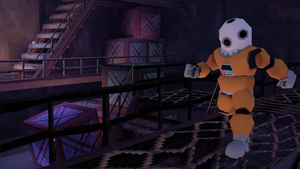
Mirror's Edge desaturates the world as you come closer to death; that sort of implementation wouldn't have the same effect in a 3rd person view. You're no longer looking through the character's eyes. The sensation of movement through gaps and over obstacles wouldn't be the same, either.
I can only applaud the great strides being taken to make better use of the camera in games. Like different angles and lenses being used in movies, the various pros and cons of the extensive range of camera types available in games are being explored and expanded upon.
As technology advances and experimentation continues, we are going beyond simply deciding that one view is better than another, and creating something special that couldn't be done any other way.
I agree with you about games like Baldur's Gate which sacrifice world immersion due to technical limitations. However, I disagree entirely about Half-Life: Gordon Freeman _is_ a blank slate, the HL games are all about world immersion, not character attachment (at least, not attachment to the player character). I mean, the Freeman character's lack of development is basically a long-running in-joke.
But the interviewer shouldn't be "fascinated" by the use of first person as a "design choice rather than a genre." Yeah, "first person" is normally followed by "shooter," but we've had shooters that aren't first person (Gears and GRAW come to mind right away), and we've had first-person games that aren't shooters for a very long time. Oblivion isn't a shooter (neither is Fallout 3, even if they try to tell you that it "can be") and it's first-person. Thief, from 1998, is clearly not a shooter. The "Eye Of The Beholder" series in the early to mid 90s (I think) were first-person and you were controlling a whole group, not just a single character. And those old gold-box AD&D games had first-person dungeon exploration, and they go back to the 80s, before first-person shooters even existed.
So I'd say we've always had first-person as a design choice. What's interesting here is that platforming is usually third-person because of the radical angular changes that the character's head needs to make in order to accomodate acrobatic leaping and climbing in games like Ubisoft's Prince Of Persia series.