|
Can you point to just any examples of recent games you've found to be meaningful?
JB: Well, there are the art games that I talk about all the time, like Passage, The Marriage, and Gravitation. In terms of bigger games, it is kind of rare. I think Everyday Shooter was definitely a very expressive game, in a very different way from Braid. I talk about that one all the time, too.
The reason I talk about these games all the time is because it's just not often that I see new examples of that. I played a bunch of games from this wave of Christmas games. I haven't played them all.
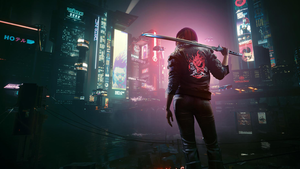
But I played Fable II, Fallout 3, stuff like that. And in Fallout 3, there's one section of the game that people comment on that feels kind of personal and emotional, and it's not the stuff that's supposed to feel that way. It's not the stuff with your dad at the beginning, or trying to find him. That all feels generic.
It's when you find this abandoned camp that's now got monsters in it, but there are these stories of this nurse trying to hold it together right after the bombing.
And you think, "That was really a touching story that I just found out there." And it wasn't actually the game. [laughs] It was just this little pre-authored story.
BioShock had a fair amount of that outside of the critical path.
JB: In the little dialogs, yeah. I can't really count that as an example, though. It's a neat thing that they did, but it's not the game.
The gameplay in Fallout 3 is shooting a guy in the head and watching his blood fly everywhere, right? Or the dialogue paths, of which it seemed there weren't that many.
As you suggested, it still isn't clear what even the basic framework for expressing meaning through a game actually is. At this point, if you're trying to deliver a story or message through a game, most are still doing it in a filmic way. You have the gameplay, and then you have the presentation layer, but they usually aren't intrinsically tied.
JB: We have a model that's somewhat successful now, right? We have these story-based games, like Fallout 3 or Gears 2.
And we know how to put a story in the game in waypoints, and you play between pieces of the story. And there's a certain kind of structural way in which that works well.
You want to know what's next. The stories act as a reward for playing through certain areas. So that's your reward structure.
But it's a problem, because there are things about the fact that it's a game at all that interfere with the kind of story that you can tell and what you can do.
Stories in games are typically not good, right? We just know that. I think part of that is because we don't try very hard, or we don't really have people that competent doing it.
But part of it is that even if we did -- even if we had really, really good writers doing this stuff -- it's still really hard to do a good story in a game, because of the game part.
To give a really simple example: almost every game we make now is challenge-based in some way, right? Unless you're talking about Wii Music, there's some goal that you have to meet. The player is here, and wants to go this way. The game's challenge pushes back on him, adding some friction. You want the player to get through the game eventually, but that challenge slows them down or makes them go in a circuitous path.
That's half our game, this challenge element. In story-based games, the other half is the story. And the problem is that story needs to go [the opposite direction challenge does]. Because stories have pacing. They have an order of events that happen.
So the challenge part is trying to hold the player back and keep him from getting to the next segment. But the story part wants you to get to the next part in order to keep going. This structure doesn't actually work, because these two fight each other. You try to balance them, but usually one of these is going to be more strong than the other, and that's the direction you'll feel more of.
Often in games, the designer says, "Oh, we don't necessarily need challenge. We need the feeling of challenge, without actual challenge." So then, if there are puzzles, we make them really easy, or if there's combat, we make it really easy. So then the strength of the challenge force gets smaller and smaller.
Those lead to experiences that don't feel that worthwhile to me. God of War, for example, is a game a lot of people like. I don't really like it, because I just feel like I just started mashing buttons and all the enemies die.
Fable II is the same way. Fable II's combat is not actual challenge. It's just there to feel like combat. But I don't feel like there's a reason to do it, because I know that I just hit these guys with the sword a few times and they'll just die.
I think this is a problem because, in terms of what games have to offer us, we're not giving people the greatest stories ever told. What we can give them is experiences that challenge them or invite them to do something that they haven't done or whatever.
But we're decreasing this challenge element more and more -- challenge being the new thing that we have to offer over other media -- in order to try and increase this story element. And I think that that might be the wrong trade-off.
If we eventually become no interaction and all story, then we're just a bad movie, right?
|
I really appreciated Everyday Shooter too, as Jonathan mentioned. It's got that screenshot problem as well, but to a greater extent. The screenshots look uninteresting, but it's also not very interesting to watch if you aren't playing it, since a lot of the good vibes you get out of it have to do with the rhythm you have with the controller and the game.
Anyways, very interesting interview. Makes me wonder what stories and challenges in games will be like in 10 years...
Maybe this is even illustrated by Braid, where the whole game is one big god mode.
However, in a game where the challenge isn't derived from "not dying," god mode does not remove the challenge.
Looking back on that I sound like a Valve fanboy, but those are just examples that spring to mind.
Anyway, on his "potential new project" I'm interested in seeing where he takes dialogue trees. We've been discussing it here recently and I think most people agree that there is much room for innovation.
From what he says I think he's overcomplicating it a bit, looking at how to change it under the hood when reworking how things are presented could be more effective, but I'd like to see what he comes up with.
Something I've been attempting is using a "moral premise" that acts as the foundation for both gameplay and story. This moral premise is a moral statement of right and wrong, something like, "quitting responsibilities leads to despair, but pursuing responsibilities leads to happiness." From that moral premise, you form the gameplay, characters and story that will let players explore, experience and hopefully agree/learn from it.
Similarly with games, we shouldn't see the challenge vs. story conflict as a fatal flaw, but rather just as a problem to be solved. Puzzle games provide hints, God of War provides difficulty adjustment, etc. etc. Alone in the Dark had the DVD feature thing. None of these are perfect, but they deal with the issue in a practical way, ensuring that most - not all - people will get the optimal experience.
I'm interested in what Blow said on indie developers vs. corporations. And I think he's right. In some ways, its better for the gaming press to hype your game for you than to overhype it. But all the same, its tougher, because if your product isn't that great, it reflects back on you. Sometimes its nice to have that corporate protection.
However, these are partial fixes and the whole problem remains deeply anchored.
The observation is correct : challenges and story are fighting against each other. But I don't feel Blow is giving solutions, except the one that consists to omit the story. Don't put in dialogues, don't use branching narratives, ... well, don't use narrative at all and it will be more pure, like the good old Super Mario Bros III. Wooha.
But is that really what people wants today? I also dislike stories in games and how they are usually integrated, but no one can't deny the hype surrounding games like MGS4, Gears of War 2, ...
So, why does this work, can't you ask yourself?
Is Ubisoft's three-game Prince Of Persia arc forgotten? They made three games that were all about a character rewinding time to undo his mistakes and finally taking responsibility for his actions instead of using magic to fix everything. No slight to Braid or anything, but "you can rewind time" has in fact been done before and certainly isn't completely exhausted by one title.
Games have the added challenge (opportunity?) of 'audience' input, and the audience is singular since the capacity for input is singular. The audience becomes a subjective participant rather than an objective viewer. The trick seems to be engaging both sides: the imaginative with no center or point of reference other than the media itself, and the participatory side where your activeness as a player is essential.
There seems to be a focus on one or the other, usually, but I think both are essential. This could be a non-issue in multiplayer games, since the imaginative side is taken care of by the setting and the 'story' becomes your interaction with other players. One way to tie the two together in singleplayer may be to have a story play out among AI players with the player involved in some way through relationship. This would take some creative use of AI like Seth said earlier about Left 4 Dead's AI Director.
Braid explores this in one way, as do the art games he refers to. I don't doubt Blow will continue exploring in future. As he says, interactivity and challenge are the strengths of our medium. Ditching them for story doesn't seem the right direction to go.
For a small game such as Braid, this metaphor resonates easily with players since there are few other elements clouding its purpose and its relevance. Unfortunately, for games that try and do the whole open-world thing, or incorporate many different types of actions or object manipulation or whatnot, most game elements are not as fine-tuned or are not treated with enough care to be well-represented.
Referring to a comment made above, Derek Rumpler points out the distinction between a cinematic of kicking in a door in versus the player actually controlling the kick. One passive, the other immersive. For those familiar with how often this action exists in the Gears of War campaigns, Epic uses the former. The player pushes X and is treated to a short cinematic of Marcus Fenix kicking in a door.
The experience is completely binary, without a variation of the degree of power of the kick, how far the door opens, or whether or not its blown of its hinges. Compare this then to the active door mechanics of say, Mirror's Edge, and the experience is both more memorable and immersive (though still not perfect).
The bigger the game, the more details need to be accounted for (and the more unlikely each action will receive its adequate fine-tuning), but even a game like Gears of War which has a relatively small set of gameplay mechanics can account for these small detail experiences.
Until games can account for even small detail actions being immersive, we will simply be pushing buttons for the sake of seeing a movie at the end.
As a gamer, I want to keep playing this type of games that really CHALLENGE you to go on and learn more from it.
Both thumbs up!