|
[In this in-depth article, veteran designer Davies looks at games from Call Of Duty 4 through Dead Space to analyze the art of game level pacing.]
Introduction
"Pacing" is
a word bandied around a lot when talking about level design, but it is actually
a very complex concept to pin down. Just how does the pace affect the player's
perception of the level and what is it that sets a well paced level apart from
a poorly paced one?
The Fundamentals
With these questions
ringing in my ears I was determined to try and delve a little deeper into just
what constitutes level pacing, but I found very little literature on the
subject. Instead I decided to focus my efforts on breaking down the core
elements of what determines pace itself.
In doing so I
identified several key aspects of game pace:
- Movement
Impetus -- the will of
the player to move through the level.
- Threat -- the notion of danger.
- Tension -- the atmosphere and mood of the level
or perceived danger which is reflected in the player.
- Tempo -- the level of actual action currently
being experienced by the player.
Movement Impetus
Movement impetus is
the will or desire of a player to move forwards through a level. There are
several ways in which the player can be pushed into moving or stalled from pushing
forwards in order to affect the movement impetus and thus the pace of the
action.
There are many
elements that increase impetus to move:
- Introduce
a threat from behind --
as long as the threat is significant it will cause the player to want to
move away from it.
- Present
an objective ahead --
dangling the carrot is one of the most effective methods of encouraging
movement. A clearly defined goal is vital in creating this urge to follow
it.
- Impose
a time limit -- quite
obviously the restriction of a time limit will encourage the player to not
hang around. Too many imposed time limits can be extremely frustrating
however.
- Narrow
physical options -- limiting
the space in which to travel -- i.e. long corridors as opposed to open
spaces, limits the amount of choice available to the player and in turn
increases the speed at which they tend to move.
- Draw
the eye -- items of
interest will pull the player towards them. Judicious use of these will
help to pull the player through parts of the level. Bear in mind that once
they reach the item of interest they are likely to pause at that point.
- Architectural
pressure -- specific
forms of architecture promote movement. Walls that angle down, long
corridors, junctions, etc all have psychological impact upon the player.
- Snatch
desired object -- taking
away a desired object will often trigger the player into chasing after it.
- NPC
leads the way -- having a
third party lead the player though the level will nearly always directly
affect the movement impetus.
Continual movement
keeps the tempo high, but it is undesirable in many ways. Often players want
time to take stock, catch their breath, formulate a plan or even just soak up
the atmosphere -- it provides a break from constant travel. Also in production
terms continual travel often requires much more real estate in which to move --
this is both a production risk and possibly a technical issue.
Conversely there are
also many elements that decrease impetus to move:
- Wow
moments -- stunning
scenery, dramatic actions, impressive vistas or other elements that halt
the player for a while.
- Obstacle -- something blocking the progress ahead
will decrease movement impetus and force the player to find a way around
or a way to clear the blockage.
- Altered
movement -- a different
movement method may require more thought, such as scaling walls via
handholds.
- Introducing
a threat ahead -- a group
of enemies ahead, a flaming pit or any other potential threat will slow
the player whilst they plan to deal with it, then execute said plan.
- Increased
tension -- when tension
is particularly high (usually through a high perceived threat and good
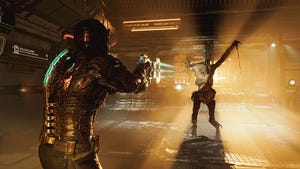
atmosphere) then the player will often be fearful of moving quickly. Dead Space is a classic example of
this -- many players tend to move slowly to ready themselves for sudden
attacks.
- Multiple
Routes / Open World --
choice requires thought and thought slows movement impetus. Multiple
routes and open world games offer a plethora of choice. Perhaps the
ultimate example of slowed impetus is the moment when a player exits the
sewer in Oblivion and sees the
huge expanse of the world before them. It takes a moment or two just to
take it all in.
- NPC
halts player -- just as
an NPC can lead the player, they can also halt the player or slow them
down.
- Taking
stock of inventory (collecting items) -- whenever a player encounters an item they are likely to slow
down to investigate. Complex inventory systems will also require
management that will slow movement impetus. Further still -- having
collectible items in the first place will encourage exploration.
- Dialog
/ Roleplay -- moments of
dialog with NPCs or getting into the character will generally require more
involvement from the player, and will thus slow movement impetus.
- Story
exposition -- generally
the exposition of story will require the player's attention and will thus
slow movement impetus.
Constantly slowing
movement impetus can also be dangerous, as it can prevent the player having a
feeling of progression. A balance needs to be struck in providing a sense of
movement and accomplishment and allowing the player time to themselves to
explore, soak in the atmosphere or to take stock of their situation.
Threat (Actual Danger)
The pace of the game
can also be increased by the sense of peril that is experience by the player.
The more threat the player believes they are under, the quicker their pulse,
the more nervous and often more panicked them are.
Threat can come in
many forms -- each form having a different feel of pacing. For example combat
tends to be more frantic and higher paced than traversing an environment, even
though the end result -- death -- could potentially occur in either situation.
Generally the level of
threat felt by the player is determined by whether the threat is being caused
by an external force -- an enemy, an encroaching hazard, etc, or whether is a
danger that will result from the player's own mistake. Threats from external
forces tend to have a much higher level of pace than those that will result
from a player's mistake, as they have time to gather their thoughts and create
a plan when they have control.
Proximity of a threat
also has a huge influence on the feel of the threat. An enemy at a distance is
not nearly as threatening as one very close by. This is something that stealth
based games can really use to their advantage (and is something that can also
build a great sense of tension).
Adding a time limit to
a task automatically increases the level of actual danger, as the control the
player has over the game world has been reduced -- there are now limits placed
upon them which can induce a level of panic.
|
One point I took from this article that really makes me think, is using the language of formal music to describe level design - not that musical analogies work in all examples, but that music has a language to describe these things, but gaming does not. With (video)gaming being only a few decades old, this is understandable, and does not need a forced correction, but it will be very interesting to see how the language of game design evolves in the future years. For now, however, I think musical terms make a great analogy.
Many of your Threat analysis moments just take the moment into consideration, but what if the player is playing on very easy just to see the story? Then all threat moments of low+ are actually very low. All the tension moments of low+ are actually very low. Movement impetus is always very high.
Now if the player is playing on very hard then any moment, doesn't matter what is happening threat is very high and tension is very high. The only time in that situation when threat and tension are not very high is right after they see a "checkpoint reached", but 1 minute later they have something to lose and their movement impetus is in danger, and thereby the entire pacing of the game is in danger. If a player dies and in a battle and is set back to a checkpoint the movement impetus actually goes in reverse.
So I think difficulty and resurrection methods also have a very large part to do with pacing. If your game is designed for pacing I think it would be in your best interest to not include any difficulty sliders at all. It would also be good to come up with a resurrection mechanic that won't impede the movement impetus by too much.
Everyone that plays your game isn't going to be the same skill level anyway so I think even with the same difficulty for everyone, not everyone will have the same pace. This is a hard solution to fix for an interactive media type, pacing that is, because of the vastly different skill levels that will be playing your game. So I think the answer is in pacing by mechanics that aren't governed by player skill at all. Keep in mind that perceived threat is part of player skill, if they are good at the game or if it is on easy nothing you can do visually or with sound is going to give them the perception of threat. Also keep in mind pacing mechanics like items laying around could very well be ignored entirely by someone that is good or playing on easy because they don't feel they need them at that point.
Planer line drawings of the flow can help people get a sense of what to expect and strive towards. Dotting the spline with symbols representing experiences described by a simple legend can further aid you in taking your musical score from your noggin to the team.
Maybe it just helps to visualize your levels like an Opera piece. If you can internalize the level in your head and especially in your inner ear, then I believe you start from a much more solid and palatable footing.
Cheers, for writing this. I especially like that you took the extra time to create the breakdown of the CoD level. Watching the video and reading your notes side by side was very helpful in picking out the importance of things that may have seemed purposeless without this exercise.
One point of disagreement though:
"Introduce a threat from behind -- as long as the threat is significant it will cause the player to want to move away from it."
Well, in my experience players always first move _towards_ a threat, even a significant threat, unless it's an obviously unbeatable environmental one on the order of rising lava.
And you haven't mentioned the most significant way to guide a player through a level: leaving a trail of enemies for them to kill (of course, this doesn't necessarily apply, some games with progression through levels don't _have_ enemies I suppose, but it's common enough to be worth mentioning).
I like to think that levels are pieces of music, and the game (the whole single player campaign) is an album or an opera. It's not just the level that should have a carefully crafted pace, but playing through all the levels should create a good sense of rhythm and integrity. It's not just a matter of creating different levels; each subsequent level should have something to do with the previous one, giving something to the player that ticks him to keep playing the game. If the levels are not crafted together, the player loses interest if the levels are repeating themselves, or gets confused, and consequentally bored, if the levels are totally different from one another.