Our Properties: Gamasutra GameCareerGuide IndieGames Indie Royale GDC IGF Game Developer Magazine GAO
My Message close
Contents
Art For Art's Sake: Why Your Studio Needs An R&D Team
 
 
Printer-Friendly VersionPrinter-Friendly Version
 
Latest News
spacer View All spacer
 
February 23, 2012
 
Interview: Silver Dollar uses XBLIG for its mad experiments
 
Last year's Supreme Court case on games cost California $1.8M [6]
 
GDC 2012 details Moriarty, Della Rocca, 'Rant' sessions in Education Summit [1]
spacer
Latest Jobs
spacer View All     Post a Job     RSS spacer
 
February 23, 2012
 
2K Games
Public Relations Manager - 2K Games
 
2K Marin
Level Designer
 
2K Marin
Senior Rendering Programmer
 
Zindagi Games
Presentation/Game Programmer
 
The Workshop
Art Director
 
Blizzard Entertainment
Senior Software Engineer, Tools
spacer
Latest Features
spacer View All spacer
 
February 23, 2012
 
arrow Postmortem: Days of Wonder's Ticket to Ride Pocket [1]
 
arrow Sponsored Feature: Canada - Scoring High as a Game Nation [3]
 
arrow The Vita Interview [19]
 
arrow Gamification Dynamics: Identity and Story [7]
 
arrow What Makes Social Games Social? [3]
 
arrow Will Tablet Game Quality Soon Leapfrog Consoles? [27]
 
arrow Tearing Down Barriers: How to Bring MMO Players Together [10]
 
arrow Withstanding the Collapse of the Middle [4]
spacer
Latest Blogs
spacer View All     Post     RSS spacer
 
February 23, 2012
 
Piracy and the four currencies [5]
 
The Secondary Costs of Outsourcing [10]
 
Sixty to Zero [4]
 
The Combinatorial Itch [5]
 
God Games and the Superman Complex [13]
spacer
About
spacer Editor-In-Chief/News Director:
Kris Graft
Features Director:
Christian Nutt
Senior Contributing Editor:
Brandon Sheffield
News Editors:
Frank Cifaldi, Tom Curtis, Mike Rose, Eric Caoili, Kris Graft
Editors-At-Large:
Leigh Alexander, Chris Morris
Advertising:
Jennifer Sulik
Recruitment:
Gina Gross
 
Feature Submissions
 
Comment Guidelines
Sponsor
Features
  Art For Art's Sake: Why Your Studio Needs An R&D Team
by Jolyon Webb [Game Design, Visual Art]
9 comments Share on Twitter Share on Facebook RSS
 
 
October 20, 2010 Article Start Page 1 of 4 Next
 

[Blitz Games Studios' (The Biggest Loser, Dead To Rights: Retribution) art director Webb shares lessons and experiences in applying R&D strategies to art, unifying tech and tool chains with artists to create a tighter visual ship.]

I trained as a traditional artist and have worked as an artist for more than 20 years now. The last 12 years have been in the games industry. As soon as I was in my first games job I fell in love with it. I'm constantly fascinated by the way game development requires a crashing together of right and left brain thinking to make art and tech gel together and strengthen each other.


Over the years a lot of my focus has been not only on driving the aesthetic quality of games upwards, but also on constantly improving the means to achieve that quality and then pushing the potential to do more.

This means thinking across boundaries, looking at art, tech, and tool chains together with the aim of driving improvements wherever they can be made.

My current role as R&D art director for Blitz Games Studios allows me to pursue exactly these goals, and I want to share some of our recent experiences with you in the hopes that you can benefit from what we have learned.

In the current challenging economic climate it might seem counterintuitive for companies to spend money and effort on anything beyond their core game teams. Nonetheless I am proposing that having an art research and development team that doesn't make paying games is a significant business win.

The R&D team at Blitz came about because our chief executives had the forethought to encourage and support its growth. Its remit is to investigate strategically significant, multidisciplinary issues which don't easily fit into pure engineering development, but equally cannot be explored safely in a current game project.

The first thing to understand about an R&D team is that while many of its aims involve improving aesthetic quality and pipelines, it is absolutely not just a team of artists. It must be a fully-staffed, multi-skilled development team of programmers, artists, animators, and designers, all working as equal members.

What differentiates it from other teams is its broad remit and a mindset focused on problem-solving away from core engine technology or game specifics. Let me explain further by exploring the different mindsets of different teams, and how those mindsets and a team's best abilities are linked with R&D.


Early problems exposed with vertex formats show need to test early and break things away from dev teams.

A strong independent dev studio will have a dedicated technology team. Blitz has exactly such a team. It is exclusively an engineering team -- the largest single group of programmers in the studio -- and has been in existence for over a decade focusing on the studio's crown jewels, our cross-platform game engine that every game team uses.

This is hardcore tech work. These are the devs who code to the metal, get the prototype kits first, and have crafted a constantly-evolving engine over man decades of work. Their mindset is to be highly focused on making the core and low level systems work, on delivering long term core engineering goals and providing immediate engine support on technical issues.
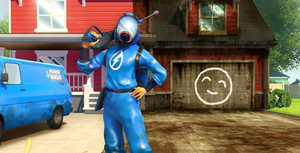
Again, a strong dev studio will have dedicated, creative and professional game teams. These developers have to focus on their immediate project specifics and their ongoing milestone deliverables which are tightly bound to the current game's theme and scope. The game is king; they cannot afford to be distracted beyond the game's core focus. Nor can they risk the project by using too much unproven functionality or tools. Their mindset is highly focused on the best possible delivery to the scope and deadline of the current project.


Moving to a live game's large volumes of asset production works more smoothly when the art pipeline has been researched and tested.

Typically this produces a studio with one mindset focused on core engineering needs, while others are focused on immediate project needs. Clearly both are crucial, but neither allows the space for strategic exploration of techniques and functionality that won't fit comfortably into either engine development or current game project specifics. This is dangerous, as it is exactly this space between the core tech and game specifics that has the potential to give new direction and edge to a studio, allowing it to break new ground and counter problems that arise in development.

What an R&D team can deliver is work that even before it's finished and is still in "kit form" can be used as a business development tool; publishers will always be happier with what they can see than with what you are telling them you can do. This allows you to pitch for projects that previously you would not have been able to go for, and equally to add value to projects that you would probably already have got, but perhaps now with a higher budget.

The traditional method of incremental improvement in game development is to make such changes during the life cycle of a project, which inevitably means that you cannot take big risks. This limits what you can achieve and can result in your game team or even the entire studio being locked into a genre-trap. The sort of exploration that an art R&D team can undertake allows your studio to evolve by building on your existing achievements and opening up inventive new possibilities.

 
Article Start Page 1 of 4 Next
 
Comments

Radek Koncewicz
profile image
Interesting read. I'm wondering if you could elaborate a bit on the funding your R&D team received?

I'm mainly curious if grant requirements ever guided the direction of your R&D work, and if research (whether on open or proprietary technologies) was a prerequisite for the funding and how it affected the R&D goals.

Kyle Horne
profile image
Good idea people get afraid in the production pipeline but having a team dedicated to streamlining everything is a practice more companies should find a way to impliment.

Michael Meyer
profile image
Once the R&D team has made something useful to the studio, do they still handle maintaining it, fixing bugs and making improvements as they are needed? If the game teams do it themselves, how do you make sure everybody benefits from the improvements and fixes the other teams do?

Yiannis Koumoutzelis
profile image
It is ofc imperative to have an R&D team in every dept not only Art especially if you plan to operate in large scale. The R&D team is the spearhead of technological and creative advancement and in my book is meant to explore a breath of expressive and technical possibilities, and allows to unleash the creativity of the team.

Whether a single pipeline team, or for multiple pipeline studio the R&D team will generate creative tools and streamline the pipeline for each production team. What R&D generates in coordination with AD and TD and CD based on production needs becomes a common practice across the studio (or if multiple projects are in progress to each team respectively). This of course is not always possible in smaller teams, that is to have a dedicated R&D team but in order for the entire unit to go forward such need is obvious and in smaller scale operations this is mainly something that leads or other members(depending on size, structure etc.) are expected to do and usually not only during pre-production.

Jolyon Webb
profile image
Hello Guys,

I’ll try and answer as best I can bearing in mind some of the direct business and funding negotiations are not something I am directly involved with and that my background is the Art side of development.
@Radek: Blitz Games Studios over the last few years has managed to acquire funding from both the UK government through the Department of Trade and Industry (DTI) and through European Union Technology funding.
The DTI funding was geared towards making commercial prototypes of innovative systems with the potential of taking these to market if a full commercial sponsor showed interest. We worked in a small group of companies and academic groups on these projects, mostly in a medical field. This obviously guided the research. However the areas we wished to research, primarily engaging display of characters, were a near perfect overlap with what the funding was geared towards so this was a big win.
The European funding was more geared towards development of reusable systems with a slight focus on characters. This funding was used in the Serious Games and R&D teams on character systems work and also was available for the Tech team to work on more general systems tools such as some distributed building of packages and a generic node based editor now used for set up of state machines, shaders, animation blending etc.
In both cases we had to present for full scrutiny at periodic reviews and track manpower and work areas very closely (this was a significant overhead). I do not recall their being a requirement to work on open tech though this isn’t really my field so apologies if I sound vague.
@Kyle: Couldn’t agree with you more about streaming pipelines. This is quite a large part of the philosophy behind an R&D team separate from a Tech team. The streamlining generally needs a more development style team to encounter the problems before they can be tackled and this doesn’t really fit with a main focus on core technology.
@Michael: Yes, we largely support systems we generate and this can become a major load. We operate individual bug databases for our systems and liaise very closely with the core Tech team too. Obviously this introduces some push and pull on the scheduling between research of the new and support of the existing. Working in short focused research sprints helps overcome this. For example we have just come off a four week research sprint and the programming team is going to spend a week or so picking up a backlog of bugs while the art and design team lay in a ground work of assets and plans for the next research block
Thanks for the questions and I hope that’s helped
Jolyon

Benjamin Marchand
profile image
A permanent R&D is always profit generating, indeed, but that profit perception seems too subtle for most big studios nowadays.

Thank you Jolyon for bringing this creative advantage to light. :)

Jeremy Tate
profile image
This is something I drove as a tester with our Tech Art Director at a previous studio. Benefits were huge on the reliability of the art pipeline and thus the reliability of their estimates to deliver content. Once this was in place, I don't recall our art team ever being late for a deliverable.

Tora Teig
profile image
Extremely well put. Having an R&D will drastically decrease so many risks in projects. I dare say this should go for most IT-systems developers, and also for every department in a game studio - not just art!

Thanks for the enlightenment.

Wayne Wang
profile image
Nice article,learnt a lot from it, thx a lot!


none
 
Comment:


UBM Techweb
Game Network
Game Developers Conference | GDC Europe | GDC Online | GDC China | Gamasutra | Game Developer Magazine | Game Advertising Online
Game Career Guide | Independent Games Festival | Indie Royale | IndieGames

Other UBM TechWeb Networks
Business Technology | Business Technology Events | Telecommunications & Communications Providers

Privacy Policy | Terms of Service | Contact Us | Copyright © UBM TechWeb, All Rights Reserved.