My Message close
GAME JOBS
Latest Blogs
spacer View All     Post     RSS spacer
 
May 20, 2013
 
Making 2D Games With Unity [1]
 
All You Need is Love [3]
 
Students: Tips for Learning Game Development Over the Summer [2]
 
All Your Nintendo Let's Plays Are Belong To Nintendo? [86]
 
Even Further Down the Curation Rabbithole [12]
spacer
Latest Jobs
spacer View All     Post a Job     RSS spacer
 
May 20, 2013
 
Sony Computer Entertainment America LLC
Sr. Network Systems Engineer
 
Treyarch / Activision
Technical Animator
 
Amazon Game Studios
Sr. Game Designer
 
Amazon Game Studios
Quality Assurance Manager
 
Amazon Game Studios
Lead 3D Environment Artist
 
Amazon Game Studios
Game Graphics Engineer
spacer
Latest Press Releases
spacer View All     RSS spacer
 
May 20, 2013
 
Conquer Online Holds
World Fighting League
To...
 
SOCIAL GAME STUDIO
NORDEUS CELEBRATES FC
BARCELONA...
 
Ultimate Line-Up of Fan
Favourites Available
in...
 
Ready for some wanton
destruction? Blow some
socks...
 
KIRBY TAKES CENTRE STAGE
ON NINTENDO eSHOP,
WITH...
spacer
About
spacer Editor-In-Chief:
Kris Graft
Blog Director:
Christian Nutt
Senior Contributing Editor:
Brandon Sheffield
News Editors:
Mike Rose, Kris Ligman
Editors-At-Large:
Leigh Alexander, Chris Morris
Advertising:
Jennifer Sulik
Recruitment:
Gina Gross
Education:
Gillian Crowley
 
Contact Gamasutra
 
Report a Problem
 
Submit News
 
Comment Guidelines
Sponsor

  Video: Designing puzzles that make players feel smart
 

February 11, 2013   |   By GDC Vault Staff

Comments 9 comments

More: Console/PC, Smartphone/Tablet, Indie, Programming, Design, Video


GDC Vault offers for free a lecture from the 2009 Game Developers Conference on how to design puzzles effectively to help players feel smart, given by Tiger Style's Randy Smith.

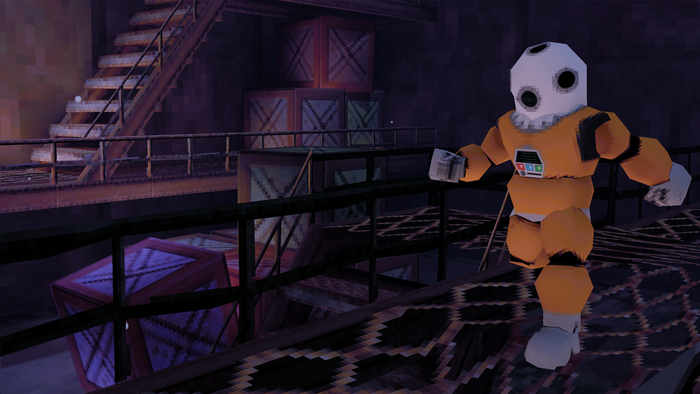
Rather than providing too much advance information or dumbing the challenge down, Smith argues for user-centered puzzles that provide "guidance on demand." He shows Tomb Raider and Portal puzzles as excellent examples that scale to the players' needs and provide more hints only if necessary.

In this presentation, Smith covers puzzle structure along with six principles of user-centered design: visibility, affordances, mapping, visual language, feedback, and conceptual models.

Check out the free video here.

Session Name: Helping Your Players Feel Smart: Puzzles as User Interface

Speaker(s): Randy Smith

Company Name(s): Tiger Style

Track / Format: Game Design

About the GDC Vault

In addition to this presentation, the GDC Vault offers numerous other free videos, audio recordings, and slides from many of the recent GDC events, and the service offers even more members-only content for GDC Vault subscribers. Those who purchased All Access passes to events like GDC, GDC Europe, and GDC China already have full access to GDC Vault, and interested parties can apply for the individual subscriptions via a GDC Vault inquiry form.

Group subscriptions are also available: game-related schools and development studios who sign up for GDC Vault Studio Subscriptions can receive access for their entire office or company. More information on this option is available via an online demonstration, and interested parties can find out more here. In addition, current subscribers with access issues can contact GDC Vault admins.

Be sure to keep an eye on GDC Vault for even more new content, as GDC organizers will also archive videos, audio, and slides from other events like GDC China and GDC 2013. To stay abreast of all the latest updates to GDC Vault, be sure to check out the news feed on the official GDC website, or subscribe to updates via Twitter, Facebook, or RSS.
 
 
Top Stories

image
The laws behind Nintendo's Let's Play crackdown
image
New layoffs reach Trion
image
How developers mess up immersion (you might be doing it wrong)
image
Steam Trading Cards: The next-gen of achievements?


Comments

Maria Jayne
profile image
These are great examples, the Red herring feels especially true for me. Whenever I get stuck it's usually because I believe an object or location which is irrelevant is in fact part of the puzzle. Either because it has an unusual texture or is physicaly mobile.

Making the player feel smart by implying they figured it out is huge though, it's like the freeform combat in Batman Arkham Asylum. While you do need reasonably good timing and reactions to perform well, the majority of the combat looks far more impressive than the activity you are performing to initiate it. This leads to the player feeling/looking awesome. Equally if you solve a puzzle that required some leaps of faith and intuition seemingly on your own without guides or hints it can be very satisfying.

Also: Dark Messiah of Might & Magic....such a great, underrated game. Makes me sad it never got more attention.

Jimmy Albright
profile image
Dark Messiah had 1st person melee combat down, it was so far ahead of it's time. It was so depressing to play something like Skyrim and see that despite all the praise the combat is still not as good as something that came out 6 years before it.

My only complaint about Dark Messiah was the obvious ending, but I still had a blast playing it.

Bart Stewart
profile image
Well, on the bright side, Arkane and Bethesda are now both Zenimax companies, so.... ;)

Who else is curious to see what a new game might look like with tech from id, world-building by Bethsoft, and systems-design by Arkane?

Joshua Oreskovich
profile image
I like the feedback emphasis. But I just can't help but think Portal was way too easy because it was so obvious. It really felt spoonfed, I enjoyed the narrative and and odd puzzles that weren't in whitewashed walled rooms far far more than those that were perfectly scripted. In fact the only reason I didn't feel stupid had nothing to do with the game excluding signals, but really the fact that I was facing off with a rather arrogant and over confident opponent .. which played into the allowance to believe I was smart .. not really a game mechanics thing.

In fact wihtout the narrative this game wasn't even Sudoku level interaction.

This is really the problem, because of this commercial metriced methidology, there was nothing in this game to really actually test me.

Also there were 6 puzzles between both Portal 1 and 2 that even took longer than 5-10 minutes to figure out. The rest was just chasing cheese.

So despite all that effort I did get stuck a few times, and it was these puzzles that made the gameplay worth it. Had there not been at least those 6 puzzles one of which took me about 3-4 hours to figure out I would have balked the entire game ... but I get the impression you seem to think that is failure in game design when in fact it's the only mechanical enjoyment.

the primary descriptions make sense but I think this just comes back to having enough game play logic ... it's especially discouraging to see games designers that feel it's necessary to use ammo symbols on boxes forcing a particular path finding methodology, you have also undermined you're players prospect at learning to learn.. really at all.

I really believe this is a common sense error.

Jimmy Albright
profile image
In the co-op sections in Portal 2 my friend and I actually solved a couple puzzles using unconventional methods.

One of them I remember we solved it by timing our portals so we would collide mid-air, being launched from across map and fall down on the right platform. I'm not sure if this was the intended way or not, but I never found another puzzle that required a similar solution or built off that. My friend and I used to play climbing maps in CS, and were rather good at jumping mid-air around walls and and bunnyhopping. There was 1 or 2 levels we were able to circumvent by finding areas where we could jump and turn mid air around a wall.

Some people might argue that we weren't doing it the intended way but personally I find quite a bit of satisfaction in puzzles with multiple solutions, even if isn't intentionally designed that way.

Daneel Filimonov
profile image
Indeed, that particular puzzle you speak of was intended to be unconventional. I think part of the fun of making (and playing) puzzles, especially first-person is to consider every aspect of the game as a viable mechanic (ie. the "wall looping" or even surf maps in CS/CSS), even when there was no mechanic intended.

David OConnor
profile image
^ Totally agree.

I greatly enjoyed the freedom of Grand Theft Auto: Vice City for the same reason.... the ability to accomplish missions, sometimes by doing things the designer hadn't thought of: the flexibility and diversity of the game's systems allowed that kind of freedom.

Sometimes, walking through a game of scripted sequences can be a bit dull. Achieving goals in different way than the the designers intended is often more satisfying, and makes the player feel smarter.

Like Frank Sinatra says, "I did it my way" :)

Nick Green
profile image
I think most puzzles should have multiple solutions.

Possibly showing my age but I cut my gaming teeth on games like Sierra's Quest for Glory series in which many puzzles were designed with different solutions, catering to fighter / thief / mage skills and playstyles.

Each alternate solution can make a game seem a bit less linear and a bit more interactive.

Marvin Papin
profile image
About the speech, and not portal... I just wanted to say EXCELLENT.


none
 
Comment:


UBM Tech