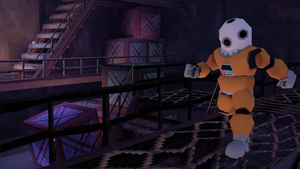
[In this opinion piece, Gamasutra publisher Simon Carless muses about what it would be like if bad guys ruled the world of games -- and, heck, who are the bad guys, anyhow?]
"This was a triumph -- I'm making a note here: huge success."
As everyone knows, the one truly memorable character in Portal was GLaDOS, the deranged AI in residence at Aperture Science. As a first-person title with a relatively anonymous lead character, GLaDOS is the character I keep returning to -- because she's funny, and unexpected, and beguiling.
So it got me thinking. Could a game work starring the homicidal computer as the lead character? You could argue that this would make approximately as much sense as a 2001 sequel starring HAL. Yet games work in a very different way narratively to films, so that flippant comparison may be a little, well, flippant.
As a result, I've been starting to question the meaning of the antagonist in games. Could there ever be a game that makes you play the bad guy in an existing franchise, but changes the gameplay accordingly alongside the perspective shift?
Luckily, we've asked a similar question before, and the answer tends to be that it's the mascot-style games in which this happens. Some of the earliest examples are the most interesting -- after all, Donkey Kong is the antagonist in the original arcade game named after him, before switching to protagonist in Rare's SNES platformer series.
While we're discussing Nintendo, Wario is probably the best example of video game antagonist turned protagonist -- and it's particularly fun because his games reflect his dastardly nature. But he is essentially a Bizarro Mario, with fairly conventional mechanics to match. Oh, and Dr. Robotnik's Mean Bean Machine is deliciously tangential, but still... tangential.
Appropriately, one of the most interesting protagonist/antagonist flips, albeit not so direct as the above examples, is the Gearbox-developed Half-Life: Opposing Force, in which the player is one of the enemies from Valve's original Half-Life. There are no major gameplay changes, but it's an altogether less cartoon-y way to switch perspectives.
There's also Triumph Studios' Overlord, of course, an antagonist view of a world that there's never been a protagonist-starring game in. But it's replete with the kind of humor you'd hope for, and is squarely in the tradition of earlier games like Dungeon Keeper which rain derision down on the stylized hero.
So how about it, Valve? The entire 'god game' genre allows those currently ensconced in basements to believe that they are taking over the world. Why don't you go all Evil Genius for a spinoff?
In this slightly tortured game, GLaDOS can be designing nigh impossible traps for 'test subjects' to traverse. Throw some Tower Defense-style enemy and obstacle placement in there, and you've got a game. You can even pick varieties of cake for victors to hypothetically snack upon.
Still, get anyone to evaluate the chances of this game being successful, and I think they'd be pretty skeptical. Most passively-acted games, like the Deception series, just aren't that popular, because, y'know, most people don't like being passive.
Thus, there are two approaches. There's the mascot-style absolutism. But today's forward-thinking game is dealing with this issue in a completely different way.
Why get the player to empathize with the good guy, and then completely switch his allegiance to the bad guy for the sequel -- a bit of a stretch -- when you can be all these things in one game?
In the modern era, BioWare's Knights Of The Old Republic was one of the first titles to do this, with some obvious Jedi/Sith themes to riff off. And at least one of the top games of this holiday season, Lionhead's Fable II, builds its entire hook around the protagonist have the choice of whether to be good or bad. It's malleability taken to extremes.
One of my favorite movies, Jake Kasdan's Zero Effect, has Ben Stiller's character Steve Arlo explaining to the slightly overwrought, self-deluded 'world's greatest private detective' Daryl Zero (Bill Pullman): "There are no good guys. There are no bad guys. It's just a bunch of... guys."
In today's post-black & white society, this maxim equally applies. Which is probably why the answer to this column's question is subtler than you might think.
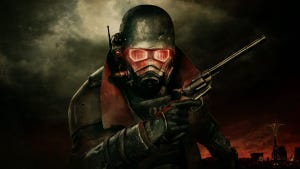
After all, what games like Fallout 3 and Fable II show above all is that, in this nuanced world, it's not really about the barrel-chested hero and the moustache-twiddling villain. It's just a bunch of... guys.
|
I love those games where the roles are switched, and would welcome any game developer to tackle the opposing psyche (Nazi's excluded, obviously). This not only makes a whole new perspective to retell a well established story, but also opens up a whole new treasure trove of gameplay options. All the while, it adds a heck of a lot more depth to a game's universe if pulled off properly. It makes the player realize that one game's terrorist could be another game's freedom fighter, so to speak. Imagine if Fallout3 was envisioned from the perspective of the Enclave, and (spoiler alert) a bunch of ragtag terrorists were besieged DC, and it was your duty to restore DC to the glory of its days past using those terrorist's technology against them? Fallout3 did a great job at exploring that aspect and emphasizing the Enclave's self-absorbed righteousness, but never thrust the player into the psyche, the brainwashing, the staunch objectives of the Enclave much in the same way as...well...
...Tie Fighter.
Not that anybody in the west cares about the license, but one of the major strengths of the Gundam franchise is that there's really not so much a "good" and "bad"; it's more of a matter of perspective, though some of the actions perpetrated by both sides (in the fiction outside of the games) are genuinely horrific. Consequently, there have been a huge number of games that take place exclusively from either of the sides of Gundam, or at least feature both forces equally.
Obviously, Star Wars: The Force Unleashed is a (very successful, commercially) attempt to do this in recent times. Star Wars is a strong candidate in general both because of its popularity and its highly binary universe. It would be nice to see some grey, though, which that universe can't really provide.
Command and Conquer: You can play as NOD or GDI, the opposing forces
GTA1-4: You're a criminal committing crimes
Counter Strike: You have terrorists and anti-terrorists, trying to prevent each other from succeeding
World of Warcraft: Horde vs. Alliance
Warhammer Online: Chaos, Skaven, Undead, Dark Elves, and such vs Dwarves, Empire, High Elves, etc.
Army of Two, Manhunt, Postal, Hitman, and others in a similar vein among others.
There are plenty of games out there that have stories or modes dedicated to playing from the other side, although there aren't many that take an existing story and allow you to play it through as the bad guy. Though there is, as someone pointed out, Opposing Forces.
To write an article like this and not address Tie Fighter is an oversight that greatly diminishes the credibility of the piece.
I think the point of this (short) article is that there are few games which try to make the player empathize with the antagonist. TIE Fighter doesn't do that. Player is seemingly a conscript, there's no chance for them to influence the big picture, most campaigns revolve around minor aspects of the original plot, and the first one actually depicts Empire as a kind of a (not quite honest) peace-keeping force.
I think the biggest challenge is that the player is always their character's accomplice. You can't let the player feel too bad about what they're doing, or they will stop playing. Watching Hannibal Lecter eat someone, and helping him to that end, are not quite the same. A lot of people will never choose to become a Sith in a Star Wars game, because they don't enjoy such fantasy. If you force them to, they will stop caring, and the narrative won't work the way it's supposed to. Personally, the narrative is the main reason why I have a strong preference for X-Wing to this day.
You could play as Harkonnen in Dune 2, and you could choose an aggressive, militaristic strategy in the original Civilization, but those were just colored tokens erasing each other from the map. Some other games escape into parody and satire in order to make sure player doesn't care about what they're doing too much.
I think role-playing games should be exempt from discussion as well, because letting the player be "evil" is part of their convention. A role-playing game, that doesn't let the player make choices other players would consider inappropriate, is not a role-playing game at all (although it may well be a narrative-intensive tactical combat simulation). I mean, does anyone think Ultima IV would work the way it did if Avatar was actually forced to be virtuous?
The game even causes you to make a crucial decision at the end, and the sequels which follow basically play it off that you made the "evil" and "selfish" one.