Our Properties: Gamasutra GameCareerGuide IndieGames Indie Royale GDC IGF Game Developer Magazine GAO
My Message close
Latest News
spacer View All spacer
 
February 23, 2012
 
Interview: Silver Dollar uses XBLIG for its mad experiments
 
Last year's Supreme Court case on games cost California $1.8M [6]
 
GDC 2012 details Moriarty, Della Rocca, 'Rant' sessions in Education Summit [1]
spacer
Latest Features
spacer View All spacer
 
February 23, 2012
 
arrow Postmortem: Days of Wonder's Ticket to Ride Pocket [1]
 
arrow Sponsored Feature: Canada - Scoring High as a Game Nation [3]
 
arrow The Vita Interview [19]
spacer
Latest Blogs
spacer View All     Post     RSS spacer
 
February 23, 2012
 
Piracy and the four currencies [5]
 
The Secondary Costs of Outsourcing [10]
 
Sixty to Zero [4]
 
The Combinatorial Itch [5]
 
God Games and the Superman Complex [13]
spacer
Latest Jobs
spacer View All     Post a Job     RSS spacer
 
February 23, 2012
 
2K Games
Public Relations Manager - 2K Games
 
2K Marin
Level Designer
 
2K Marin
Senior Rendering Programmer
 
Zindagi Games
Presentation/Game Programmer
 
The Workshop
Art Director
 
Blizzard Entertainment
Senior Software Engineer, Tools
spacer
Latest Press Releases
spacer View All     RSS spacer
 
February 23, 2012
 
Hektische Feuergefechte
und neue Waffen
für...
 
Combat Arms Whips up a
Gun Frenzy
 
MocoSpace Unveils Five
New HTML5 Mobile
Social...
 
Waveform arriving on
Steam in early March!
 
GAME INSIGHT ANNOUNCES
NEW SAN FRANCISCO...
spacer
About
spacer Editor-In-Chief/News Director:
Kris Graft
Features Director:
Christian Nutt
Senior Contributing Editor:
Brandon Sheffield
News Editors:
Frank Cifaldi, Tom Curtis, Mike Rose, Eric Caoili, Kris Graft
Editors-At-Large:
Leigh Alexander, Chris Morris
Advertising:
Jennifer Sulik
Recruitment:
Gina Gross
 
Feature Submissions
 
Comment Guidelines
Sponsor
News

  Analysis: New Moon - How Castlevania, Silent Hill Hit The Reboot Button
by Jeffrey Matulef [PC, Console/PC]
5 comments
Share on Twitter
Share on Facebook RSS
 
 
November 8, 2010
 
Analysis: New Moon - How Castlevania, Silent Hill Hit The Reboot Button

[In this Gamasutra analysis piece, Jeffrey Matulef analyzes gaming conventions and the pros and cons of breaking them, this time exploring reboots, focusing on Silent Hill and Castlevania's most recent outings.]

Whenever a series tries to reinvent itself by handing the reigns to a new developer it's met with trepidation. Long time fans may complain that it looks too different, the story's not the same, or the design's been changed too drastically. While it's easy to understand such criticisms, I've found that the best reboots emulate the feeling of their predecessors, but achieve it through radically different means.

Last year we saw avant garde horror cult sensation Silent Hill reinvented by Western studio, Climax. While this wasn't the studio's first foray in the beloved series (they worked on Silent Hill: Origins), it was the first time it changed the formula up dramatically.

More controversially, this was a 'reimagining' of the first Silent Hill. Many oldschool Silent Hill fans were outraged, lamenting the loss of the series' occult lore, industrial otherworldy settings, and combat. Some argued Shattered Memories should be a new IP unto itself because the story veers off in a wildly different direction than previous installments in the series.

Richard Mitchell wrote in his review at Joystiq, "What really bothers me, though, is the Silent Hill name attached to the project... Apart from characters with the same names, the game has next to nothing to do with the first Silent Hill."

I'd argue that that's missing the point entirely. Shattered Memories deals with such dark psychological themes like guilt, loss, denial, family, love and death that have been mainstays in the series since its inception. It also capitalizes on such series motifs like wheelchairs, hospitals, and even the series trademark easter egg UFO ending (which can only be obtained on a second playthrough and might be the funniest game ending since GLaDOS serenaded us with her dying thoughts).

What's great about Shattered Memories is that it sets up a familiar scenario only to defy our expectations at every turn. You keep waiting for occult elements to show up and they never do. It's not a remake, but a completely different story that uses your expectation of Silent Hill games against you.

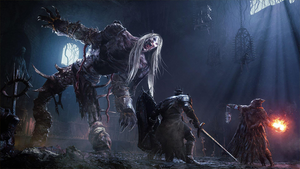
Currently we're seeing a similar treatment applied to Castlevania with Spanish developer Mercury Steam's first foray into the series, Lords of Shadow. Reaction has been divisive, but most critics have agreed that it doesn't feel like a proper Castlevania game. Since Symphony of the Night in 1996, the series has gone in a non-linear direction dubbed "Metroidvania" due to its clear cribbing of Nintendo's well-known design.

Lords of Shadow eschews that in favor of a stream-lined level by level format more akin to the 8- and 16-bit Castlevanias of yesteryear. The focus has shifted from exploration to combat with a prerendered camera and robust combo system. Drawing even more venom from the community is that less than half of the game even takes place in a castle.

Oh, and the lead character Gabriel Belmont is revealed early on to not even be a proper member of the series' Belmont clan. At a glance it would appear as if Mercury Steam took the name to sell a bunch of copies of an otherwise unrelated action game not unlike how Nintendo turned Doki Doki Panic into Super Mario Bros 2.

This was my initial impression as well, until a moment before the halfway mark where I realized that this was more than God of War in Castlevania's clothing. I'd just entered the vampire's castle when bat-like lesser vampires accosted me in a lavishly decorated hallway. I used my combat cross, a variation on the series' trademark whip, to draw open the curtains, allowing beams of light to shine down upon my nocturnal predators.

After slaying all of them and solving a puzzle, the beams of light withered as I realized the sun had set and I was trapped in this colossal vampire infested tomb for the duration of the night. This brooding note of delving deeper into the rabbit hole was always one of the series' greatest charms.

As the game wore on, many of my early criticisms turned to praise once I'd acclimated myself to the idea that this wasn't a 3D Symphony of the Night. The prerendered camera may seem at odds with the exploratory nature of the series, but it also gives the games a 2.5D feel where you can only see what the designers intended.

The segmented levels initially feel disjointed when you move from a forest to a snowy field separated only by a scant loading screen, but this adds a greater sense of surprise as you wonder what kind of environment the designers will throw at you next. It felt like a 16 bit game remade in 3D with modern technology which is precisely its intent.

Castlevania wasn't about its design or story, though, which have shifted throughout the years just as Dracula's castle has morphed its architecture. Castlevania excelled was in its depiction of hunky whip wielding pretty boys thwarting a rogues gallery of folklore and literary machinations in nonsensical Victorian architecture. This is something Lords of Shadow gets right.

While story has always taken a backseat to monster slaying in Castlevania, there is one plot element that's largely missing from Lords of Shadow that's sure to anger many fans. Spoiler alert: Dracula is largely absent from the game. And what mentions we do get may not gel with our knowledge of the character from previous installments.

Personally, I love this. Rather than retread previous ground, Lords of Shadow is taking the series in a bold new direction that's fascinating purely because its so unpredictable. If it were a new IP it would still be good fun, but part of its appeal is comparing the old to the new and guessing where they're going with this.

Change isn't always good, though. While not a reboot per se, Team Ninja's foray into Metroid with Other M was a radical departure for the series and took away more than it added. Allowing Samus to talk had a lot of potential, but the story was poorly told with atrocious dialogue.

By tying it into an already existing series' canon instead of a reboot, it defied everything we already knew about this character by making her a whiny emo girl. Had a similar approach been taken to telling Samus' origins it could have successfully reinvented the series. Unceremoniously stapling it to the end of Super Metroid, one of the most revered games ever, made the transition incongruous.

At their best, a reboot is a happy medium between a sequel and an original IP. It's a great way to reinvent a series, introduce it to new fans and start fresh with already established conventions. The best reboots explore similar themes or convey a similar feel as their predecessors without adhering to the same design or even story.

Where Shattered Memories succeeded as a Silent Hill game due to its unsettling psychological journey, Lords of Shadow succeeds as a Castlevania game by tapping into the series' bombastic gothic ambiance. Silent Hill isn't about a cult just as Castlevania isn't about Dracula and it's only by playing off our expectations that we're able to fully appreciate what it is we liked about them so much in the first place.

[Jeffrey Matulef is a freelance writer for G4TV.com, blogs about games at JumpingMoustache.com and is a regular on the Big Red Potion podcast. You can contact him at jmatulef at gmail dot com.]


Comments

Gregory Kinneman
profile image
I've got to say that I disagree with you on this one. A remake should recreate the original, not simply adopt its name. Crystal Dynamics' Tomb Raider: Anniversary was a phenomenal remake, with the same levels and puzzles, but new twists, animations, art and combat mechanics. It recreated the first game for the modern gaming system. By this standard, Shattered Memories is not an effective remake.

Likewise, a reboot should strive to keep some of the strong connections to the original titles. I understand that perhaps these games are trying to mix things up, but Silent Hill without the occult is much like System Shock without the cyberpunk. Maybe you've recognized one of the elements of Castevania that isn't as immediately noticeable (pretty boys with whips), but it still feels weird to have Castevania without Dracula playing a heavy role, or most of the game in the castle.

I have nothing against trying to push franchises into new directions, but I feel that alienating the original fanbase removes any benefit of using an existing IP, and I'd personally rather see designers making new IPs rather than just recreations.

Raymond Grier
profile image
He didn't say "A remake should ...simply adopt its name".

James Camilleri
profile image
But there is a System Shock reboot without the cyberpunk, the developers just never told anyone it was a reboot; The cyberpunk was replaced with Art Deco design, objectivism and a simplified RPG system.

When you look at it that way, Bioshock is a good example of Jeffery's idea of what a good reboot should be. It kept the same familiar feel of isolation and fear in a dead or dying environment, yet it twisted so many other things to make a completely new experience.

Prash Nelson-Smythe
profile image
James, I think it's important that Bioshock used a different name and universe. That way System Shock fans who relished all the depth didn't need to take the simplifications of Bioshock so personally, while knowing it was "inspired by" their cherished classic.

George Monroy
profile image
I completely agree with the article on Castlevania. It is a very good reboot.


none
 
Comment:


UBM Techweb
Game Network
Game Developers Conference | GDC Europe | GDC Online | GDC China | Gamasutra | Game Developer Magazine | Game Advertising Online
Game Career Guide | Independent Games Festival | Indie Royale | IndieGames

Other UBM TechWeb Networks
Business Technology | Business Technology Events | Telecommunications & Communications Providers

Privacy Policy | Terms of Service | Contact Us | Copyright © UBM TechWeb, All Rights Reserved.