My Message close
GAME JOBS
Latest Blogs
spacer View All     Post     RSS spacer
 
May 24, 2013
 
Want To Help Stop Youth Cyberbullying? Let Your Kids Raid More.
 
We're Indie, we like Microsoft. Too Controversial? [5]
 
The Procession of Progression in Game Design
 
Xbox One: a flawed plan, well executed [9]
 
Letting the Player Find the Fun [2]
spacer
Latest Jobs
spacer View All     Post a Job     RSS spacer
 
May 24, 2013
 
Trendy Entertainment
Technical Producer
 
Telltale Games
Lead Environment Artist
 
Wargaming.net
Release Manager
 
Virdyne Technologies
Project Manager
 
Virdyne Technologies
Software Engineer, iOS/Mobile
 
Stomp Games
Web Game Programmer
spacer
Latest Press Releases
spacer View All     RSS spacer
 
May 24, 2013
 
Ragnarök 2: Legend
of the Second llega a...
 
NINTENDO DOWNLOAD
HIGHLIGHTS NEW DIGITAL
CONTENT...
 
New indie game developer
Glowingpine Studios...
 
Zoombies iOS Game On Sale
Memorial Day Weekend
to...
 
Zomber Squad Guide: Hero
System
spacer
About
spacer Editor-In-Chief:
Kris Graft
Blog Director:
Christian Nutt
Senior Contributing Editor:
Brandon Sheffield
News Editors:
Mike Rose, Kris Ligman
Editors-At-Large:
Leigh Alexander, Chris Morris
Advertising:
Jennifer Sulik
Recruitment:
Gina Gross
Education:
Gillian Crowley
 
Contact Gamasutra
 
Report a Problem
 
Submit News
 
Comment Guidelines
Sponsor

 
PAX East 2011: Activision Studio Heads Vouch For 'Owned But Independent' Model
 

March 12, 2011   |   By Andrew Vanden Bossche

Comments 16 comments

More: Console/PC


Once-independent studios praised how parent Activision allows its subsidiaries to operate relatively autonomously, in a panel called "Owned but Independent" at PAX East in Boston on Saturday.

Dan Amrich, former games journalist and current social media manager of Activision, hosted the panel, asking panelists from Raven, Vicarious Visions and High Moon Studios about the pressures of their parent company and the challenges with working with outside IPs.

The panel at the consumer-centric PAX East comes amid an ongoing lawsuit between Activision and former heads of wholly-owned Call of Duty studio Infinity Ward, and just weeks after the closure of UK-based subsidiary studio, Bizarre Creations.
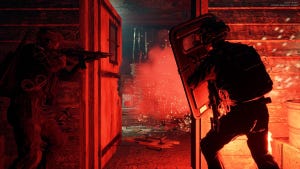
Amrich said his aim was to help dispel the notion that publishers and studios are constantly at each others' throats, citing his own difficulty understanding the relationship back when he was a journalist. Of particular concern to him was the pressure that came from above, and his impression at the time that it was a stifling force for owned studios.

Jennifer O'Neal, executive producer at Vicarious Visions, found herself wondering about the lost creative opportunities with being a subsidiary. But talking with her studio heads, she found they felt felt as if they were "not in as risky of a position as we were when we were independent."

Yet at the same time, she said that Activision allowed them to be able to spend their money more freely on technologies such as motion capture, which as independents would be too risky or impractical a move.

Eric Biessman, who had been with Singularity developer Raven Software since 1994 and currently is senior project lead, actually said that he felt less pressure from parent Activision than when he was independent. Even without direct ownership, his company still worked under contracts that he felt were far more controlling than Activision ever was.

"If we didn't turn in a milestone every month that wasn't exactly what was listed in our contract they wouldn't pay us," he said, which left his company head paying his employees with credit cards.

Peter Della Penna, head of High Moon Studios, was grateful for Activision CEO Bobby Kotick's support of the "independent studio model," which allowed his studio to, among other things, continue to surf during lunch breaks.

"You're good for a reason," he said, speaking for Kotick, "and the key to that is the studio culture." The responsibilities Activision placed on the studio of keeping on budget and delivering quality games never changed High Moon into something it was not.

Activision didn't force Della Penna or High Moon studios to work on properties they didn't want to work on either. He acknowledged that while Activision would suggest properties he felt weren't suited to the studio, he would still seriously consider them and discuss with the publisher whether working on those properties was a good idea.

Della Penna, whose studio's most recent game was Transformers: War for Cybertron, also said he wasn't sure that original IPs led to efficient usage of their time. "When you're creating new worlds and characters you get a lot of people with opinions," he said. He felt that his studio's passion for a certain license helped workers focus on the game rather than distracting them with the difficulty of agreeing on a new imagination.

Discussion of interference from outside forces seemed to keep segueing into the studio's relationship with licensors, and the ups and downs of dealing with outside IPs. Della Penna described Activision's process as "structured, but not heavy-handed," while Eric Biessman's experiences with licensors ranged from the passionately helpful to the passionately meddlesome.

On the other hand, Biessman's experiences with Raven's original IP, Singularity, involved a lot more pressure from Activision than licensed projects. It kicked off from a small internal team that worked on a playable demo they could show to Activision, but an original IP meant much more involvement from the the parent company. "It's more work for us to make sure they feel it's worth it," said Biessman.

Della Penna and Biessman agreed that it was not a good economy for original IPs, echoing Gears of War designer Cliff Bleszinski's recent quote about the death of "middle class games" as being a tragic reality of the current climate.

Even so, Della Penna suggested that despite the reputation of Activision and other large publishers for turning out the same licensed games, original IPs are still a vital part of the business. "As a publisher you need to think about the future," he said.
 
 
Top Stories

image
Blog: I took my Ouya game to retail, and here's what happened
image
Video: Thief vs. Deus Ex - a design discussion
image
Here's how much 'whales' spent so far this year
image
Player progression: Understanding how players get through your game


Comments

Tim Carter
profile image
Independent but not independent. I don't get it.


I will say it again: free-agent-driven, modular, project-based game development is the way to go.


In the film industry, which uses project-based development, the odds of a project failing are now less than 1%.

Kale Menges
profile image
I'll believe it when I see it.

Robert Gill
profile image
Stole the words out of my mouth.


Even better seeing how it's coming from Activision.

Evan Moore
profile image
They're kind of like Fox News: the more they try to shove their message down our throats, the less I believe it.

Blain Newport
profile image
I'm glad these developers are happy with their work environments. It's good that Activision knows not to meddle in the culture of acquired companies. And the fact that Raven got to take a stab at new IP last year with Singularity is laudable. It also sounds like the developers were able to talk about aspects of working with Activision that weren't so great, which goes a long way to establishing their perspectives as credible.


But holding a one-sided event like this always begs the question of what people from Respawn, Neversoft, Double Fine, or any of the recently shuttered developers (Bizarre Creations, United Front, 7 Studios, and possibly Freestyle Games) would have to say.


It's also weird to hear Jennifer O'Neal talk about it feeling "not as risky" to work for Activision when one out of four people at Vicarious Visions recently lost their jobs.

Rafael Brown
profile image
@ Blain - please check your studio facts.


A clarification, United Front and Double Fine are both independent 3rd party developers. They are neither shuttered nor owned by Activision.


That said the absence of more or other devs owned by Activision does seem to bear out that some devs develop a better working relationship or more independent relationship than others. Like Orwell's 1984, "some are more equal than others."


Activision has closed or is in the process of closing: 7 Studios, Freestyle Games, Luxoflux, Bizarre Creations, Underground Games, Budcat Creations & Red Octane.


Activision has downsized: Radical after the Vivendi merger (Radical was owned by Vivendi).


Activision has direct control over formerly independent: Treyarch and Infinity Ward (the dual cores of CoD development).


Activision has presumably left largely independent: Raven, High Moon, Neversoft, Sledgehammer, Vicarious Visions.



Activision is largely unable to change Blizzard (presumably due to the terms of the Vivendi merger).

Robert Bailey
profile image
Well, I've been in the business a long time (17 years) , and during my time at 7 Studios, I found Activision to actually be a pretty decent comapny to work for. Except for the small matter of shutting our studio down and putting us all out of work, of course. Aside from that one niggly point, they've been really cool.

Jeffrey Crenshaw
profile image
This just in, panel of professionals working for a parent company that can lay them off in a bad economy say nice things about their parent company.


The truth of the matter is, if your primary source of income (meaning your primary source of life-sustainability) can be ended by a single entity, you are not independent. We have to inverse the industry model so gamers think about and follow studios and individuals instead of umbrella publishers. Then publishing tasks can be contracted out, and if we (the developer) don't like the marketing or support coming from publishers, _we_ can fire _them_. _we_ are the ones that make gaming possible, and I'm getting sick of the current direction of power in this industry flowing from those that just want to make big bucks instead of from those that want to bring joy to the world through games.

Joe McGinn
profile image
>> This just in, panel of professionals working for a parent company that can lay them off in a bad economy say nice things about their parent company. <<


LOL!

sean lindskog
profile image
I think there's a distinction to be made between independent creativity, and independent finances.

Joe McGinn
profile image
>> I think there's a distinction to be made between independent creativity, and independent finances.<<


No sean, there absolutely 100% is not. None whatsoever.

Carlo Delallana
profile image
A long leash is still a leash.


Being truly independent is being free from external control or constraint.


"On the other hand, Biessman's experiences with Raven's original IP, Singularity, involved a lot more pressure from Activision than licensed projects. It kicked off from a small internal team that worked on a playable demo they could show to Activision, but an original IP meant much more involvement from the the parent company. "It's more work for us to make sure they feel it's worth it," said Biessman. "


That paragraph alone contradicts the meaning of independence.

Thomas Bousquet
profile image
So, let me get this straight : the panel involving Activision studios was moderated by a PR guy from Activision? oO

How could anyone expect this discussion to get off message at any point?... and how could PAX allow this to be labeled as a panel, when it's clearly a press conference in disguise ?

Scott Jordan
profile image
lol...I can always count on Activision to start my day with a laugh


none
 
Comment:


UBM Tech