|
By
André
Vrignaud
Gamasutra
October 24, 1997
Originally
published in the October 1997 issue of:

|
|
|
Features

Postmortem:
SSI's Dark Sun Online:
Crimson Sands
The
initial design goals for DARK SUN ONLINE (also known as DSO) were quite
simple. We were tasked to take the DARK SUN II single-player code base
and turn it into a large-scale multiplayer online game for AT&T's
now-defunct Interchange network. The game was initially planned around
a client/server architecture (although it didn't end up that way) to protect
against hacking, to support thousands of simultaneous players, and to
have plenty of quests and global events to keep players entertained. However,
while designing the project, we had several considerations to keep in
mind:
First, our resources were quite limited, especially when it came to art
and audio. We had one part-time artist available to create the few odd
objects that we absolutely had to have; otherwise, we had to make do with
art we could reuse and steal from other internal projects. We had the
same limitations with sound and music resources and often had to go to
extraordinary lengths to find quality material.
Second, we knew we had to use the existing code base and couldn't rewrite
the game from scratch. This obviously tied us down with a great deal of
baggage, not the least of which was that we were using a dated game engine,
both graphically and in terms of the game's code. Because of this we chose
not to focus on the graphical aspects of the game, which would have been
futile, but dedicated all of our resources toward creating a multiplayer
game with strong game play elements.
Finally, we had to coordinate all of our efforts with an external programming
group and contract art group. As you'll see, there were definite challenges
with meshing the internal game design and the external programmers. In
addition, we had to go through many iterations of art creation for some
of the new characters and monsters. This proved to be an entertaining
experience in its own right.
The
origins of DARK SUN ONLINE can be traced back to the summer of 1994 when
representatives of AT&T's Interchange network approached SSI to do
a new ADVANCED DUNGEONS AND DRAGONS online game. At that time, AT&T
was in the process of planning its own proprietary online service, and
believed that having a strong game presence would be of great help in
launching the network. Having seen the success of NEVERWINTER NIGHTS on
America OnLine, the company wished to fund the development of a sequel
based on the DARK SUN engine for its exclusive online use.
Our first challenges became apparent in October of that year as the contract
was signed and work began. Due to some overly aggressive estimates as
to the ease of porting DARK SUN II to an online environment, the project
was basically underbid from the very beginning. This had many ramifications,
beginning with a lack of art and sound resources to draw upon, and continuing
with difficulties keeping external team members' morale up.
Thanks to these resource constraints, we had to go to great lengths to
get the material needed to create the game. To begin with, we raided the
source code archives and reused art from both DARK SUN I and DARK SUN
II. This turned out to be more difficult than it sounds, since there was
a slight perspective shift from the first game to the second, and much
of the early art simply didn't look right in the new DARK SUN II perspective.
We also borrowed a great deal of art from an SSI title called AL-QADIM,
which had an Arabian Nights theme. Although much of the art was unusable
for the same perspective reasons, some fit perfectly. Sand is sand, after
all, no matter what angle you view it from!
For the entire duration of the project, we only had a half-time artist
to do some miscellaneous objects, interim cut-scenes, and cinematics.
Since there was always a huge crunch going on with other internal projects,
we also had to deal with losing that artist at the oddest (and most frustrating)
times - especially since there was enough work to keep several artists
occupied for months. One of the biggest effects that this situation had
upon the original game's design was the loss of all of the game's cinematics,
apart from the introduction. (Ironically, even this introductory cinematic
was only available for a short time in the DARK SUN ONLINE 1.0 retail
version. Later versions of the game were never re-released at the retail
level, and the introductory cinematic scene was too large to be included
in the downloadable versions.)
Additional art work that needed to be accomplished for this project included
the customization of hundreds of player icons, some perspective tweaks
on DARK SUN I monsters, and the creation of several new monsters. Since
we effectively had no internal resources to create this art, we turned
to an external art house.
The character
portraits went relatively well, with only a few redos on dental-floss
bikini bottoms and overly-endowed female characters. The Dark Sun I monsters
were also tweaked with little problem. Unfortunately, the new monsters
turned out to be far more challenging for the external artists. Two monsters
in particular - the Dragon and the Nightmare Beast - were somewhat less
than fearsome. As you can see from the sample art, the Dragon (even after
some rework) looked like a gecko, and the Nightmare Beast
well,
the Nightmare Beast just looked like Barney. Perhaps luckily, the Dragon
encounter ended up being cut from the game, and since we never could get
Barney looking right, his appearance was cut, too. (There were those who
thought keeping Barney in could be quite a cathartic experience to certain
twisted people, but fortunately saner minds prevailed.)
We did much
better as far as sound effects went. Digging in the archives, we were
able to draw upon the sound effects from Dark Sun I and II, which pretty
much covered most of what we needed.
|
|
|
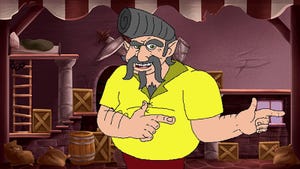
Much
of the art from DSO was reused from earlier games
|
However,
we were still a little short in some areas and cast about trying to find
a few more additional effects. Lo-and-behold, the sound department coincidentally
sent out a large archive of .WAV files from the soon-to-be released THUNDERSCAPE
title for use as Windows event sounds. Much to the chagrin of some on
the THUNDERSCAPE team, those effects quickly found their way into DSO.
Using Contracted
Developers
Beyond all
of the internal resource issues, DARK SUN ONLINE was also an interesting
project due to its use of external programming talent for the online coding
and porting of the game. At the time, SSI had no internal online programming
talent available to code a multiplayer version of DSO. So the online coding
was subcontracted out to an external programming group. Now, working with
external groups is pretty common in the industry, and normally isn't that
big of a problem. Unfortunately, due to some political and financial issues,
the contract was finally signed (over a few objections) with the external
group getting paid on a strict milestone basis, with no royalty points
or interest in the finished title. As you can imagine, this became a bad
morale issue for the group.
|
|
|
"Barney,"
the Nightmare Beast
|
This morale
problem reared its ugly head quite quickly as the external programmers
and internal scriptors began to interact. Earlier DARK SUN games (other
than the art work) were created as a joint effort between the programmers
and the scriptors (also known as the designers). The programmers would
work on the game engine, adding features such as spells, new monster effects,
and new GPL (Game Programming Language) commands for the scriptors' use.
Meanwhile, the scriptors would use GPL to code the actual adventure parts
of the game - the events, quests, and NPCs (nonplayer characters). The
key to this arrangement working harmoniously was that most of the GPL-interpreting
code (in the engine itself) was already done, allowing the scriptors to
work relatively autonomously. Unfortunately, this wasn't the case with
DSO.
The big problem with this project was that the external programmers had
to take a code base for a game that was designed as a single-player game
and make it a multiplayer game. Unfortunately, the original programmers
(on DARK SUN I AND II) made assumptions about the way certain GPL commands
would work, in order to save time on coding error-checking routines. For
example, the original programmers never had to deal with the possibility
of two different people trying to talk to the same NPC at the same time;
it simply wasn't possible in a single-player game. However, this situation
is extremely common in the online version. The result of this was that
the external programming group had to recode the way GPL worked - many,
many times as the game's development progressed and we learned more about
how the engine would really work.
|
|
|
Sysop tools were added that allowed the DSO world to expand beyond
its original size and let players discover new challenges.
|
Rich Donnelly,
the lead scriptor for DARK SUN ONLINE says, "Oftentimes, I would write
script for the engine, and the engine would change halfway through, in
such a manner that the script would no longer function. Even worse, there
were times when crucial information was lost in the associating chain,
such as new GPL functions or commands. This caused a lot of strife and
recoding on everyone's part."
To sum up,
since the external programming group had no buy-in or incentive to make
the project the best it could be, they generally took the easier path
whenever possible. The most grievous example of this was the networking
change from the planned client/server architecture to a peer-to-peer system.
Due to low morale and compensation, the external group insisted on coding
the networking architecture as a peer-to-peer network, using the local
clients to run most of the game logic. Although we raised the red flag
multiple times about problems inherent with this scheme, our team was
overruled in the interests of keeping costs low. To be fair, the peer-to-peer
coding was done competently for what it was. Unfortunately, though, this
type of networking code wasn't the best for the game at large, and we
had to deal with the hacking issues that it raised for the life of the
project.
The Debugging Process
A few months
passed, and eventually the programming group got the engine to the point
where the scriptors could do some GPL coding without having to restart
every month. At this point, the scriptors dug in and started coding the
underlying global routines for the game, and the external programmers
started modifying the game engine to work over an IPX network, which would
to allow us to test and develop internally. Within a few weeks, we had
that IPX-capable version of the engine to work with - which raised new
issues.
Chronologically, this was soon after DOOM was released, and if you'll
recall, the early versions of DOOM had problems with packet flooding,
which brought down quite a few corporate networks. This was quickly fixed
in subsequent releases, but the internal management at SSI was still a
little gun-shy, and asked us to set up a completely separate network for
our development work. This in turn meant we needed a UNIX box to run the
game's server code, which meant we needed to set up and configure a Linux
box (Linux is a free variant of UNIX) to act as the host. To make a long
story short, configuring a UNIX machine isn't an easy task, and by the
time we got the hardware, built the network, and configured the host,
we had lost a few weeks of development time.
The greatest hit that our original timeline took resulted from the initial
plan to run DARK SUN ONLINE as a DOS application in a DOS box, but communicate
with a Windows-based TCP/IP stack. AT&T's Interchange online service
was a Windows 3.1 application and ran over a proprietary TCP/IP stack
that AT&T had licensed. Since the original DARK SUN games were DOS
applications, and since Windows 95 hadn't yet penetrated the market sufficiently,
it was thought best to keep DARK SUN ONLINE as a DOS application. We would
depend on a "shim" of sorts to allow the game to communicate with the
Windows protocol stack. We spent a couple of painful months trying to
get this going, and eventually had something that worked, but not well.
The shim would occasionally lock up for seemingly no reason, and we were
unable to get the source code for the protocol stack to try to fix the
bug. Eventually, we scrapped that effort and ported DSO to a true Windows
application. In retrospect, we probably should have bit the bullet early
on and moved the game to a Win32 application from the start.
After this initial setback, work progressed for a few months without any
particular disasters to note. Art from the external group was slowly coming
together, and we resolved most of our sound and music issues. The external
programming group was hitting its milestones, and all in all, everything
was quiet. Yes, as many of you just guessed, too quiet.
In early November of 1995, I received a call from the head of Interchange's
game group. It turned out that AT&T had pulled one of their classic
turn-arounds and decided that it didn't actually want to be in the online
network business after all. In short, AT&T's Interchange network was
canceled, along with all of the projects being funded for it - including
DARK SUN ONLINE.
At first, it didn't look too bad. Although we didn't have a network to
launch the game on, we had gotten a great deal of the project funded,
and through a nice quirk in the contract, all rights to the game reverted
back to SSI. This allowed us to shop the title around to different networks
and possibly negotiate a better royalty deal. Unfortunately, this process
took several months, and since SSI's internal management wasn't confident
that they'd be able to find somewhere to place the title, the project
was placed on a back burner. A couple of the scriptors and I continued
development, along with the external programmers, but little other work
was done. However, a few months later, it was decided that TEN was the
appropriate network for the title, and work began again in earnest in
January of 1996 - with one other little bump.
In mid-January, one of the three internal scriptors decided to move on
to new opportunities. This normally wouldn't have been that big a deal
- things were moving along well, and the two remaining scriptors would
simply have had to pick up the remaining work and take care of it in the
extra months we'd allocate for them. However, the scriptor that left was
responsible for a great deal of the global game code upon which the game,
along with much of the other scriptors' work, depended. Sadly enough,
it turned out that much of that work had either not been done, or had
been done so poorly that the code couldn't be depended upon. It fell to
Rich Donnelly to pick up the pieces.
"It was quite horrific for me to find that the game was missing some serious
pieces of code. These were pieces that were vital to an online environment,
such as global region transfer code that handled moving entire parties
instead of individuals, or monster generation routines for general combat
encounters that could incorporate several different players in the same
combat. Suddenly, I found myself with little time to correct these problems.
I worked heavily for about a month, and managed to finish getting everything
implemented and working."
The Beta Test
The extra
months added to our schedule after AT&T folder their service were
quite useful, as they gave us some extra time to prepare for the external
beta test. Although we had a core group of internal testers on the project,
we knew that we'd need to run a large-scale external test to really shake
out all of the bugs. To that end, we prepared a web page that gave instructions
on how to sign-up for the beta test - and were quickly inundated with
responses.
We originally planned to solicit beta testers and mail out a CD-ROM to
everyone who responded. Unfortunately, so many people responded that we
couldn't follow through and were only able to send out around 500 discs;
however, the rest of the testers were able to download a 30MB PKZipped
version of the game.
The beta period in particular proved to be quite an educational experience,
and we definitely learned some lessons from it. In fact, it's probably
worth taking a bit of space here to list some of them.
LESSON ONE. You can never allocate too much time for beta testing
and debugging an online title. The sheer number of bugs found by the external
testers was absolutely amazing - and the potential for each of those bugs
to cause havoc was greatly magnified by the interactive nature of the
game. Allocate significantly more time than you first think for your testing
period - and double it. Seriously.
LESSON TWO. Be sure to have robust facilities to deal with the
flood of bugs. I highly recommend setting up some method for external
testers to enter their bugs on a web page, and a method to import those
bugs into whatever bug database you use. We had the bug submission page,
but no way of automatically moving those reports into our database. In
fact, due to the kludged nature of our bug-tracking system, we ended up
having each and every bug sent to my office e-mail account. I would then
log in every morning and run a mailbox filter, forwarding all of the bugs
to my lead tester to sort, compile, and enter into our internal bug system.
I don't think he's forgiven me to this day.
LESSON THREE. Have a FAQ. Period. Every morning I would spend hours
reading and answering hundreds of messages. Some were suggestions, some
were flames, but most were simple questions - and we quickly realized
that we were seeing a great deal of them over and over. However, once
I got the FAQ written and published, the flood relented
a little.
Beyond that, though, the FAQ turned out to be a great promotional and
educational tool; it even staved off our marketing department a few times
by proactively giving them whatever information they were looking for.
Really, now - can you ask for a better reason to do a FAQ than that?
LESSON FOUR. Don't hype the product until it's ready. We purposely
kept quiet about the title until very late in the project and were thus
mostly able to handle peoples' expectations. (I say "mostly" because there
are some people you'll never be able to satisfy.) We wince now when we
see the hype that's been built around ULTIMA ONLINE. Although UO is likely
to be an impressive and groundbreaking product once it's finished, it's
also unlikely to ever satisfy the heightened expectations that have been
built up around it.
LESSON FIVE. Make it extremely clear that it's a beta-test. Then
do it again. And again
and yes, yet again. Even so, I guarantee
you people will threaten, flame, and otherwise get extremely mad at you
when changes are made. As Donnelly says, "Players are not concerned with
the fact that the game may not be in its final state - if you change anything,
there will be complaints, regardless. During our beta test, we altered
the way the environment worked several times and wiped the host quite
often to insure that the test was started afresh, with no corruption.
Naturally, players screamed at us every time this happened. In addition,
watch what you show the players during testing periods, as people aren't
thinking about what the project will look like in the future; they care
about what it looks like now. I recall that ULTIMA ONLINE got quite a
negative reputation initially when Origin showed their alpha, as players
immediately assumed that was what the game was going to be like. Beta
testing includes more marketing than most people realize."
LESSON SIX. Hackers will exploit the slightest loophole, and it's
often that exploitation that ruins the game for all of the other players.
DSO was particularly hackable due to its odd peer-to-peer architecture
- an unfortunate legacy of the external programming group doing things
the easier way for them. Again, if you're doing to do a large-scale RPG
on the 'net, don't consider building it around anything but a client/server
architecture - and make sure the server is the arbitrator of all key game
logic.
After a long and painful beta period, DARK SUN ONLINE was finally launched
live on TEN - and as dictated by Murphy, the inevitable bugs popped up.
DSO version 1.1 was released a few months later to address most of those
bugs, and DSO version 1.5 came along a few months later as a game expansion.
Discussions are underway as to the possibility of doing a DSO 2.0 - and
as the player base continues to grow, I'm sure we'll see the game expand
and evolve even more in the future.
Modifications Along
the Way
DARK
SUN ONLINE differed from its original design goals in a number of ways.
First, the peer-to-peer architecture we ended up with limited us to hundreds
of simultaneous players instead of the planned thousands. That same peer-to-peer
architecture also made the game extremely hackable, as much of the game
logic was processed on the local machine instead of the host.
Second, a great deal of new sysop tools were added due to beta tester
feedback. Those tools, in turn, helped keep the game viable by allowing
staff members to run hand-made events while the scripted quests were being
fixed. In addition, extra regions were added to give the players more
room, and even more regions were added for version 1.5.
Third, due to the easily-hackable architecture of the game, players were
able to cheat and escape routines to punish character death. Version 1.5
of DSO removed those penalties until we could move the game logic to the
server - hopefully in a future version of the game.
Finally, all cinematics were cut except for the introduction for version
1.0. That introduction cinematic was also cut in post-1.0 versions, due
to its being too large to realistically download. In addition, since the
game was never re-released at the retail level after version 1.0, the
Red Book music became unavailable. However, it's possible that the original
DARK SUN I MIDI tracks might be reintroduced in future versions of the
game.
Despite these changes, however, DARK SUN ONLINE stayed with most of its
original design goals. The game play was our focus, not the graphics.
Some of this was simply because of the original art that we were forced
to use, but a great deal of it was due to beta testers' suggestions during
the testing period.
Player interaction and communication was the focus of the entertainment,
and not prescripted elements as in the original DARK SUN games. We also
reused legacy art to great effect (albeit cheating like dogs the whole
while to steal decent).
Finally, the online interface added a great deal of functionality, while
remaining inspired by the original DARK SUN games and thus familiar to
players' of those titles. The chat system in particular was quite powerful
and worked out well.
I'd
like to highlight a few things that went particularly well during the
development of DARK SUN ONLINE
and a few things that didn't go so
well. Some of them have already been touched on above, but there are a
few others also worth mentioning.
What Went
Right
1.
A close feedback loop with the external testers proved to be incredibly
helpful. Other than the obvious benefit of learning about bugs and interface
problems, we also got a good deal of free publicity and goodwill. That
goodwill was particularly useful when we made the inevitable screw-ups.
In addition, it was beta-tester feedback that spurred development of
the FAQ.
2. The chat interface turned out to be far more intuitive and user-friendly
than we ever thought it might. Rich Donnelly says it best. "The chat
interface is probably one of the most dynamic and user-friendly chat
interfaces to be seen in any online role-playing game. In almost every
case, there are multiple ways to do the same task, something that almost
every user enjoys. As a designer, I have found that players adopt their
own style of play, regardless of how the interface or game environment
is designed. Having the ability to perform tasks in a variety of different
ways allows the player to find the method of play that is most comfortable
to them. Look at Windows 95, for example. Some people prefer to work
from their Desktop, others like it nice and clean and prefer to use
the Start menu and Explorer to find the items that they're seeking.
It is this versatility that people desire, and including it in your
product is essential."
3. The reuse of DARK SUN I and II, and AL-QADIM art assets proved to
be an effective decision. Although many on our team would have liked
to improve the existing art, or create a great deal of new art done,
we were able to reuse most of the art from DS II, some from DS I, and
a little from the external project AL-QADIM to good effect.
4. Our online role-playing paradigms were well thought out, and some
are finding their way into other games. We learned that you can't allow
a real, permanent character to die if a player was paying for it. We
discouraged and punished people to keep them from cheating and skipping
out of combat. DSO also allowed and encouraged player vs. player combat
- an element we see being supported in more and more online role-playing
games. Finally, we implemented the concept of instant communication
across the online world, no matter where you were. Purists seem to disagree
and dislike the lack of reality, but those purists also forget that
chatting is the single most important community support tool you have.
Nothing in your game design should ever discourage communication among
players.
5. Although the basis of the game is player interaction, we found that
having a strong random quest generator helped fill in the gaps. To quote
Rich, "Having a system that can essentially generate quests on its own
is something that definitely increases the entertainment value of the
game. The quest generation system currently in the game is rudimentary
at best, but it's definitely a solid model and a step in the right direction
for what might be termed a 'story-telling engine.' As is the case with
all developers, my only regret is that I didn't have the time to take
this quest engine as far as we would have liked. However, the model
as it stands is a serious piece of machinery, and something to be proud
of."

What
Went Wrong
1.
We tried to make a DOS application running in a DOS window communicate
to a Windows 3.1 TCP/IP stack. Instead, we should have simply ported
DSO to a Win32 application and developed the game with the Windows 95
TCP/IP stack - as ended up being done months later.
2. SSI's internal resources were severely limited for the project, which
in turn made us far too dependent on external resources. On top of that,
the contractors should have been better incented to provide quality
work. In particular, the external programming group was competent, but
not financially-motivated to do the job "right." In addition, the external
art group needed a great deal of hand-holding, and at the end of the
day we still didn't quite get everything we wanted.
3. One of the scriptors left in the middle of the project and didn't
do a great deal of the work that was necessary for the game's underlying
routines. We ended up having the two remaining scriptors doing the work
of three, with one of them having to redo all of the key global routines.
4. Not enough test time was allocated for debugging such a large-scale
online game. This forced us to move extremely quickly which, in turn,
frustrated players due to the speed and severity of the changes. Although
many of these issues were unavoidable, having more time to prepare and
a more flexible deadline would have allowed us to be more accommodating
to testers' issues and frustrations.
5. Probably the biggest issues we had during the development of DARK
SUN ONLINE were the hacking problems. These problems came as a result
of taking a stand-alone game and turning it into a multiplayer game
with a peer-to-peer networking system. Game logic then ran locally on
the client, rather than on the host. Rich Donnelly has a little more
insight on this, and explains it thusly: "The game environment itself,
having been converted from a stand-alone product to an online product,
left the game with most of the logic running on the user side. The host
itself merely transfers the information back and forth between all the
players, keeping everyone in a huge loop of data sets. This causes some
serious problems with hacking, as people could use editors on their
local machines and change critical data. "Hacking thus became quite
a nightmare for DARK SUN. Hacking a stand-alone product is no big deal
- change the game all you like, nobody is going to complain. In an online
environment, you are affecting not only yourself, but also everyone
else playing the game. It's kind of like a movie theater; you purchase
a ticket for one seat, but you don't buy the whole theater. When you
begin screaming, the ushers escort you out, as you are disturbing others.
It's the same for an online environment - it just takes one bad apple
for everyone else to feel the effects."
And
On the Seventh Day...
All
in all, the development team was quite proud of how DARK SUN ONLINE turned
out. It's one of the few large-scale graphical multiplayer online role-playing
games now in existence, and currently generates tens of thousands of hours
of paid use every month. However, we've also learned a great deal during
the creation of the game; some have been listed above since they were
key issues during development, but I'd like to take a moment to list a
few more miscellaneous lessons. We hope they help you in the development
of your title!
-
People want their name in lights, so the more recognition you give
game players, the more they'll feed back into the system. No player
wants to be the anonymous shopkeeper - but they'll be a lot happier
about it if they get a big lit-up sign with their name on it! Players
want recognition for their acts, be they good or evil. The more you
let individuals stamp their name on the world, the more they come
back - both to see their name in lights, and then to keep it there.
The one caveat I'd add is that you have to be cautious when giving
recognition for "evil" deeds such as player killing, thieving, and
so on. Eventually some players live only for the recognition they
get for harassing other players - who eventually get fed up and move
on.
-
Resources allocated to the project must remain accessible during the
entire beta period, until the title is finally launched. In addition,
if you're serious about online games, you should expect to keep at
least some portion of the team on to support and expand the game in
the future. I realize this latter point sounds particularly obvious,
but we've seen quite a few times when this didn't happen and it had
a detrimental effect on the game. (Yes, DSO was one instance of this
happening.) I'm not really sure why resources get pulled at this point
by companies, but I assume it has something to do with people underestimating
the amount of work and support an online title requires.
-
The people who designed and built the game should also be the team
that supports it after its launch. These are the people who have the
understanding, the tools, and most importantly, the passion. Although
it is possible for an external group to take over the support for
such a title, you definitely take a bit of a hit as they get up to
speed. On top of that, the new support team often fails to get much
support with bugs since the game company doesn't "see" them. As you
may have guessed, this exact situation happened during the development
of DSO. SSI was unable to dedicate resources to support the game once
launched, so TEN took it over. The problem was that SSI often had
no empathy for TEN when confronted with the bugs and support issues
that needed attention. Sadly, SSI had become too far removed by taking
themselves out of the loop.
-
Checks and Balances to control player killing (Pkilling) are absolutely
mandatory. Although we personally believe that allowing players to
prey upon each other is a worthy and admirable goal, you have to have
checks to keep the balance of power from tipping completely toward
the Pkillers. Once that happens, you get into an ugly situation with
Pkillers consistently preying on newbies, which in turn dramatically
affects the popularity of your game. All it takes is one negative
first experience to lose a potential new player forever. We dealt
with this issue in several ways. The first was to simply create an
arbitrary non-combat zone in the area newbies first appear in the
game. These new players also got warnings (tied into a character level
check) when they tried to leave that safe area. Finally, we put the
highest priority on fixing bugs that allowed players to hack the game
and attack people within the safe zones.
-
The last lesson I'd like to leave you with is that a retail version
of an online-only title is a tough sell to consumers, especially if
you're also going to charge an additional fee to play online. We attempted
to add a few extras to the retail version of DSO, including Red Book
music, cinematics, and a printed manual. It turned out that only a
few die-hards bought the retail package, and I personally suspect
that many of those were people had been deeply involved with our other
game, NEVERWINTER NIGHTS, and wanted a "collectable" for this sequel
of sorts.
As another data point on this, Meridian 59 was originally released
as a retail product only, with a street price of around $40 (which
included some amount of free online playtime). Within a couple of
months 3DO changed their policy and also allowed users to download
the title from their web site. Origin's ULTIMA ONLINE is a retail-only
product that sells at a premium price point ($64.95), and also charges
for online time. I suspect this title might be one of the few that
actually pulls the retail play off, but I also wouldn't be surprised
if EA does some dramatic pricing shifts a few months into the game's
release.
I hope this article has given you a few things to think about, and helps
you in the development of your title. I'm always interested in discussing
gaming and the online industry in general, so if you have any comments
or questions, please feel free to drop me a note.
André Vrignaud has worked in the computer gaming industry since
1990. Most recently, he's worked at SSI and TEN, where he produced much
of their online content and direction. He wishes thank everyone involved
with DSO, with special thanks to the Lead Scriptor/Designer Richard Donnelly,
TEN's RPG Producers Alex Beltramo and Don Hupp, and in particular, all
of the thousands of external beta-testers. He can be reached at andre@null.net.
|