|
Features

Designing
Interactive Theme Park Rides:
Lessons From Disney's
Battle for the Buccaneer Gold
Intuitive
user interfaces are crucial for interactive theme park rides.
In order to ensure the high throughput that theme parks demand, there
must be no time wasted acclimating the guest to the story, interface,
or game rules. One thing Pirates makes extensive use of is an incredibly
rich back-story that every guest can relate to - that of being a pirate.
The attraction title, music, and theming of the queue line immediately
gets the guest in the correct mind-set to play. They know what to expect,
what is expected of them, and can then focus on the details of the interface
and game rules.
The physical
interface must be easy to learn and easy to use the first time a guest
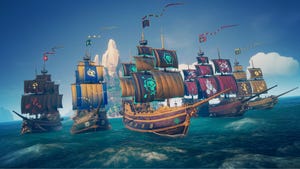
plays. Pirates uses very simple, obvious interfaces like a steering wheel
to steer and actual cannons to point and shoot virtual cannonballs. We
decided to make the helm and cannons active while the guests are boarding
the ship. This gives them a few seconds to fire off a test shot or try
a turn on the wheel to acclimate to the interface before the pressure
of the actual game begins. Extensive guest testing of the interface assured
us the design would work with real guests.
Aside from
physical interface, the communication between the guest and the game elements
must be intuitive. We chose to bend reality in places where it would make
the game easier to adapt to and play. Some examples include:
- We exaggerated
the virtual cannonball color to an unexpected light blue color because
it contrasted with most other colors in the game and thus made the cannonballs
easier to see. We changed the cannonball physics during the final scene
of the game to be attached to the ship because the ship moves, bumps
and turns too much to keep track of your cannonball otherwise.
- In the
opening scene Jolly Roger delivers an introduction on the left side
of the ship. We found many guests looking to the right would not realize
he was even onscreen so we slowly darkened the rightmost screens to
encourage the guests to look in the direction of Jolly Roger.
- The captain's
throttle can move the boat at about 90 miles per hour and turn on a
dime because actual boat physics would have resulted in a very slow
and boring game.
- Instead
of programming what the optimal strategy for an enemy pirate ship to
defeat the guest whould be, the enemies were developed with rules that
would provide a good show. Some examples include:
- Staying
broadside with the guest ship
- Attacking
evenly on both sides of the guest ship
- Keeping
pace with the guest ship
- Leading
guests from the relatively low action open seas into high action
scripted scenarios at the islands
- Sneaking
up from offscreen when the guests had nothing to shoot at
- Staying
away from the guest ship while the serpent was onstage
By choosing
to be less concerned with reality and more concerned with what was fun,
we created an experience that matches guests' expectations of what being
a Pirate might feel like. Therefore it is easier to adapt to, quicker
to learn, and is a better show.
More emphasis on the real experiences, less emphasis on virtual.
To be successful, the ride must extend beyond what guests can get elsewhere.
With the power of graphics supercomputers in video game consoles in the
home, these rides simply cannot keep up with the curve to remain fresh
from a visual standpoint. To be worth the price of admission, these rides
must overwhelm, play to more senses, and provide a real physical experience
that cannot be replicated in the living room. In Pirates, the use of a
motion base gives guests a unique experience of feeling every cannonball
hit, every wave, and the bites of attacking sea monsters. Localized 3D
surround sound and tactile speakers create a wide sound bed of cannonballs
whizzing by, crew yelling from the rigging, and boat creaks underfoot.
Strobe lights help create the explosion of a direct cannonball hit on
the helm. 3D stereo glasses not only put the action in your face, but
also make the projector screens disappear, creating a very convincing
virtual world.
Because
guests must run from cannon to cannon to best defend their ship they get
a physical experience instead of merely sitting passively in front of
a monitor. Guests get social interaction from bumping into each other,
taking turns on cannons, barking out orders, and negotiating the rocking
ship. The feeling of being tired and practically out of breath after five
minutes of plundering with your friends or family is a feeling that you
got your money's worth.
In the cannon
interface we had a problem that guests could fire the cannons too fast,
sometimes more than 5 shots per second thus trashing the enemies before
the other players could even get a chance. Software timers to keep the
number of shots down created frustration because the cannon was not responding
to the guest input. Instead we created haptic blocks to keep the number
of shots low. By introducing some weight and friction into the firing
mechanism (a pull string) it is physically hard to shoot more than once
or twice per second. By solving the problem with real physical methods
instead of arbitrary virtual software blocks, the game remains fair and
playable. For the ambitious player with enough energy to still shoot a
ridiculous number of shots per second, each rapid fire shot decreases
in power after the first few shots. This keeps the game balanced between
the casual players and the hard core shooters.
______________________________________________________
No
one goes to a theme park alone.
|