|
Designer's
Notebook

Bad Game Designer, No Twinkie! IV
I'm
not going to write this month's column. You are. Or rather, you
already did. After last year's "Bad
Game Designer" column, I asked readers to submit their
own peeves about games, and hooo-eeee, did I get letters! So herewith,
a compendium of design flaws and irritations sent in by various
readers. I'll try to give appropriate credit where I can, but some
E-mailers don't use their real names, and in that case there's nothing
I can do.
Bad Guys With Vanishing Weapons
Many
people wrote to complain about this one. It's the corollary to the
"birds that carry swords" complaint I mentioned in the
previous "No Twinkie" column. You spend forever trying
to take down some major bad guy, and when you finally do, his weapon
has disappeared. Evan McClanahan said, "If I sneak up behind
someone and knife them in the back with one of my characters, as
he's keeping my other characters pinned down with The Inexhaustible
Machine Gun of Perforation (+2), I expect to get that gun, not an
empty corpse with three Futuristic Monetary Units and a stick of
gum."
Now,
in online games this is understandable in some respects. Monsters
respawn all the time, and if they dropped a big weapon every time
they died, the world would soon be awash in such weapons. But in
single-player games, you have the freedom to balance the game properly,
and can compensate accordingly for these issues. If it unbalances
the game too much, you can limit the player's ability to use the
weapon -- OK, you killed the troll and got his club, but actually
you can't wield a 30-kilo tree trunk all that conveniently. Or maybe
you get the big bad guy's amazing gun, but the only ammo available
for it is what he's got on him at the time. If you insist on lugging
that gun all over the place hoping to find more ammo, well, that's
your choice.
Another
corollary to this, sent in by Chris Oates, is the demon woman in
a leather thong bikini who drops a full suit of plate armor when
she dies. What, she had it with her but didn't feel like putting
it on for battle? Did it need to go to the cleaners or something?
I
have played games that got this right. You kill a little kobold,
you get a little knife. You kill fifty little kobolds, you get fifty
little knives, none of which is really worth your while to fool
with, so you just leave them behind-which is what you would do in
real life.
No Variable Skill Levels
This
one's a bit tricky because I know what it costs to implement. Balancing
a game for multiple skill levels takes more time than balancing
it for just one, and time is money in game development. Still, not
all gamers have the same degree of skill, and not all of them want
equally hard challenges. (Making games that are nightmarishly hard
just because you can is a sign of designer self-indulgence, as I
discussed in an earlier column, "What
Kind of Designer Are You?") By giving players different
skill levels, you actually increase the longevity of your game,
because players can crank it up and play through again. More importantly,
you increase the size of the market. If a game is too easy, it'll
get a bad reputation among the hardcore gamers; if it's too hard,
it'll get a bad reputation among the casual players. If you offer
variable skill levels, you can appeal to both groups.
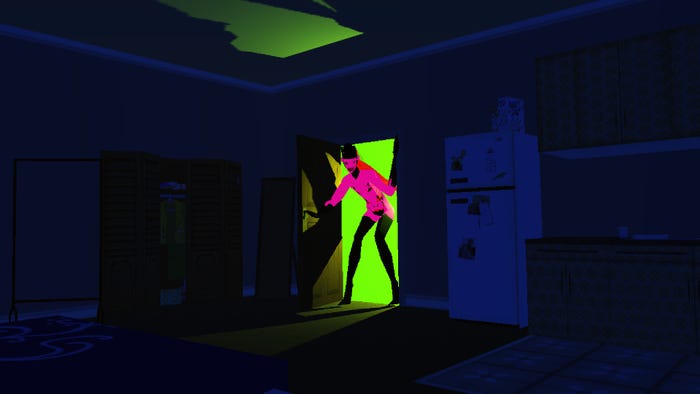
Overuse of Darkness
Trent
Lucier wrote in to complain about games that you have to play with
the blinds drawn and the monitor brightness cranked up in order
to see anything. OK, for the first five minutes it's all creepy
and atmospheric, and after that it's just annoying. And how come
all the bad guys can see in the dark a whole lot better than I can?
I agree completely on this -- I don't object to "dim,"
but I don't get much enjoyment out of "dark." Peering
around like a mole and bumping into things all the time isn't my
idea of being a cool, stealthy thief/assassin/ninja. The whole point
about stealthy assassins is that they can see well in the dark.
Charlie
Byers also pointed out that this is a problem with a lot of Mac
ports of Windows games: Macintosh monitors have different gamma
values, and he says the gamma correction feature in the Unreal engine
doesn't seem to work properly on Macs. Port programmers take note!
Sloppy Shell Menus
Various
people complained about crummy user interfaces in the game's "shell"
-- the set-up screens that you have to go through before you get
into the main gameplay mode. These are never very interesting to
design; they're just configuration screens, save and load slots,
and so on. As a result, they tend to suffer from one of two problems:
either they're done hurriedly, with poor layout and awkward organization,
or they're much fancier than necessary. In an effort to disguise
the fact that they are computer-oriented bookkeeping functions,
and make them fit in better with the theme of the game, all the
menus are done in rotating letters of fire, with sparkle effects
on the currently highlighted item.
The
best way to make the game's shell work for the player is not to
gussy it up with a lot of meaningless effects, but to make it well-designed
and easy to use so that he can get into the game as quickly as possible.
Create a font that fits with the theme of your game by all means,
but make sure it's easily readable, too. Try not to have menus any
more than two layers deep. Be sure you have reasonable defaults
for everything so the player can jump right in, without having to
make any changes the first time he plays. (Given the variability
of PC hardware, I know this can be tricky.) The first page of the
manual of the old Borland Turbo Pascal compilers -- even before
the title page -- was called, "How to Get Started Immediately,"
because they knew everybody was going to want to dive in headfirst.
That's even more true of players.
Never
forget: while the shell is the least interesting part of the game,
it's also the first thing the player is going to see, before he
gets into the real experience. As they say in the job-hunting manuals,
you only get one chance to make a good first impression.
Time-Wasting Random Encounters
So
you've cleared the entire town of Squelching-in-the-Marsh of the
nasty rats that were making life miserable there, gained a few experience
points, and now you're off to greater deeds of derring-do elsewhere.
But of course, you have to return to Squelching every now and then
to sell your loot and replenish your stock of Crossbow Bolts of
Extra Pointiness +3. Problem is, every time you come back, you get
attacked by rats again in random encounters. By this point you've
got the strength to take on ferrets or even juvenile badgers, so
it's a complete waste of time. Rather than stand around fighting
rats for the measly few experience points they get you, you actually
find yourself running away from them just to avoid the problem!
A
variant on this nuisance is that you get back to Squelching only
to discover that it has mysteriously repopulated with a whole lot
more rats, only now they're five times as mean, and you have to
do it all again. They look and act exactly like the last lot of
rats, so there's no new gameplay, just another meaningless challenge.
This
is clearly a Twinkie Denial Condition. A moment's thought will give
the correct approach. 1) Any region that you have denuded of a given
species of creature should remain denuded of them for a while (that's
basic ecology as well as good game design). 2) Random encounters
with creatures too small to represent much of a threat should result
in those creatures fleeing in terror (that's basic animal behavior).
That way you don't waste the player's time with pointless combat.
Not Being Able to Save After Fine-Tuning
Things
Regular
readers of this column will already know where I stand on the "save
game" debate: I think players should be able to do it when
they want to, and if they reload all the time to get through a tough
patch, that's their privilege. However, I'm prepared to acknowledge
that there are other points of view on this.
But
it's really annoying, as Brendan Sechter pointed out, when the game
requires you to fine-tune your units/weapons/whatever at the beginning
of a level in order to face its challenges, then gives you no way
of saving that work. Tuning the disposition of your forces can be
a fun part of gameplay, but not when you have to do it repeatedly
every time you restart a level -- after a while it's just boring
bookkeeping.
Bad (or Nonexistent) Camera
Controls
Dave
Wilson brought it to my attention that there are some third-person
3D games that give the player no control over the camera at all.
Bad game designer! That's what 3D environments are for: it costs
you nothing, zip, nada, to provide freedom of perspective. Look:
the ordinary human field of view is about 120 degrees wide. The
width of the field of view varies considerably in games, and will
get larger as HDTV becomes commonplace, but it's nowhere near 120
degrees in any case. In order to compensate for the fact that the
player is effectively trying to play while wearing a box over her
head, she needs decent camera controls. It can be done well. Look
at Spyro the Dragon or Toy Story 2 for the original
Playstation, and you'll see excellent examples of smooth, intuitive,
player-controlled cameras.
Creatures That Can Resurrect The Corpses of the
Fallen
I've
seen this in a couple of places, and it feels like a fun and natural
addition to a fantasy game's gameplay. The Dark Necromancer has
the power to resurrect the bodies of his fallen enemies and make
them fight on his side as zombies or some such. Great touch
or so it seems. Unfortunately, if it's not properly handled, it
unbalances a game something fierce, because it creates uncontrolled
positive feedback: the more units you lose, the more the enemy gains.
As I've said elsewhere, imagine what would happen to chess if you
got to keep the pieces you captured to use as your own: the game
would be a whole lot shorter. Any game mechanism that enables one
side to take over the other side's units is going to require great
care in balancing.
Dungeon
Keeper actually had no less than four mechanisms for turning
enemy creatures into "friendlies," and they were all balanced
in different ways:
1.
You could capture enemy creatures, put them in the prison, and
let them starve to death. (In certain respects Dungeon Keeper
made Grand Theft Auto look like a model of human decency,
but we won't go into that now.) In that case they turned into
low-level skeletons, and skeletons were pretty flimsy warriors
at the best of times. It also took a while. Between the time required
and the reduction in strength, it wasn't a severely unbalancing
technique.
2.
You could capture enemy creatures and torture them in the torture
chamber (yes, yes, I know), which would eventually cause most
of them to switch sides. In this case you got a creature who was
just as strong for you as he had been for the enemy's side. The
disadvantage here was that it took a very long time and you had
to constantly cast expensive healing spells, or the creature would
die under torture. Also, the tougher the creature was, the longer
it took, so that naturally tended to balance out the benefit.
3.
You could drag the bodies of dead enemies to a graveyard, and
when enough bodies had been buried there, the graveyard would
yield up a vampire. The balancing factors here were that it took
several dead creatures (eight, if I remember correctly) to produce
one vampire, and the graveyard was extremely expensive to build.
On the other hand, vampires were among the most powerful creatures
in the game once they were trained up, so this was a highly efficacious
technique.
4.
The original Dungeon Keeper had a special room called the
Scavenger Room, in which your creatures worked to persuade those
on the other side to come over -- a sort of traitor recruitment
facility. The tradeoff here was that the Scavenger Room was extremely
expensive, like the graveyard, and while your creatures were working
in it they were not available to train or fight. Besides, the
other side could have its own Scavenger Room as well. However,
this feature was really too unbalancing -- in two-player mode,
whichever side built a Scavenger Room first tended to win -- and
so it was eliminated in Dungeon Keeper 2.
In
short, Dungeon Keeper is an example of a game that managed
to get this right, and one to learn from.
The
other problem with resurrecting the corpses of the fallen is that
often the resurrecting unit is something very strong: a mighty warlock
or something similar. As a result, any group with him in it is well-nigh
invincible. If you're going to give a particular unit the power
to perform such resurrections, consider making him weak and vulnerable
by way of compensation.
Conclusion
I've
still got lots more Twinkie Denial Conditions that I didn't have
room to use this time around
I'm thinking of setting up a
database! But I'm always interested to learn about new ones. Drop
me a line at ewadams@designersnotebook.com
and tell me about the game design flaws that really hack you off.
(You might check the previous columns first to see if I've already
mentioned them).
______________________________________________________
|