|
Features

Enhancing the Impact of Music
in Drama-Oriented Games
Observing games over the past ten years has been fascinating.
The medium has constantly been maturing - graphics have become more
sophisticated, gameplay mechanics have evolved, and improved AI
has enabled programmers and designers to create more realistic interactions
with virtual characters in gameworlds. My favorite evolution has
been the increase in quality of game music. We now have the potential
to do what any film composer can do... we can tap into the deepest
parts of the human emotional pool; for the most part, we're not
restricted by playback or storage limits anymore.
This
leads to a question. Regardless of these constant improvements,
why hasn't the level of emotional intensity in a game reached the
same level that film achieves? Why do we find ourselves permanently
affected by watching great films like the Lord of the Rings
trilogy, yet we don't glean that same heart-level impact from the
games based on the same stories? There are multiple reasons. Some
facets of the typical game require a bit more evolution before they
can effectively suspend the disbelief of a player to any substantial
level. However, the one facet that could contribute to a
higher level of emotional involvement in today's games has been
consistently under-utilized. That facet is music.
It's
very apparent that game designers are striving and wishing for the
level of emotional sophistication in their games that Hollywood
achieves in film. It's apparent because we're always trying to "filmize"
our games. We set up cut scenes to try and propel an emotion onto
a player using camera angles, character expressions, and of course,
orchestral cues. We attempt to add drama to in-game events by triggering
intense battle music whenever a player gets into a fight. We add
music to areas and levels to bring them an identity and to try and
create an emotional backdrop. It would seem like this approach makes
sense, but there's a problem. Games aren't film.
Film
benefits from the luxury of being linear - having a fixed set of
visuals and order of events. This enables a composer to know exactly
what is coming, and to choose to speak through that fixed reality
in a musical way that sets up the perfect emotional "hook."
Games, however, hold levels of relativity that can't be foreseen,
calculated, or controlled. Things don't always happen the same way
(or on the same timeline) between two different players playing
the same game. We can't expect the emotional formulas that work
on a film audience to work exactly the same way on a gamer.
However...
there are some concepts that we can take from film soundtracks,
rework them, and apply them in games.
Before
we talk about solutions, we need to dispel some myths and mistakes
we currently make in how game soundtracks are implemented today.
Music
Mistake #1 - "Watering down my music and making it 'subtle'
will help it to fit in and work in multiple situations."
This
is the "sidestepping" approach that has been used in game
music for a long time. It needs to be addressed.
One
of my favorite role-playing games is Elder Scrolls III: Morrowind
by Bethesda Softworks. I love the music from this game, but in terms
of its emotional function throughout a gameplay session, it honestly
doesn't accomplish much. The music is ambient in nature and simply
plays straight through for roughly thirty minutes, then starts over
again. There are cues for battle encounters, but other than that,
nothing. When I enter a dark dungeon that is critical to the game's
storyline, the music doesn't foreshadow anything. When I have just
finished a battle and am inches from death, struggling to get back
to an area where I can rest, the music doesn't reflect the critical
nature of the situation at all. There is not even a shift in the
wrong direction - there's no shift at all. This forces the
question: why is the music even playing? It's obviously not to impose
emotion onto the player in a direct way. Does keeping the music
playing in an ambient state add to the "ethereal experience"
of being in the gameworld? Not really. It's just white noise. It
would be more effective to create a soundscape of wildlife or city
bustling noise; this would at least draw the player into some sort
of virtual reality. Playing ambient music in the background actually
does the opposite; it further detaches a player from being
convinced that the gameworld is any sort of reality at all.
So
why do designers and producers (and even composers) make this mistake?
There are a couple of reasons. The biggest one is simply the fact
that it's the norm. There has always been level music. There has
always been something to hum to while you're jumping from pipe to
pipe, squashing mushroom people. We generally aren't comfortable
with musical silences in games. The irony is that not even a film
plays music the entire time. It appears that designers and composers
don't understand the significance of the "less is more"
factor in music for games... we're just too attached to what's comfortable
and we won't let it go.
I
think we also make the mistake of watering down the music because
we don't trust the player to be able to form their own emotional
picture based on what they're doing and experiencing in the game.
We don't realize that entering a dark forest in Lionhead Studios'
Fable can be just as immersive and spooky when you're only
hearing the audio backdrop, as when the music accompanies it. (Try
turning off the music next time you play.) We forget, that simply
by giving a player a form of input and letting them become part
of the game, it is already emotionally involving them on a certain
level. When we can learn to trust this concept, we can use music
in specific situations to augment emotions and raise the
stakes a notch. You don't have that opportunity when ambient music
has already been playing for ten minutes or more - it's just not
as effective.
Music
Mistake #2 - "Adaptive music will solve emotional detachment
issues and tie players into my game because it will follow what
is actually happening."
A
level of interactivity is necessary when it comes to music in games.
We need to trigger things at the right times, and even having music
that evolves to a degree based on changing circumstances can be
effective. However, looking to highly-adaptive music methods as
a solution to express more mature emotions might not be the way
to go. We talked about how ambient music doesn't accomplish much
emotionally because of its lack of being placed in a context. Adaptive
music can suffer from a different problem: it can be too reactive.
One
of the great powers a film composer has is the ability to choose
from various types of music in a single scene to bring across different
emotional impressions. As an example, by tying humorous music to
a physically violent scene, a different type of emotion is aroused
in the viewer than if there was agitating music (or even no music
at all.) For this reason, it is important that the music retains
its independent position of emotional influence and power, and doesn't
become dependent solely upon literal events in the film. This is
no different for games. If my dynamic music engine simply follows
gameplay and triggers "appropriate" music based on what
the player is doing or experiencing, then that music loses its ability
to speak independently. It can no longer impose unique kinds of
emotions by relating the music in contrasting or half-parallel ways
to the situations themselves. The music loses its position of influence
and becomes a slave to game events (and ultimately, a slave to player
input.) If ambient music is on one end of the spectrum, then dependent
"adaptive" music is on the other. Neither extreme serves
very well in drama-based games; they both end up being a sort of
watered-down function.
Music
Mistake #3 - "Cut scenes with live orchestral music will get
players more emotionally involved in my game."
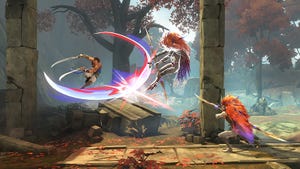
Prince
of Persia: The Sands of Time by Ubisoft is a gem in the animation
department. Not only are the Prince's in-game movements a smooth
sight to behold - the cut scenes that precede and end the game are
spectacular to watch as well. It's interesting, though - the cut
scenes that occur during the Prince's journey through the palace
aren't rendered in "full movie splendor" like the opening
and closing ones. Instead, they are either fragments of gameplay
(while the Prince is receiving a vision) or they are sequences rendered
with the same "realtime level" of graphics detail that
appears during actual gameplay. When designing a game that focuses
so heavily on story and dramatic presentation, wouldn't Ubisoft
have been smarter to go all out and do all of the cut scenes
"movie-style," sparing no gimmicks, including a no-holds-barred
policy on the picture-synchronized musical underscore? One would
think so, but it's a good thing they didn't. This approach might
have actually dropped the immersion factor a notch.
We're
really addressing two different issues here, but they tie into each
other with the same subtly deceptive concepts. It's important to
get down to the core of the issue and ask "why do game designers
put cut scenes in a game?" Yes, it's true; they do expose storyline
and introduce new material into the game, but then, couldn't we
just do that with a simple dialogue box on the screen? We could.
But that's the point . . . cut scenes are created because the designer
thinks; "I want to make an emotional, dramatic impact on the
player with the way I present this information." By all means,
a game designer should have this goal! It makes sense then why a
designer would ask for a full orchestra to accompany these cut scenes.
The orchestra is legendary. It's been around for hundreds of years
and is the dynamic, de facto standard for injecting emotion into
a film. "So we should use it for games!" Yes we should...
but by tying it to a cut scene in a game, we've quite possibly lowered
its impact. How can this be?
Watching
a film is a passive form of entertainment. When one sits down to
watch a film, one expects to be taken on a ride of sorts and be
moved in some way by simple observation. Games are different. If
I've been playing a game for an hour or so, I've learned to identify
with the character I'm controlling. It goes beyond identification
with a film character.. it's an extension of me. When we
are talking with friends about our recent Halo escapades,
we don't say, "It was cool when Master Chief lobbed that grenade
from the cliffs and took out a Warthog." Instead, we say, "It
was cool when I lobbed that grenade." Even if Master Chief
doesn't look like me or move like me, I'm still attached because
I'm in control. I'm actively participating in the character's fate.
Then comes the cut scene. Suddenly I'm not in control of my character
anymore. And what's more, those black bars have closed in on the
top and bottom of the screen, signifying to me that this is, indeed,
a cut scene.
|
|
|
 |
 |
 |
You
are the Master Chief.
|
What
does a player do next? They revert immediately to "film mode"
as well. They sit back and watch things happen to the characters
on screen, soaking in the great visuals and thundering orchestral
music. You've just lost your player. Regardless of how attached
they were to the character they were controlling, that character
is no longer an extension of the player once the cut scene begins.
They're "taking a break" from their role in the gameworld
reality, and even if the cut scene has the best stuff in the world
in terms of video and music, your player's emotional involvement
will never be as high as it would have been had they remained involved
in some way. In the Prince of Persia example above, at least
the player maintains some connection with the Prince during
an in-game sequence, because most of these sequences resemble gameplay
(thus psychologically relating to user input.)
The
point isn't to veer off into the philosophy of game design, but
rather, to identify the reality that better sounding and more dynamic
music will never compensate for the loss of agency that a
player experiences during a cut scene in a game. If you were to
take the same dynamic, intense orchestral music that you used during
a cut scene and instead, triggered it when the player began fighting
the final boss, the emotional message portrayed by that music would
be ten times more effective. Why? Because the intense music is not
just coloring the situation emotionally, it's also indicating to
the player, "You're in the hot seat right now."
Music
Mistake #4 (The Big One) - "Let's just loop the music once
it reaches the end."
From
the dungeon music in Final Fantasy to the Overworld theme
in The Legend of Zelda, from the eighties through the new
millennium - we've constantly used this technique. There are so
many reasons why this is a bad approach. Looping tends to go hand-in-hand
with the "watered-down, ambient music" approach; and,
it makes it worse. Not only have you eliminated the emotional effectiveness
of the music by generalizing it and not applying it to a context,
but by looping it over and over, you've completely detached the
player from even registering it altogether. And what's worse, it
usually becomes annoying after a time. Now we've moved down from
"why should we even have music playing here" to "why
shouldn't we turn off the music altogether and listen to MP3s?"
Let's be honest. Why even hire a composer in the first place if
the music isn't going to play a functional part in the gaming experience?
Why
do we fall into this trap? We covered some of the reasons earlier.
It's familiar. It's how we did it in the eighties, the nineties,
and how we still do it in most games. We can make this mistake if
we have a small music budget and we "want to make the best
of what we have." It might even be as simple as "I don't
know what else to do besides looping, because I'm just the programmer
and Mr. Producer told me to stick Music A into Level B." A
programmer should not have to make these kinds of decisions on AAA
titles. Ideally, they should never have to make these kinds of decisions
on any title. The bottom line: If we can't move beyond mediocre
methods of implementation when it comes to music, we will never
progress and mature in this area.
So
then... what is a good, effective way to compose and implement music
as we're trying to avoid these pitfalls? How can we create situations
in our games where music begins playing and literally instills fear,
joy, love or anxiety in a player? Here are some basic rules we could
keep in mind that would set us on the right track.
Good
Music Rule #1 - Follow the dramatic arc with the game's soundtrack.
In
film, the soundtrack has two purposes. One is to impose emotion
on a scene, whether that is a subtle underscore during dialogue,
or a full-blown cue with just visuals and music. The second purpose
is to supplement a dramatic arc over the whole of the film by connecting
everything together musically. This musical arc is often more
important than the literal events themselves because it can infer
deeper meanings... more than simple actions on the screen can. Good
directors know this. Music can depict aspects like motivation, hidden
emotion, or sarcasm. This second function of a musical score is
something that we have not begun to address in any sophisticated
manner in games. In a film there are key scenes or events that,
when coupled with key musical themes or cues, bring together meaning
into a whole picture. These "musical events" should occur
in a game as well (beyond simply inserting a cut scene.) Composers
should start thinking beyond "What does this level sound like"
to "What role does this level and its characters play in the
grand scheme of the game and the plot? How do I portray that with
the music I write? Where do I place the music within the level to
bring this across in the most effective manner?"
|
|
|
 |
 |
 |
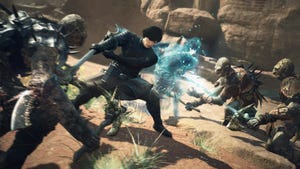
Baldur's
Gate: Dark Alliance has more dramatic music.
|
In
Baldur's Gate: Dark Alliance, composer Jeremy Soule comes
a little closer to developing some dramatic points in his score,
compared to Morrowind. Boss battles feel more intense than
common battles because there is no music triggered to accompany
the everyday, normal monsters. (There is only ambient background
music specified by area.) When specific music kicks in for a boss
battle, you not only know you are fighting a boss, but it feels
more important as well. Each boss has its own identifying style
and theme. And in the final battle against Eldrith, Soule brings
back the main theme of the game that plays during the title screen,
signifying that this battle is, indeed, the most important of all.
Create
a musical climax in your game. Don't use your most intense music
until you've reached critical points in the game's dramatic arc.
Is the final boss battle more important than the miniboss battle?
Show it in the music. A player should be able to subconsciously
interpret the importance level of events based on the music that
accompanies them.
Good
Music Rule #2 - Never use music unless it is making a specific
emotional statement to the player.
When
music plays in a game, it should mean something. It should support
something specific. In a film, music never plays just to play. So
why do we do this in our games? Here is a good rule of thumb: "The
less you use something, the more effective it is when you do
use it." We shouldn't be afraid of musical silences in games.
This is what ambient sound is for. Use the sounds of forests or
dripping caves or crowded streets to immerse a player in a game's
reality, and trigger the music when you want to bring the player
up to the next level of emotional awareness. By keeping the music
more sparse, it will retain its special element of influence and
won't be simply "tuned out" by players when it is triggered.
And more than likely, you can completely avoid looping your music
by using this mentality. This approach is the best way to spend
a composer's 60 minutes of music, because each minute will count.
Good
Music Rule #3 - Get the composer involved early in the process!
To
add to the rule above, this is absolutely necessary if you
expect to have any type of emotional coherence in your game. Film
composers can be given a fixed and final product (usually) and they
only need to watch it to get an idea of how music should be inserted
from a technical and artistic standpoint. Games are intricate pieces
of software and the composer needs to understand how the
system of the game works. The composer needs to know the designer's
motivations from a dramatic perspective and from a story perspective,
but they also need to know how that story is going to be presented,
and what kind of influence the player might have on how that story
progresses. The bottom line: games are much more complex than film,
and require a deeper understanding from everyone involved when artistic
choices are being made. This is why the current model of "hiring
the composer when we're done with the game" is not a good idea
and will never result in an emotionally mature experience for the
player. (Especially if the composer is under extreme deadline pressure
from the get-go.)
It's
also important that the composer be able to do at least some (if
not all) of the music implementation. The composer knows his/her
music better than anyone else, and needs the ability to experiment
and find what works best to match the producer/designer's vision.
Whether this involves teaming up with an audio programmer, or having
decent implementation tools created for inserting music, there should
be a way for the composer to have a heavy influence in all the musical
performance aspects of the game.
Good
Music Rule #4 - The more content, the better.
Drawing
off of what we just talked about in Rule #2, a piece of music can
have an even greater impact if it is only played in one place in
a game. There is nothing more effective than having a section of
music that identifies a single critical moment or event in a dramatic
storyline. The more musical content that can be created for a game,
the more headroom a composer has for dedicating certain unique cues
to certain places. The reality of music budget size and the cost-per-minute
to hire a composer can get in the way of this; but maybe, by getting
a composer involved earlier and dedicating more of a game's budget
to music and sound, we can alleviate this issue. Awareness of how
much influence a well-written and well-implemented musical score
can have in a game, hopefully, will raise the priority of a game's
soundtrack in the budget in the near future.
We
are on the brink of a new reality. Games are becoming more and more
a part of popular culture with every passing year; eventually, interactive
entertainment will take the lead, outdistancing forms of passive
entertainment like film. (I think, for me, the reality of this really
sunk in when one of my friends bought Halo 2 from a local
gas station.) For this transition to happen, however, we will need
to focus on issues such as emotional maturity and the important
role of music in our games. Music plays a large part in how a dramatic
medium is perceived and processed and it's something that we need
to start developing further by breaking out of old traditions and
comfort zones. I hope someday soon we will all be talking about
certain moments in games that moved us to tears or held special,
personal meaning for us. I hope those moments come with a great
soundtrack as well.
______________________________________________________
|