Latest News
spacer View All spacer
 
November 22, 2009
 
Video Game Watchdog National Institute On Media And The Family Shutting Down [12]
 
Modern Warfare 2 Infinity Ward's 'Most Successful PC Version' Yet [14]
 
New Tech, Design Details Of Project Natal To Emerge At Gamefest In February
spacer
Latest Features
spacer View All spacer
 
November 22, 2009
 
arrow Upping The Craft: Susan O'Connor On Games Writing [7]
 
arrow Small Developers: Minimizing Risks in Large Productions - Part II [7]
 
arrow iPhone Piracy: The Inside Story [51]
spacer
Latest Blogs
spacer View All     Post     RSS spacer
 
November 22, 2009
 
Managing Creativity
 
Time Fcuk - A Postmortem [3]
 
Accepting the Inherent Value of Games
spacer
Latest Jobs
spacer View All     Post a Job     RSS spacer
 
November 22, 2009
 
Trion Redwood City
Sr. Environment Artist
 
Trion Redwood City
Sr. Evnironment Modeler
 
Sucker Punch Productions
Network Programmer
 
Sucker Punch Productions
Texture Artist
 
Sucker Punch Productions
Character Artist
 
Sucker Punch Productions
3D Environment Artist
 
Crystal Dynamics
Sr. Level Designer
 
Sony Online Entertainment
Brand Manager
spacer
About
spacer News Director:
Leigh Alexander
Features Director:
Christian Nutt
Editor At Large:
Chris Remo
Advertising:
John 'Malik' Watson
Recruitment/Education:
Gina Gross
 
News

  D.I.C.E: Harmonix Co-Founder Rigopulos On 'Living The Dream'
by Frank Cifaldi, Brandon Boyer
0 comments
Share RSS
 
 
February 9, 2007
 
D.I.C.E: Harmonix Co-Founder Rigopulos On 'Living The Dream'
Advertisement
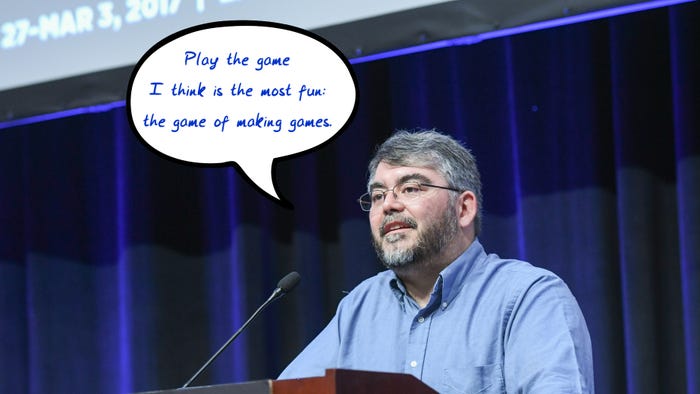
As the first lecture of the second day of the D.I.C.E. 2007 summit, Harmonix co-founder Alex Rigopulos led the audience through a brief history of the company from The Axe to more recent axes, and previewed its future.

Harmonix's first four or five years, described by Rigopulos as "not pretty at all," saw the release of the PC CD-ROM The Axe, which, he said "took all the hard aspects of creating music and buried them into AI,” exposing players only to the fun parts of playing music.

Though innovative, and certainly prescient of the direction the company would soon be headed, the application "went on to sell was literally about the same as the amount of people in this room right now," [approximately 100] and, and the team "convinced ourselves that where this stuff really belonged was in karaoke boxes in Japan."

"This was a profoundly wrong revelation," said Rigopulos, saying it wasn't until the birth of the rhythm game genre in Japan with Parappa and Beatmania changed everything for the company: "We said, ‘oh, games.’"

The company's following years, from the company's first critically acclaimed rhythm game Frequency which won multiple awards, but, Rigopulos said, from a sales perspective, "made mouse nuts,” to its similarly acclaimed but poor performing sequel Amplitude and experimental EyeToy project AntiGrav, saw the company struggling through "the pits of despair" despite a more marketable partnership with Konami on Karaoke Revolution.

It wasn't until Harmonix took a risk on a partnership with then fledgling company RedOctane with Guitar Hero that, Rigopulos says, "things got kind of interesting."

On the future of the company, following Activision's acquisition of RedOctane and the more recent move of the Guitar Hero franchise to Neversoft and MTV's own acquisition of Harmonix, Rigopulos says that despite the 'visions of stardom' the phrase ‘living a dream’ brings, the CEO is "approximately as anxious and stressed out about my work as any four months during any game development."

Though the company is still not prepared to talk specifically on forthcoming projects, "There’s a new fear of high expecations for our next game, and a fear to not let down MTV," he said, adding that more importantly, "we have the resources and expertise to get our vision right, and along with that comes the stress with wanting to make absolutely certain we don’t screw it up. And in a lot of ways this stress is every bit as potent as it was before we made a hit game."

"This ‘dream’ that Harmonix has started living is not a place that we’ve just arrived at," he said, "Success doesn’t come from just one achievement, but this ongoing sense of forward motion, of beating a level and opening a door to the next level."

He added, "The key thing for us to constantly recognize, I think, is that all of this anxiousness and urgency and self-doubt and stress, which every game developer deals with, flows from something profoundly positive. We all genuinely care about the games we’re developing."

"Laboring creatively in the service of something we love," Rigopulos concluded, "This is the dream that all game creators are living all the time."

A full write-up of Harmonix's history of the company will appear on Gamasutra at a later date.



Comments

none
 
Comment:


Submit Comment