|
 |
 |
If you enjoy reading this site, you might also want to check out these Think Services sites:
Game Career Guide (for student game developers.)
Indie Games (for independent game players/developers.)
Finger Gaming (news, reviews, and analysis on iPhone and iPod Touch games.)
GamerBytes (for the latest console digital download news.)
Worlds In Motion (discussing the business of online worlds.)
Game Set Watch (the Group's alt.game weblog.) |
 |
|
 |

| |
GDC: Zimmerman Milks The Casual Cash Cow
by Vincent Diamante
|
|
| |
|
March 6, 2007
|
| |

Based in China with over 400 staff, Virtuos is one of the largest providers of outsourced production services
to the games industry, specializing in 3D Art, Animation, Co-development, Engineering and QA.
Its international
management team is led by Gilles Langourieux former Founder and Managing Director of Ubisoft China Studios and
backed by Legend, the number one IT group in China. Since its creation in late 2004, Virtuos’ clients include
leading developers as well as 14 of the top 20 games publishers worldwide.
Website: http://www.virtuosgames.com
|
gameLab, the New York City based independent game studio co-founded by Eric Zimmerman is now in its seventh year of operation. Starting with a deal from Shockwave.com, he and Peter Lee moved the company from a small computer game developer to a much less small and still successful developer of casual downloadable games. Throughout, gameLab has maintained its focus and identity within the game industry.
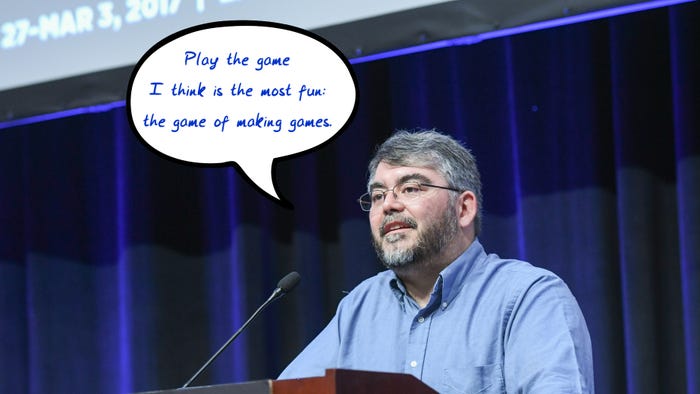
“The most important thing is this idea of staff authorship... that people feel like the work they’re doing is their work,” said Zimmerman. This means actually giving individual employees authority and responsibility, something developers just can’t fake. There is scariness there, but letting people make mistakes is essential.
Developing the company culture starts from day one. At gameLab, Zimmerman knew that they wanted to create a culture of research, so they encourage the staff to have rich lives outside of the company. Culturally sophisticated employees, says Zimmerman, contribute to the identity of the company as a whole, insisting that developers be aware of the company culture that you’re actively making.
Zimmerman also pushed the idea of the “honest hustler.” You should have a designated hustler at your company, and he should know what you are hustling. He should also be able to hustle to different contexts, such as serious games, academic grants, or different licenses. Involving staff in creating the vision is also helpful. If they’re part of the process of creating the vision and stand by it, “They’re going to help hustle the company for you.”
While gameLab has seen success doing casual games, Zimmerman couldn’t ignore the problems that still permeate the model: low conversion rate, conservative portals, and a crowded, competitive space. Still, there are plenty of positives, like its meritocratic nature and the ease of digital distribution, that keep Zimmerman of the firm belief that it’s overall model is the future of games distribution.
Alluding to the earlier talk by Jonathan Blow, Zimmerman stated that a great process is much more important than simply great ideas. “If you have a good process in place, the process solves the problems.”
By the end of the session, Zimmerman couldn’t let the hour escape him without referencing some game design ideas. Just as rules directly create play in a game design, rules create a model for running a company and potentially transforming the industry. “Within the culture of games, we have the models for rethinking and reinventing what a game studio is.”
|
| |
|
|