|
 |
 |
If you enjoy reading this site, you might also want to check out these Think Services sites:
Game Career Guide (for student game developers.)
Indie Games (for independent game players/developers.)
Finger Gaming (news, reviews, and analysis on iPhone and iPod Touch games.)
GamerBytes (for the latest console digital download news.)
Worlds In Motion (discussing the business of online worlds.)
Game Set Watch (the Group's alt.game weblog.) |
 |
|
 |

| |
DICE 09: Valve's Newell On 'Using Your Customer Base To Reach New Customers'
by Chris Remo
|
|
| |
|
February 19, 2009
|
| |
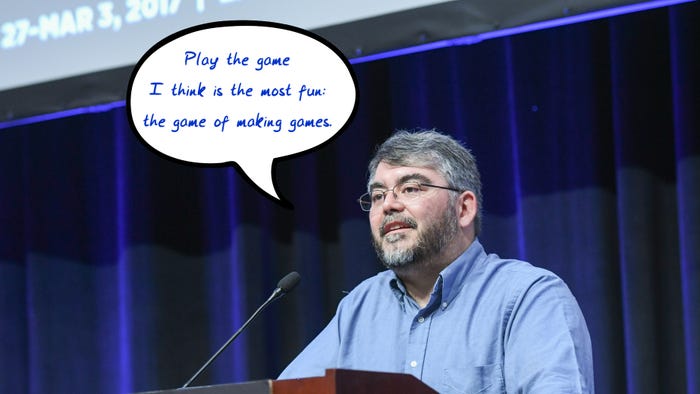
Kicking off DICE 2009, Valve co-founder Gabe Newell discussed a theme central to his company’s success: entertainment as a service.
“The old way was using intermediaries,” Newell said, in a lecture attended by Gamasutra as the Las Vegas game business event.
“The product would be sold through retailers or other intermediaries. …You were really focused on spending three years to build value for your customers to get through the friction of the retail experience.”
When you focus on entertainment as a service, on the other hand, “you will use your customer base to reach new customers, and your focus is much more about providing ongoing value to your customers – maybe every three weeks, or even more often than that.”
The internet is fundamentally changing the medium, says Newell, and the new model affects all parts of the business.
“There are songs that are dusty, sitting in the back catalogue, and by putting a service layer on top of it – some level of interactivity – those very same songs become very profitable all over again,” he says, pointing to games like Rock Band and Guitar Hero as ways of making existing media “vibrant again.”
The Piracy Thing
Moving onto the hot-button issue of piracy, Newell says pricing is not the main problem. “The pricing issue, I think, is really misleading,” he says. “In the PC audience, these people are spending thousands of dollars on their PCs and their internet connectivity. They are perfectly happy to spend money, so that’s not the issue. But when it comes to the service, that’s where the pirates are way ahead of us.”
He gave an example of wanting to own copies of the Dr. Who television series on DVD – but being unable to legally do so, because it isn’t available in his region. When consumers are presented with such scenarios, pirates win out.
Furthermore, Newell claims, techniques like DRM actually increase piracy, not decrease it. It puts more distance between content creators and their customers, which ends up disempowering the creators.
Keeping The Customer Close
On that theme, Newell noted that Valve conducts huge amounts of gameplay and other data tracking on Steam to help with game design and pricing schedules – but rather than putting a veil of secrecy between users and that information, Valve makes it available to the press to distribute it out to the gaming community at large, strengthening the bonds between creators and consumers.
The word of mouth and other “natural” marketing that occurs as a result of close communication with the user base ends up being far more meaningful and effective than traditional paid marketing, Newell notes.
Newell says Steam, Valve’s digital distribution platform was formulated after asking the following question: “How can we have a relationship with our customer to maximize the relationship to our customer and monitize that relationship?”
Steam currently boasts 20 million users and 350 games – and the service is seeing consistent year-on-year growth of 100 percent.
What People Want
There are some key desires on the part of both the customer and the provider, Newell notes. Customers, for example, want portability of their content and files, multiplayer games that are free of cheating, software that keeps itself updated, a broad and diverse variety of games, and a rich social environment.
On the other hand, says the co-founder, businesses have their own desires. They want to be paid for their content without needing to worry about rampant piracy, and they want to be able to maintain worldwide pricing structures.
“If it makes total sense for me to have certain pricing in one part of the world, I want to make sure that price doesn’t flow into other parts of the world and mess up my distribution models,” he says.
Developers also want to stay in touch with their customers – a desire that intersects with the consumers’ own desires. But they also want useful data that shows if, and to what degree, promotions are having a real, tangible effect. Trying to track such information at retail is “like handling your data with oven mitts on,” says Newell, but Steam-like platforms make it trackable in real time.
Businesses also want a choice of business models – some games might be subscription-based, some might depend on advertising revenue, some might rely on downloadable content, and so on.
A Case Study
Valve’s Team Fortress 2 provides a real-world example of the “entertainment as service” model. When the company shipped the game, “that was just the start,” Newell says.
In the 14 months since the game shipped, the PC version of the game has seen 63 updates – “that’s the frequency you want to be providing updates to your customers,” he adds. “You want to say, ‘We’ll get back to you every week.’”
“The degree to which you can engage your customer base in creating value for your other players” is key, says Newell. “When people say interesting or intelligent things about your product, it will translate directly into incremental revenue for the content provider.”
“We think our customers are ahead of us on the notion of what kind of entertainment company they want us to be,” he says. “They’re saying, you can’t be a game company anymore, you have to be an entertainment company. …The successful entertainment companies are the ones who have product development groups who are successful at making cross-media entertainment choices that are the most valuable.”
For example, Valve has made a series of Team Fortress 2 short films that have proved very successful in increasing visibility of the game – and the company plans to have the team responsible for those movies to move onto creating comics.
“Why does it work?” he asked. “It works because the people who build it are the same people who build the game.” Newell painted a strong contrast between keeping such supplementary content in-house, and contracting it out to a third party that has less investment in the core property.
Converting Customers
Much of the success of Team Fortress 2 comes from players who become evangelists for its games – Valve hands out limited-time Steam-based “guest passes” to its most fervent players, who then introduce their friends to the game.
The hardcore players tend to become invested in making sure their friends have a good time for the duration of their free pass – and the conversation rate among those friends ends up being incredibly high.
“Converting people from being spectators to being paying participants,” Newell sums up, “is something that a clerk at a retail store can’t possibly do.”
Pricing As A Service
The retail model of “lower the price until the game ends up in the bargain bin” is purely a function of “friction in the [retail] system,” Newell argues – it’s not a necessary pricing model outside of brick-and-mortar stores.
In reality, he says, with an online service, pricing can be moved up or down depending on appropriate data, those changes can be executed instantly, and customer response data will be available “within five minutes.”
“Last weekend, we decided to do an experiment,” he says, referring to this past weekend’s Left 4 Dead sale, which brought the game down to $24.99 through Steam – sales rose 3000 percent, and revenue far eclipsed the game’s sales during its launch window.
Meanwhile, Newell notes, retail sales did not change at all (full Steam integration allows Valve to monitor retail sales as well) – defeating the assumption that Steam sales cannibalize retail sales.
“One thing that really annoys me is the inefficiency of pricing we have in our industry,” Newell says.
When Valve held its recent holiday sale, titles discounted by 10 percent (the minimum) they saw revenue (not unit) increases of 35 percent. At a 25 percent discount, revenue was up 245 percent.
At 50 percent off, revenue was up 320 percent, and at a 75 percent discount, revenue was up an astonishing 1470 percent. Newell stressed again that those revenue boosts represent actual revenue dollars, and not unit volumes.
Wrapping it up, Newell again pointed to emerging services like Kindle and iTunes as further proof of this service model permeating modern business development – and reinforcing its importance to the games industry.
|
| |
|
|
I grabbed the ENTIRE id Software catalog for about $35 over the holidays. From Commander Keen to the latest Doom 3 mission pack, it was all there.
I also like their automatic patching and updates. I hate having to track down patches for games. Just keep my games updated and let me spend my time playing and not scouring the Internet for patches.
One thing that I do hope gets worked out is the ability to get downloadable content for Fallout 3 via Steam without having to screw around with Games for Windows Live. You end up having to manually cut and paste games files from one service's folders to the other to get it all to work right.
I honestly hope it is a matter of time. Steam is now my preferred way to buy games. (disks are SOO pre-willenial)
I'm sorry I have to say this, but Gabe Newell lies when he says "prices don't matter". It's a very important topic and he knows it very well : did you notice the regular price cutoffs on Steam?...
Simply replacing the dollar for the Euro without taking conversion rates into account doesn't make your European customers very happy campers.
Games on steam are now rarely cheaper than retail and in some circumstances they're 50 to 70% more expensive!
Even during "sales" steam games remain more expensive than retail or other online stores.
And since that valve made this change, valve has completely ignored complaints about this!
While you talk about having a good relationship with your customers, you seem to act very differently when it comes to your European customers.
I absolutely loved everything Valve did before this.
But now I see Valve as just another money grabbing greedy cooperation.
Genius.
I mean, the world "discount" alone pushes you to buy a game even when you didnt want to buy it initially. So you feel like you saved some money by buying a discount product, when you actually spent some money that you didnt want to spend (if you know what I mean?)
I'm not sure you get this "instinct to buy a discount product" when it's not a discount product?
Some studies also proved that a game released at a low price is often perceived by customers as a bad game.
Again, you get rid of this when the low price is justified by a "temp discount"
What do you think?
Steam indeed is helping against piracy, cheap games, better service, unfortunally this service is still limited to people with broadband and foreign langauge knowledge.
Here in Brazil we have a rampant piracy, not piracy like you know in the US, it is REALLY rampant piracy, 95% of ALL games are pirated (specially CONSOLE games... not PC) the reasons for that, are in first place price...
But after that, comes the fact that piracy dealers (here broadband is so rare that people BUY pirated games, even when they are more expensive than a original digital copy), offer a awesomely crushing uberbetter service.
Example: Here the game Winning Eleven (The game was supposed to be known as Pro Evolution Soccer on western side of the world, but they pirated WE not PES) is bizarrely pirated, so pirated that people only know the wrong name (WE) instead of the right name (PES).
I asked several owners of WE (of course, pirated, since WE is not supposed to exist legally here), the reasons of that...
Awnsers: First, price, PES is 80 USD or more here...
Second, localization, PES is in english, WE is in Japanese, pirated WE comes in portuguese, dubbed in portuguese, modded to have local stadiums, teams and players, and have .pdf manual or a portuguese pamflet with the basic gameplay and has brazillian-version package (that altough lack the same material quality, being just a cheap media inside a cheap plastic with a sheet of printed paper as cover) that attracts more attention than the original.
Third: Piracy dealers accept return.
Fourth: Piracy dealers give techinical support for free and more efficient than the crappy phone support of most publishers.
Fifth: Piracy dealers are easy to find, usually having stores in the city center, or near bus stations.
Sixth: Piracy dealers do their own marketing, making runners run around (obviously) calling people, distributing pamflets and showing posters, also they do that themselves when there are not much clients nearby.
Seventh: They have a consistant supply, shortages are a rarity, not because they can copy it like mad, but because they built a distribution network, you ask a dealer a game, a runner go to a warehouse (obviously hidden, the police cracks down hard on piracy dealers), and returns with the game shinly packed. If they need a game that does not exist in the common warehouse (because several dealers use the same warehouse), it is not common to they have friend dealers that has other warehouses and share with them the products (and the profit, of course), this ensures that a shortage is a rarity.
Eight: Piracy dealers usually sells the most current version of the game when possible (ie: they sell the game already patched with the lastest patch)
Thanks!