|
 |
 |
If you enjoy reading this site, you might also want to check out these Think Services sites:
Game Career Guide (for student game developers.)
Indie Games (for independent game players/developers.)
Finger Gaming (news, reviews, and analysis on iPhone and iPod Touch games.)
GamerBytes (for the latest console digital download news.)
Worlds In Motion (discussing the business of online worlds.)
Game Set Watch (the Group's alt.game weblog.) |
 |
|
 |

| |
EA's Riccitiello: Recession 'Blessing In Disguise' That Can Clear Away 'Junk'
by Chris Remo, Leigh Alexander
|
|
| |
|
February 19, 2009
|
| |
Electronic Arts CEO John Riccitiello says the current economic climate is "a blessing in disguise," because it will force the industry to rethink stagnant attitudes and methods -- and lead to "clearing away" some of the "junk" that currently fills gaming retail shelves.
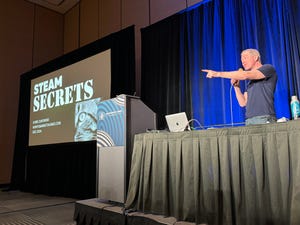
"Junk is hard to compete with," said Riccitiello frankly, speaking as part of a Gamasutra-attended speech during the DICE Summit in Las Vegas.
"We did get fat in too many places. It seemed like anyone who could draw a guy with a gun with a crayon could get funded. At least for EA, we got a little too fat, and a little too reliant on where things were."
Analysts consider Electronic Arts -- the biggest third-party game publisher in the world -- one of the most obvious cases of disproportionately large development budgets.
It recently reported disappointing revenues that couldn't close the gap between the company's mounting operating expenses, and the revenue that its underperforming holiday portfolio brought in.
The publisher is now undergoing significant restructuring to reduce its costs, an undertaking the company says will ultimately help it become more profitable.
"I’m not pro-recession," EA's Riccitiello was quick to add, "but to quote Rahm Emanuel: never waste a crisis."
|
| |
|
|
This "brightside" stuff is a load of garbage, as a third party recruiter I've seen way too many good people lose their jobs lately and it's not because they were drawing with crayons or had garbage IP.
This culling has resulted in the loss of some great IP that will never see the light of day and in my opinion weaken future game offerings....think about it, would an investor rather back a new IP or a "tried and true" licensed franchise for it's 14th iteration.
The chinese written word for crisis is written with two characters.
One is problem.
The other is opportunity.
It’s when I perceived a sanctimonious scorn towards the game developers themselves that I felt compelled to call out a few points.
I also hope that this whole industry downturn is “a blessing in disguise" and that we see a major change in the way business is done. But in order for anything positive to come from this whole situation, we’ll have to focus on the disease itself, not the symptoms.
Junk is hard to compete with, and certainly there is a lot of filler on the store shelves today. Is this down to unwillingness on the part of developers to innovate? I’m made to think of Renaissance Italy- the most talented artists were snapped up by various religious orders and exchanged their considerable talent for wages and short-lived fame. Did Michelangelo only want to paint biblical themes? We’ll never know what else he was capable of, because he did what he was *paid* to do and, at the time, there was no other game in town.
Up till now, publishers and console manufacturers have a complete stranglehold on the distribution chain, and this has forced developers to acquiesce to any demands in order to keep their businesses afloat.
For the game industry to move forward in a positive fashion, we’ll have to find meaningful ways for developers to reach their audiences, and empower them to find other, viable spaces beyond the existing, stultified climate. The best patrons understand that if they’re going to get a return on leasing someone’s creativity, they need to cultivate it and treat their charges fairly.
I’ll finish with that quote from Rahm Ammanuel. I think the part you left out is the part we as an industry most needed to heed.
“You never let a serious crisis go to waste. And what I mean by that it's an opportunity to do things you think you could not do before. “
Here's the point...this shit ain't gonna change until the new generation of game designers step up and take charge of the industry. There definitely needs to be a house cleaning, but I am thinking the first place to start is the top. I mean, how does the saying go, "Shit rolls downhill", or something like that. Until then though, guys like this will be bandstanding, for doing absolutely nothing, and the industry will continue to suffer. The artists will continue to be underpaid a few undeserving folks will keep crapping on the industry some people have worked so hard to be a part of.
I got fired myself after relocating for a job and had to move back. But I still believe that this is an excellent opportunity to change practices... On of the first things I hope will change is hoping the big publishers will stop hiring producers out of marketing schools whose hands-on techniques, mis knowledge of gaming and very sketchy validation techniques such as focus groups on betas strangles innovation, kills motivation and forces even the best of teams to make bland games.
Hopefully the recession will get rid of all that junk as well.
One: here's the most important, I think - one person's junk is another person's jewel. There are top selling products that I personally cannot understand why they are top selling... or even selling at all, really. For example, I can't see why anyone would buy a product that may be a good tech demo but is certainly not a good gaming investment when one considers the cost versus gaming experience/value ratio. There are other examples, of course, but the point is that "junk" is subjective to each individual person. All media formats include products that have not been recognized properly for their quality - in fact, history is filled with examples of artists (and scientists, etc) of all kinds who weren't recognized during their lifetimes and only received recognition after they died. The "junk" that will likely be culled will certainly include products that are excellent; we don't realize what we have until it's gone, you know? Assuming we ever learn it existed in the first place, of course.
Two: I would argue that the basic problem is with the system. Therefore, having talented designers, developers, etc enter higher ranks in the system won't help because they will be forced (twisted, actually) to conform to the forces and rules of the current system in order to achieve ongoing success. The one bright spot is the ability to break out through self-publishing or smaller publishing efforts. In Japan, this happens through Comic Market and similar events, including various shops that sell doujin software. Globally, this can happen through online self-distribution or other efforts that are less regulated and smaller scale, but allow the creative talent to retain more control.
Your idea about how the best of the best get "snatched up" by the big guys, then we never know what they would have done without the funding and demands of their patrons... well... perhaps that means our best of the best really need more bawls. We've got about half a dozen incredibly viable distribution methods: consoles, handhelds, mobile distribution portals, flash portals, steam, and many other small players (and probably one or two bigger ones that've slipped my mind). If you really have a vision of something awesome, it takes some elbow grease and some capital to start off of, but you can easily do it, even if it doesn't mean even remotely comfortable living.
@Dave Endresak: I agree wholeheartedly with your first point. One of my favourite authors, H. P. Lovecraft, died almost unknown, uncared about, and lived a lot of his life in poverty... and only really became noticed and popular about a century after his death. Now he's known as one of the fathers of the horror genre, and his inspirations for other people's stories, games, and concepts run surprisingly deep.