My Message close
GAME JOBS
Contents
The Cabal: Valve’s Design Process For Creating Half-Life
 
 
Printer-Friendly VersionPrinter-Friendly Version
 
Latest Jobs
spacer View All     Post a Job     RSS spacer
 
May 23, 2013
 
2K Games
Tools Programmer - 2K Games
 
2K Games
Graphics Programmer - 2K Games
 
2K Games
Engine Programmer - 2K Games
 
GREE International
Senior Product Manager, Growth and Revenue
 
GREE International
Business Intelligence Data Analyst
 
Synergy Blue
3D Artist / Animator
spacer
Latest Blogs
spacer View All     Post     RSS spacer
 
May 23, 2013
 
Letting the Player Find the Fun
 
Using Small Studios As Stepping Stones In Your Career [3]
 
Maturity, Challenge, Art and Games
 
Combat Analysis: Guacamelee [1]
 
Kickstarter Fu
spacer
About
spacer Editor-In-Chief:
Kris Graft
Blog Director:
Christian Nutt
Senior Contributing Editor:
Brandon Sheffield
News Editors:
Mike Rose, Kris Ligman
Editors-At-Large:
Leigh Alexander, Chris Morris
Advertising:
Jennifer Sulik
Recruitment:
Gina Gross
Education:
Gillian Crowley
 
Contact Gamasutra
 
Report a Problem
 
Submit News
 
Comment Guidelines
Sponsor
Features
  The Cabal: Valve’s Design Process For Creating Half-Life
by ken birdwell [Design]
3 comments Share on Twitter Share on Facebook RSS
 
 
December 10, 1999 Article Start Previous Page 3 of 4 Next
 

Pearls Before Swine

By the second month of the Cabal, we (the "swine") had enough of the game design to begin development on several areas. By the third month, we had enough put together to begin play testing.


A play-test session consists of one outside volunteer (Sierra, our publisher, pulled play-testers from local people who had sent in product registration cards for other games) playing the game for two hours. Sitting immediately behind them would be one person from the Cabal session that worked on that area of the game, as well as the level designer who was currently the "primary" on the level being tested. Occasionally, this would also include an engineer if new AI needed to be tested.

Other than starting the game for them and resetting it if it crashed, the observers from Valve were not allowed to say anything. They had to sit there quietly taking notes, and were not allowed to give any hints or suggestions. Nothing is quite so humbling as being forced to watch in silence as some poor play-tester stumbles around your level for 20 minutes, unable to figure out the "obvious" answer that you now realize is completely arbitrary and impossible to figure out.

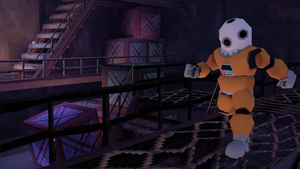
This creature was initially designed as a friendly character, but play-testing revealed players’ tendencies to shoot first and ask questions later.

This was also a sure way to settle any design arguments. It became obvious that any personal opinion you had given really didn’t mean anything, at least not until the next play-test session. Just because you were sure something was going to be fun didn’t make it so; the play-testers could still show up and demonstrate just how wrong you really were.


A typical two-hour play-test session would result in 100 or so "action items" — things that needed to be fixed, changed, added, or deleted from the game. The first 20 or 30 play-test sessions were absolutely critical for teaching us as a company what elements were fun and what elements were not. Over the course of the project we ended up doing more than 200 play-test sessions, about half of them with repeat players. The feedback from the sessions was worked back into the Cabal process, allowing us to preemptively remove designs that didn’t work well, as well as elaborate on designs that did.

Toward the middle of the project, once the major elements were in place and the game could be played most of the way through, it became mostly a matter of fine-tuning. To do this, we added basic instrumentation to the game, automatically recording the player’s position, health, weapons, time, and any major activities such as saving the game, dying, being hurt, solving a puzzle, fighting a monster, and so on. We then took the results from a number of sessions and graphed them together to find any areas where there were problems. These included areas where the player spent too long without any encounters (boring), too long with too much health (too easy), too long with too little health (too hard), all of which gave us a good idea as to where they were likely to die and which positions would be best for adding goodies.

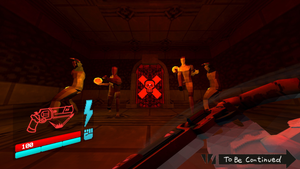
Letting players see other characters make mistakes that they’ll need to avoid is an
effective way to explain your puzzles and
add tension and entertainment value.


Another thing that helped with debugging was making the "save game" format compatible between the different versions of the engine. Since we automatically saved the game at regular intervals, if the play-testers crashed the game we would usually have something not too far from where they encountered the bug. Since these files would even work if the code base they were testing was several versions old, it made normally rare and hard to duplicate bugs relatively easy to find and fix. Our save game format allowed us to add data, delete data, add and delete code (we even supported function pointers) at will, without breaking anything. This also allowed us to make some fairly major changes after we shipped the game without interfering with any of our players’ hard-won saved games.

No Good Deed Goes Unpunished

Until the Cabal process got underway, technology was added to Half-Life freely. It was assumed that "if we build it, they will come," meaning that any new technology would just naturally find a creative use by the content creation folks. A prime example of this fallacy was our "beam" effect, basically a technique for doing highly tunable squiggly glowing lines between two points; stuff like lightning, lasers, and mysterious glowing beams of energy. It was added to the engine, the parameters were exposed, and an e-mail was sent out explaining it. The result was … nothing. After two months only one level designer had put it in a map. Engineering was baffled.

During the Cabal process, we realized that although the level designers knew of the feature, they really had no clear idea of what it was for. The parameters were all very cryptic, and the wrong combinations would cause the beams to have very ugly-looking effects. There were no decent textures to apply to them, and setting them up was a bit of a mystery. It became very clear the technology itself was only a small part of the work and integration, training, and follow-through were absolutely necessary to make the technology useful to the game. Writing the code was typically less than half the problem.

 
Article Start Previous Page 3 of 4 Next
 
Top Stories

image
A Guacamelee! combat design analysis
image
Blog: I took my Ouya game to retail, and here's what happened
image
Xbox One is Microsoft's biggest play for living room domination
image
Indies on Xbone: Where's the beef?
Comments

Arturo Nereu
profile image
I loved the concept of your Cabal.


I think that group design (involving the main areas of the development team) is a good way to:


- keep everyone on the same track

- hear ideas from everyone even if they are not game designers.


Thanks for sharing!

Bernie M
profile image
Half-life was a success because it had a story. And a very geek friendly at that: LHC getting loose, playing a badass nuclear scientist. Other Quake clones did not. Even Unreal was lame with little to no background story but fortunately Tim Sweeney could transform Epic Megagames into a middle-ware company.

Anyway, good job Valve!

Nathaniel Velliquette
profile image
Thank you so much for this. I really appreciate this article. I would love to be a part of such a creative design team. I did question their shock at how certain moments people shined when before they were mere bystanders. This is merely part of the human experience.


none
 
Comment:


UBM Tech