|
This
interview is an odd kind of reunion. I had been acquainted with Paul
Wedgwood for many years, long before we met in person. Back when I was
an obsessed Quake player he was one of the people organising
the communities, writing columns, administrating games, and
commentating for an Internet TV show for which my Quake clan played numerous exhibition matches.
Now
that his life has taken quite a different path - into the highest
echelons of game development - you might expect him to have left his
fan community roots behind, but quite the opposite it true. It is the
first-person gaming community, and its focused, implacable gamers, that
have made Wedgwood and his company what they are today.
Clearly
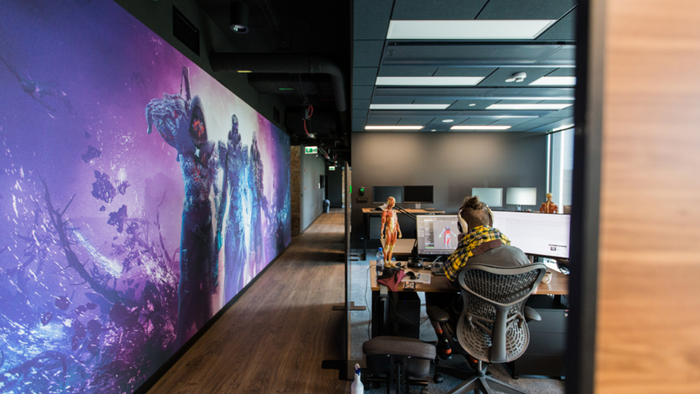
enjoying life, a smiling Wedgwood greets me in the middle of his small,
open-plan office. All thirty of his employees share the same space, and
the only members of the team that seem to get an office space to
themselves are the huge banks of servers. Wedgwood explains that the
machines are required to "compile mega-textures", a vital
ultra-high-tech process which will make his game a reality. The things
have their own disco-lit glass case, as if to illustrate their
significance.
We
walk down a corridor past a swathe of concept art: burning ruins,
troubled-looking robots and alien soldiers. One of the mutant marines
is annotated and carrying a set of "trinoculars." I wonder what its
third eye is supposed to see.
Paul Wedgwood
We sit down and
begin to reminisce. Wedgwood tells me about his early life. He was
obsessed with computing from an early age and was eventually expelled
from school for spending too much time playing truant so that he could
code games on a ZX Spectrum.
"We would go into
school, register and then go straight home and start writing code out
of Spectrum magazines," he tells me. This is a man for whom boredom has
clearly been a great motivator.
"It is one of
those jobs that is incredibly stimulating while you're learning
everything there is to know about it, but once you get to the point
where you know most of what there is to know about operating systems
and hardware it's only when new technologies come around that your
interested is stimulated again. So by around '96 or '97 I was just
really bored. I spent all night in soulless comms rooms getting
networks up and running, and my respite was to go home and play games
online."
For Wedgwood, Quake was something
of a revelation. He suddenly found something that focused his
competitive urges and locked him into extended sessions of a new kind
of experience.
"It was a much deeper level of
concentration than I had ever experienced playing Chess, or Monopoly,
or even more physical games like charging about the council estate
where I grew up on rollerskates. You could lose yourself [in Quake] completely without any kind of plot driving the game."
Wedgwood,
like many gamers discovering online gaming during the same period, was
bowled over by these fresh new videogame experiences. He was lost in
them, and soon found himself playing the popular class-based combat
game, Team Fortress.
"When I think back now to that blue ramp room in Team Fortress, I have physical
memories of it. I have memories of the torches burning, and the water
dripping. I got to know the room so well that it became a physical
memory - it's not like a memory of any other game."
Wedgwood rapidly found a clan, one of the Team Fortress and Quake-playing
teams, and began to play obsessively. His competitive nature shone
through as the team began to win on a routine basis, with Wedgwood
leading. As he played more and more he began to forge strong links with
the people he played with. More importantly, he had time to sink into
writing news and running games websites.
"I got a
job as a contract IT guy in a bank in the city," Wedgwood explained.
"Because it had trading floors I wasn't allowed to touch the network
between nine and five. So my job was to sit at my desk and not touch
anything. Instead of actually doing anything I spent most of '98
updating the Team Fortress newsdesk."
|