Our Properties: Gamasutra GameCareerGuide IndieGames Indie Royale GDC IGF Game Developer Magazine GAO
My Message close
Contents
Big Reality: A Chat with 'Big Game' Designer Frank Lantz
 
 
Printer-Friendly VersionPrinter-Friendly Version
 
Latest News
spacer View All spacer
 
February 10, 2012
 
Analyst questions validity of unusual January NPD results [3]
 
DICE 2012: Blizzard's Pearce on World Of Warcraft's launch hangover
 
DICE 2012: Insomniac's Price on Quality Of Life, ditching the 'Loser' badge [2]
spacer
Latest Jobs
spacer View All     Post a Job     RSS spacer
 
February 10, 2012
 
Sony Computer Entertainment America LLC
Audio Tools Engineer
 
Sony Computer Entertainment America LLC
World Wide Studios Technical Product Manager
 
Sony Computer Entertainment America LLC
Senior Software Application Engineer
 
Sony Computer Entertainment America LLC
Senior Gamer Insights Specialist
 
High 5 Games
Technical Artist
 
Airtight Games
Art Director
spacer
Latest Features
spacer View All spacer
 
February 10, 2012
 
arrow Principles of an Indie Game Bottom Feeder [18]
 
arrow Postmortem: CyberConnect 2's Solatorobo: Red the Hunter [1]
 
arrow Jerked Around by the Magic Circle - Clearing the Air Ten Years Later [39]
 
arrow Building the World of Reckoning [4]
 
arrow SPONSORED FEATURE: TwitchTV - How to Build Community Around Your Game in 2012 [13]
 
arrow Happy Action, Happy Developer: Tim Schafer on Reimagining Double Fine [9]
 
arrow Building an iOS Hit: Phase 1 [11]
 
arrow Postmortem: Appy Entertainment's SpellCraft School of Magic [5]
spacer
Latest Blogs
spacer View All     Post     RSS spacer
 
February 10, 2012
 
Audio Passes: Success Through Layering
 
What the current RPG can learn from Diablo 1
 
Double Fine's Kickstarter Windfall: Will Patronage Supplant Traditional Game Publishing? [5]
 
The Principles of Game Monetization
 
Did DoubleFine Just break the publishing model for good? [11]
spacer
About
spacer Editor-In-Chief/News Director:
Kris Graft
Features Director:
Christian Nutt
Senior Contributing Editor:
Brandon Sheffield
News Editors:
Frank Cifaldi, Tom Curtis, Mike Rose, Eric Caoili, Kris Graft
Editors-At-Large:
Leigh Alexander, Chris Morris
Advertising:
Jennifer Sulik
Recruitment:
Gina Gross
 
Feature Submissions
 
Comment Guidelines
Sponsor
Features
  Big Reality: A Chat with 'Big Game' Designer Frank Lantz
by Bonnie Ruberg [Game Design]
Post A Comment Share on Twitter Share on Facebook RSS
 
 
August 10, 2006 Article Start Page 1 of 4 Next
 

Frank Lantz is the creative director and co-founder of area/code in New York City, a developer that works exclusively on 'big games,' described by area/code's website as "large-scale, real-world games. A Big Game might involve transforming an entire city into the world's largest board game, or hundreds of players scouring the streets looking for invisible treasure, or a TV show reaching out to interact with real-time audiences nationwide."

Previously, he has worked as the director of game design at Gamelab, the developer behind the mammothly successful casual game Diner Dash, and as a game developer for POP. He also teaches in NYU’s Interactive Telecommunications Program.


Gamasutra: Could you describe, in your own words, what area/code does?

Frank Lantz: We create what we call Big Games – games that mix digital, electronic, and virtual elements with some form of real-world presence. These games are usually large-scale, multiplayer games that involve physical activity and face to face social interaction. They often take place in urban settings or other public spaces.

GS: How do "big games" differ from "alternate reality games"?


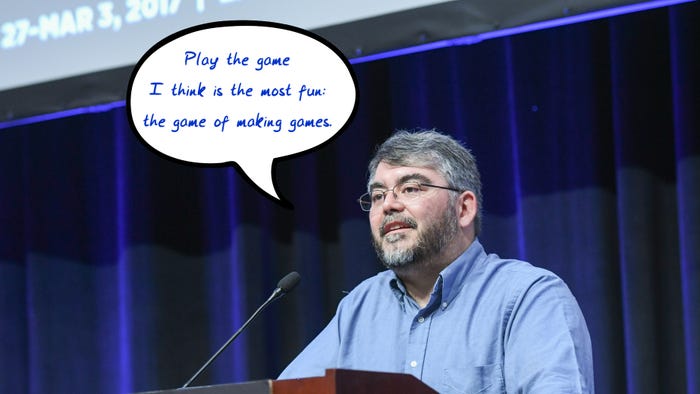
Frank Lantz at GDC 2006

FL: We see ourselves as exploring a similar territory but with a different focus, or perhaps a broader approach. ARG’s tend to be very narrative-driven. The standard ARG structure is built around some kind of mystery story that the players are exploring, and progress through the game usually takes the form of collaborative puzzle-solving which unlocks access to additional story elements. We see Big Games as more gameplay-driven. You might have a Big Game with a rich, complex narrative, but you could also have a Big Game that is totally abstract.

The games we make often have elements of collaboration, but also usually have some form of player vs. player competition, and are less about puzzle-solving and more about skill, tactics, and strategy. In general our games are more procedural, and less content-driven.

Also, ARGs seem to be more invested in the pleasures of confusion, about creating ambiguous situations where you don’t know whether what you’re looking at is part of the game or not. In the games we’re making we usually try to make things really clear and simple, so the players know exactly what the game is and what they’re doing (which is hard enough to achieve even when you’re shooting for it!) so this makes them perhaps a bit more accessible to a casual player. But in general we love the experiments that are taking place in the ARG world, and see all those guys as fellow travelers. Real-world stuff like Jane McGonigal’s Tombstone Hold’em, which was part of 42’s Last Call Poker ARG, are especially interesting to us.


The University of Minnesota-commissioned Big Urban Game.
 
Article Start Page 1 of 4 Next
 
Comments


none
 
Comment:


UBM Techweb
Game Network
Game Developers Conference | GDC Europe | GDC Online | GDC China | Gamasutra | Game Developer Magazine | Game Advertising Online
Game Career Guide | Independent Games Festival | Indie Royale | IndieGames

Other UBM TechWeb Networks
Business Technology | Business Technology Events | Telecommunications & Communications Providers

Privacy Policy | Terms of Service | Contact Us | Copyright © UBM TechWeb, All Rights Reserved.