|
The latest Question of the Week asked: “Does the recent success of World of Warcraft
indicate that this once primarily hardcore genre is now reaching the
mainstream? If not, what needs to happen for MMOs to radically expand
their market?”
No, MMOs are for the Hardcore.
A
valid point brought up by the professional respondents to our question
was that MMORPGs, being RPGs, are built around grinding on the level
treadmill. Naturally, such practices are time-intensive and tend to
turn off the more casual, mainstream audience. Some attributed World of Warcraft's success as another Blizzard brand hit rather than the mainstream embracing MMOs.
No, WoW has expanded to its player base beyond WarCraft and Diablo,
but not to the mainstream. Many of these subscribers will not play
another MMO in the near future. MMOs need to expand their playstyle
from treadmills to focusing on fun factor. Mainstream players do not
have the time or see any benefit in investing hours upon hours into an
avatar that exists in a static treadmill world. Technology also needs
to progress to allow MMOs to play like standard games, many mainstream
people will not be willing to deal with the technical issues MMOs
typically have.
-Patrick Lister, Computer Sciences Corporation
I think the mainstream is still a majority of casual gamers -MMOs do not have a place there just yet. World of Warcraft
is based on an incredibly popular franchise which has gone a long way
to ensure commercial success. This particular MMOG has shifted the
dynamic a little to allow the game to be played more casually, perhaps
grabbing the attention of a small minority of mainstream gamers. For
MMOs to expand their market, they need to take a sharp turn away from
traditional role-playing. Quick-fix gameplay and concentrated action
could lead the MMO into the mainstream.
-David Deeble
What
is mainstream? Yes, Blizzard is hitting this one out of the ballpark,
and deservedly so. But I have yet to find that any of my friends, who
were not dedicated players before WoW, have taken up playing World of Warcraft.
However all my hardcore friends have had a stab at it. Is Blizzard
really breaking through to the mainstream, or just simply rallying
every single geek out there? As for reaching the mainstream, we need
more song and dance, The Sims, and Nintendogs it seems, and less hack 'n' slash, orcs, dragons and light sabers...
-Marque Pierre Sondergaard, Powerhouse
I don't think that MMOs will ever be fully mainstream. Blizzard has done a good job of making WoW
easy and appealing for players new to MMOs, but they can't control
people. There is a certain percentage of people who play online games
who ruin the experience for other players, though perhaps not always
intentionally. I think that what we all really want is more options in
dealing with our server communities. Maybe Blizzard and the creators of
other MMOs should take it a step farther and allow players on specific
servers to form and enforce their own community rules.
-Carolyn Begle, Stardock
In my opinion, the success of WoW
indicates a convergence of the fractured MMORPG gaming population and
not necessarily the sudden adoption of the mainstream gamer. Robert
Garriott (CEO of NCSoft North America) called this "churning", as
players move from one game to another. In the case of WoW,
players from rival MMOs collectively "churned" into this new offering
of Blizzard almost simultaneously. Then, right below the core MMORPG
players, are other hardcore gamers tasting their first massively
multiplayer experience due to word of mouth. To get the mainstream on
board something needs to be done with the trap that most MMOPRGs fall
into and that's the "grind". Fed Ex quests that take hours to complete
or missions that require a specific party structure, and farming for
money/resources are going to be tough pills to swallow for the casual
consumer. What's worse is we're asking them to pay a monthly fee for
this. So how does one get the casual gamer on board? Maybe a tiered
pricing structure would help. As they grow their interest in the game
so does their monetary commitment. But most of all, MMOs really need to
create an interdependent society where personal success contributes to
the overall welfare of specific communities. Have a system where
crafting (or any other non-combat related activity) is actually fun and
rewarding. Implement a system where advanced players can take on
newbies and casual gamers as apprentices or students. You can foster a
relationship where these players can help you farm for resources and
craft. In return they can learn some of your skills and abilities a bit
faster than doing it alone. On a personal note, I'd like to be able to
break the shackles of my PC and bid/sell in the Auction House using my
cell phone... not while I'm driving of course.
-Carlo Delallana, Ubisoft
I don't believe it indicates the genre is reaching “mainstream” status. Instead, I believe the success of World of Warcraft
can be attributed more to the fact that it is a Blizzard title and less
to it being a great MMOG. With any other developer's name on the box I
think WoW would have sold significantly less. While I think the success of WoW
will have more people following the genre, and perhaps even playing a
MMOG for a short while, I don't think it will have so much impact that
MMOGs in general begin selling as well as other genres. So long as
MMOGs continue to reward players more for time invested than anything
else, I think sales of MMOGs - WoW aside - will remain similar to what they are achieving now.
Nathan Cooper, Hendricks & Partners
Yes, MMOs are Mainstream.
Some
argued that MMOs are definitely moving towards the mainstream, with a
few stating that they already are mainstream. Our respondents felt that
games like World of Warcraft, by offering something for
everyone, drew in a much larger market, and the title is definitely a
step in the right direction for the expansion of MMOs.
Yes
it does. Nothing needs to happen, the gears are already in motion. The
"next generation consoles" are going to do everything that that needs
to be done. The "casual player" will migrate to consoles, leaving the
PC market to the "hardcore players" that it made up most of its
audience in the ‘90s. This PC market will, in turn, be mostly made out
of online games - just because they are more fun. Virtually all genres
will evolve into their MMO analogs. What makes me wonder is how the
consoles will try to adapt some of those genres. Strategy and FPS, for
instance, seem to be lacking in the interface department due to the
general all-around mouseless-ness.
-Ilya Bossov, Lesta
WoW
is a good step in broadening the player-base for MMOs, due largely to
the high production values and to the enormous strength of the Blizzard
brand. That it is very solo-friendly and has a wealth of hand-crafted
content also helps a great deal. Further expansion of the market is
certain and will happen through a combination of factors, such as more
solo-friendly gameplay and content, better player-matching (allow
players to keep playing together as they advance through the game at
different rates) and the release of less hardcore games and console
MMOs. More and more I am hearing of persistence being considered in all
sorts of games and you will probably see that start to emerge in
next-generation console games as the traditional MMORPG is blended with
other genres.
-Robert Spencer, BigWorld
It's
only the way that the genre is applied that leads to a game being
exclusively “hardcore” or not. MMOs needn't include confusing
interfaces and reams of stats - as WoW proves. The move from
blanketing all these games as MMORPGs towards more specific titles is a
clear indication that the industry is opening up the “genre” to more of
a mainstream audience. Why must a massively multiplayer game be an RPG?
As we are seeing now, MMO style play can be applied to a number of
different genres; appealing to a much wider audience. I would rather
think of an MMO as a delivery method rather than a genre in itself. As
long as the time and effort asked from the game to enjoy it is not
excessive, moving into the territory of the hardcore gamer, then it
will be accessible to the masses. On the other hand, just as complex
stat heavy offline games will remain the realm of the dedicated
hardcore gamer, so will the MMOs as long as they follow that narrow
path. MMOs have shown that they have the ability to acquire and retain
vast numbers of players - now we just need to let the more casual
gamers know that there is something there for them too.
-Oliver Ashford, Chiba-it
I
think its starting to get there. Blizzard managed to make MMO gaming
far less complicated, yet still as deep as any other MMO. However, in
an NCSoft interview, the company said it best when claiming that
getting outside of the "fantasy realms" that generally are 90% of MMOs
is the way to break into broader audiences wallets. I know I'm not the
only one who has mentioned or imagined a GTA MMO. And while
the game may include people running around and killing anything that
moves, if that's what gamers want, then that's what they deserve. Less
MMOs focused on giving players tasks and more just letting them have
fun and play around in a world with the only limitation being their own
creativity.
-Angel Vargas
Yes,
absolutely. And No. Fantasy MMORPGs have reached the mainstream, not
surprisingly as the first. This means that the mainstream is ready to
adopt and accept the subscription-based business model, which is a good
thing. Other types of MMO have not necessarily breached into the
mainstream, but there is absolutely no reason this shouldn't happen.
We, who are making narrower, smaller games, should keep doing that,
because the business needs diversification, but we should also look
into business constructions that allow us to bundle our products in a
reasonable way, such that the mass market can easily and affordably try
out many MMOs.
-Lars Kroll Kristensen, Runestone Game Development
WoW is absolutely reaching the mainstream market. I'm in a guild in WoW
where there are many players who are playing their first MMO, and
beyond that, playing their first video game ever! For example, my
girlfriend plays and she would've never thought to buy a video game
until trying out WoW. She works at a medical device company, and her female co-workers talk about playing WoW. But then again, WoW is the best MMO out there for hardcore and casual gamers alike. World of Warcraft is a great license also, but to most casual gamers, Star Wars or the Matrix are more notable names. It's not about the license, it's about making a great game.
-Tony Dormanesh, Midway
MMOs Need To Change?
Over
all answers, there was actually an even split of opinions on whether
MMOs were really heading 'mainstream'. But, regardless of whether or
not our respondents felt that MMOs were reaching a mainstream audience,
many had suggestions to further grow the market for MMOs. In fact, one
of our respondents had plenty of suggested improvements to make MMOs
more accessible to casual gamers:
Recently,
there has a been a huge push-on the designer's part-to try and make
MMOs more appealing to casual players. 2 million in World of Warcraft
is a lot of active subscriptions; I'd certainly consider the game
popular. As for mainstreaming, the question is, “Who is playing?” Has World of Warcraft
succeeded in bringing new blood to the MMO market or have they merely
convinced a lot of MMO players to switch over to their product instead?
A few suggestions for making MMOs more accessible to the casual gaming
public:
-Allow for shorter play sessions. I've noticed that upon
logging into most games, I keep doing something that leads to something
else and before I know it, I've spent a rather hefty amount of time on
the game. Phantasy Star Online
is quite good about this. There are some quests that end after a
certain amount of time, or are short enough in general that I'm capable
of budgeting my time spent in the game. If I have 20 minutes before the
bus arrives, I know there are a few quests I can easily accomplish
within that amount of time and still get to work on time.
-Limit
the use of sinks and grinds. This correlates with the aforementioned
item about making “bite-sized” play sessions, but these 2 items have
become such quintessential parts of MMOs (MMORPGs especially) that they
warrant being addressed specifically. These two aspects of
gaming-forcing a player to waste resources(real world time or in-game
resources) and excessive use of repetition to advance in the game-feel
more like chores than pleasurable activities. When grinding or wading
through sinks, the players themselves look like they're in some kind of
trance; the same trance you see slot players in casinos. Being a
mindless, addicted zombie is a behavior that society looks down upon
and that seems to be the image the main stream has of MMO players, as
shown in numerous main stream media articles. Reducing the grind and
sinks should also make the game more accessible to newcomers; a
longstanding issue with MMOs.
-Allow for interruptions. Just about every game out there has some kind
of pause feature, except for MMOs. Persistent, dynamic worlds are a big
draw and pausing the entire realm every time a single player hits a
pause button would render the game unplayable. Again, I give much
credit for Phantasy Star Online
for making all log-offs easy (you always start in an area where no harm
can be done to your character) and having safe havens 10-20 seconds
away.
-Get rid of “lamers.” There are some major positives about
running around a virtual world seemingly without consequence. However,
it would be nice to have consequences for typing (or screaming if there
is voice chat support) obscenities and behaving in an uncivilized
manner. MMOs can be nice escape from reality but “1337 sp34k” and the
general barbarism exhibited by other users can destroy the game
atmosphere in an instant. Ability to control instances and whom you
associate with can be extremely helpful but having the game's
maintainer take a more active role has been something even hardcore
gamers seem to be clamoring for. These are a few major issues that
stick out to me. That and making MMOs more than chat rooms with
mindless killing and collecting shiny objects.
-Christa Morse, Perpetual Entertainment
_____________________________________________________
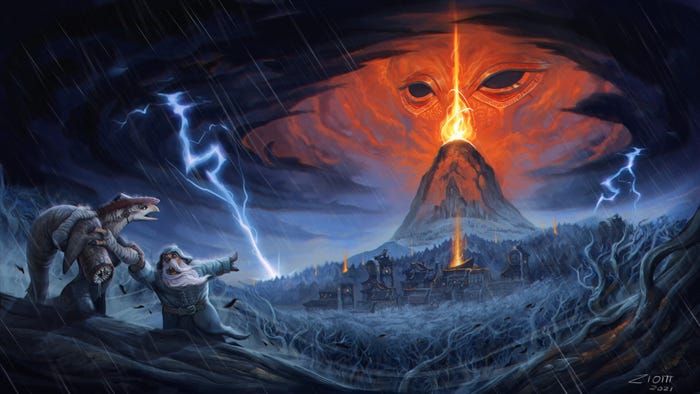
[Article
illustration by Erin Mehlos. Please note that the opinions of
individual employees responding to the Question Of The Week may not
represent those of their company.]
|