|
After
finally completing Die By the Sword in 1998, the guys at Treyarch
were pretty damn proud of themselves. Sure, it was late, and it wasn't
a phenomenal seller, but the reviews were great and we learned a lot
from our mistakes. We were dying to start over and write our dream game,
a game that would combine the animation, sword-fighting, and creative
level design of Die By the Sword with cooperative online play.
We imagined a sort of 3D Diablo. Our three-day postmortem meeting
for Die By the Sword turned into a design and planning meeting
for Die By the Sword II, as we were calling it then. We signed
a contract with Interplay and we were off. While the game designers
were writing design documents, the programmers were busy with R&D
into dynamic adaptive level of detail, asynchronous models of online
play, and a new scripting language. All of the while we were simultaneously
kicking out an add-on pack for Die By the Sword called Limb
From Limb.
 |
|
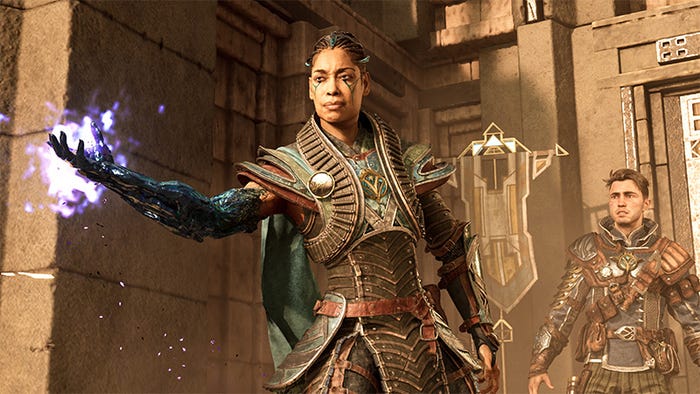
Screen
shot from Draconus
|
The
new game would have the same core management as Die By the Sword:
Peter Akemann was lead programmer and Final Word on Everything, Chris
Busse was producer, Chris Soares lead artist, and Mark Nau lead game
designer. Three months later, we had finished the research, completed
the design document, created an initial milestone schedule, and coded
a Direct3d renderer and a nifty scripting language. But trouble was
brewing; Interplay didn't want a game that wouldn't be done by next
Christmas. They weren't excited about a PC game. The Dreamcast was the
hot new topic and naturally they wanted us to do our game for that console.
They were looking for someone to sell our contract to.
Suddenly, the game to which we had planned to devote two years needed
to be ready for the Dreamcast launch. That meant September, giving us
about ten months to final. To make matters worse, we had to learn a
new platform and port the game to it. In addition, we had only a seven-man
team and needed to staff up. We all knew it was doomed to failure and
cuts would have to be made, so we eliminated network play. Some of us
felt that cutting the network play wasn't enough. The trades claim that
it takes about eighteen months to develop just a B+ title, while A+
titles like Half-Life and Metal Gear Solid might go into
a third year. If we used that as a measuring stick, and were trying
for just a B+, we would slip by about six months.
Still,
the new accelerated schedule was approved. In my experience, publishers
love overoptimistic schedules. They don't seem to care if a developer
is smoking crack, even though it happens quite often that the publisher
is the one who ends up funding the inevitable, costly slip. Interplay
sold our Crave, but then something weird happened. They didn't sell
the entire game to Crave, just the domestic publishing rights. They
kept the international publishing rights for themselves. We ended up
developing the game for two publishers: In America for Crave as Draconus
(Interplay did not sell the Die By the Sword title to Crave)
and internationally for Interplay as Dragon's Blood. We were
living in interesting times.
All things
considered, it's no surprise we didn't make it. We did, however, perform
many small miracles. We managed to get our C++ code base ported to the
Dreamcast Shinobi/Kamui libraries in time for E3, surprising Crave and
creating a small sensation. The artists created all kinds of cool characters
and levels and special effects. The programmers pushed various Dreamcast
features further than they'd been pushed before. We built a new engine
from scratch, using object-oriented techniques, design patterns, and
generic programming: The programmers had all been exposed to C++ before
they started work on Draconus.
In The
Mythical Man Month Fred Brooks points out that you'll realized you're
not going to make it three weeks before the scheduled end of a project.
Appropriately, three weeks from when we were to have our "launch
title" done, Akemann and Busse realized we weren't going to make
it. We rescheduled for a Christmas launch. Three weeks from that second
due date we realized we weren't going to make it. So we rescheduled
for a launch that would come out the day before Christmas. (Not too
useful if you want to sell titles for Christmas. We were telling ourselves
that all those people who received Dreamcasts for Christmas would want
to go out and buy our game.) Three weeks from that due date we
realized we weren't going to make it. During this period of always almost
making it we were fully death marching. The bug list went over three
thousand and took five months and about $400,000 more than we has budgeted
to tackle it, but we suceeded. To quote Patrick Hughes, one of the coders,
"Hey, it shipped." It was nine months past the date we had
originally scheduled, but still, it shipped.
Tools
On the
PC side, we used Visual C++ 5.0 for development. After switching to
Dreamcast, we ended up settling on the Metrowerks compiler and the Codescape
debugger. Although one of the promises of porting to the Dreamcast was
that you'd be able to use Windows CE with DirectX and just recompile,
it didn't work out that way for us. We found that it was easier to rewrite
our renderer to use Kamui calls and our file access routines to use
Shinobi calls than to try and fix the mysterious problems brought on
by WindowsCE. On the bright side, Kamui and Shinobi are nice, thin,
and straightforward libraries that were really quite easy to use.
The characters
were modeled in 3d Studio MAX 2.5. We didn't use Character Studio. The
artists divided the characters into segments manually and the exporter
would reassemble them, joint by joint, into a single mesh and then reduce
the detail on them. Some of the animations, like ladder climbing and
certain cut-scenes, were done with these segmented characters in MAX
and then exported for the game. Other animations (the flying dragon)
were hard-coded by Pete using his VSIM technology, or were done by a
game designer creating sequences of moves. Textures were painted in
Photoshop.
For the sounds, we used the Digidesign Pro Tools system: Pro Tools 5.0
on the software side and a d24 system on the hardware side. We also
used Bias' Peak for down sampling and editing.
All the characters voice over effects and processing was done in the
Pro Tools environment. Various plug-ins were used to get the desired
effect on certain creatures and characters. Most notably, Marto the
Troll and all his troll friends had to be pitched down in order to make
them sound like hulking brutes.
The music
was edited and mastered using Pro Tools as well. This had to be done
in order to get the music to "fit" in the Dreamcast. We had
a lot of cool music and a limited amount of space to put it in. The
sound effects Sergio Bustamante and Keith Arem created all were made
in the Pro Tools environment. Most, if not all, of the sound effects
are originals and were created using Pro Tools to mix sound effect-elements
together.
|