The
dog days of summer are here again, and that can only mean one thing:
it's Siggraph time. The biggest graphics show on Earth took place last
week in sunny New Orleans, to the great delight of 26,000 attendees.

This year's event focused mainly on the new platforms for entertainment.
Overall, the show was really huge: it lasted one full week, it offered
over 40 courses, and there were more than 300 exhibitors in about 150,000
square feet. Thus, I'll outline the major hardware and software highlights
of the show, and offer some insight on trends.

New
Hardware On Display
Sony's
GScube. The award for best booth this year probably should go
to Sony. The Japanese giant had one of the most interesting exhibits
on the expo floor, where it showcased its vision of the future of entertainment.
The space was divided into two main areas: the first was dedicated to
game systems, and the other to passive home entertainment. In the games
arena, the PS2 was presented as the essential system for both casual
and hard core gamers. Along with the consumer product, the Playstation
2 development system was shown, which some of us had already had the
opportunity to see at the GDC last March. This new development system
is very different and is an improvement over the original Playstation
development process -- PSX games were programmed via a PC extension
board. The PSX development process made creating games in a networked
environments rather complex, as the card was assigned to the PC it was
plugged into. This problem no longer exists with the Playstation 2 development
system, which is a full-blown external device that can be operated in
two different ways. The first (dubbed programming/debugging mode) is
similar to what you had with the classic Playstation. The second (dubbed
workstation mode) lets you hook the PS2 dev system to network via an
Ethernet connection, transforming it into a Linux-based development
server.
Sony's
GScube, targeted at content creation and broadband delivery markets.
In
the home entertainment arena, Sony's vision improves upon the classic
TV concept by adding Internet access, broadband connectivity, and unprecedented
digital image quality. Although we saw a large flat screen showing some
impressive movies, both the console and home entertainment areas were
nothing shocking for most of the attendees. What was shocking
and unexpected sat in between these two areas: a black cube about the
size of a microwave oven, with "GScube" printed on it. It was the living
proof of Sony's plans to blend passive and interactive entertainment
worlds together in the future.
The
GScube is a rendering device targeted at the content creation/broadband
delivery markets. It consists of 16 cascaded processing units, each
of them based upon an enhanced version of a Sony Playstation 2. Every
processing unit has an Emotion Engine CPU (which was jointly developed
by Sony and Toshiba), and an improved Graphics Synthesizer equipped
with a 32MB frame buffer (eight times the memory of a regular PS2).
This yields a total 512MB of VRAM, and it can theoretically reach a
peak performance of 1.2 billion triangles per second -- a number that
sounds like it comes from science fiction books. The device must be
controlled by an external broadband server which feeds data to the GScube,
and at Siggraph that device was the brand-new SGI Origin 3400. At the
Sony booth, we enjoyed a real-time battle between characters from the
movie Antz rendered in real time, as well as interactive sequences
from the upcoming Final Fantasy movie shown at 1920x1080 pixels
and a sustained rate of 60FPS.
In
the Antz demo, I counted 140 ants, each comprising about 7,000
polygons, which were rendered using a ported version of Criterion's
Renderware 3. All ants were texture mapped, and the results looked surprisingly
close to the quality of the original movie. The Final Fantasy demo was
just data from the now-in-development full-length CG movie based upon
the game series, rendered in real time by the GScube. It showed a girl
(with animated hair threads) in a zero-gravity spaceship, with a user-controllable
camera viewpoint. The demo rendered about 314,000 polygons per frame,
and included an impressive character with 161 joints, motion-blurring
effects, and many other cinematic feats. According to Kazuyuki Hashimoto,
senior vice president and CTO of Square USA, the GScube allowed them
to show real-time quality, in "close to what is traditionally software
rendered in about five hours." Sony believes that the GScube will
deliver a tenfold improvement over a regular PS2, and future iterations
of the architecture expect to reach a 100-fold improvement.
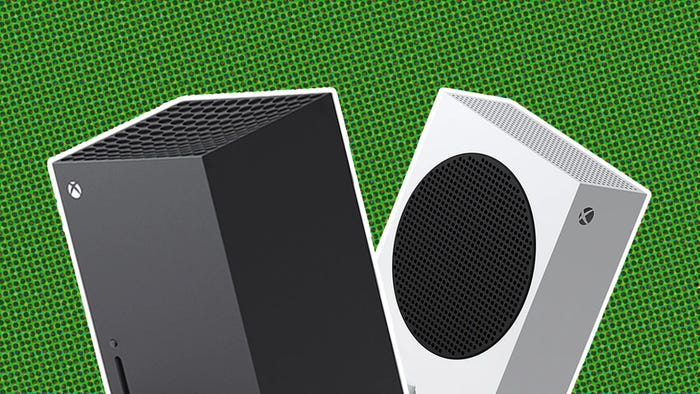
Xbox
Demos. The second surprise at Siggraph was seeing what seemed
to be a fully-operational Xbox at the Nvidia booth. The device, still
in its fancy silver X-shape, was plugged into a large screen and showed
the same demos that we saw at the GDC and E3 (the girl dancing with
her robot, and butterflies flying above the pool). Quality seemed a
bit lower than the original GDC demos, but the animations still looked
gorgeous. Whether the device was a real Xbox or just a very early prototype
is unknown, but having more than a year of development time ahead, it
seems premature to claim what we saw as the definitive architecture.
We have to wait to see how the system evolves.