|
The merging of great concepts from many different sources in order
to create a new, better whole is perhaps one of the most fundamental
aspects of human innovation. Drakan: Order of the Flame uses
this notion to full advantage by combining action and adventure game
concepts with sword combat, aerial battles, and simple RPG elements.
It is a true hybrid of many proven gaming concepts. But this attribute
made Drakan’s development doubly challenging because we had to
create a game in which multiple elements worked well independently yet
blended together seamlessly. Perhaps this is analogous to the way developers
must work well as individuals and effectively as a team.
Origins
of the Team
Because
Drakan was Surreal’s first product, the story of Drakan’s
development is also the story of Surreal’s development as a company.
Surreal’s creation is the classic game development story in which four
ambitious recent college graduates decided they had nothing to lose
and formed a game company. These four founders contributed four critical
skills to the team: art, programming, design, and business skills. None
of us had ever run a company or managed schedules, but we all loved
games, and we knew what it took to make a good one.
Lead
designer Alan Patmore had always played games and had the business savvy
to complement Nick Radovich’s business experience and connections. I
had been programming games and graphics since the age of ten, so even
though I didn’t have experience working at a game development company,
I did have the skills and motivation. Mike Nichols, our creative director,
came from within the industry and was the only member with any titles
under his belt.
Our
initial goal was to develop several game concepts and a solid technological
foundation that we could pitch to game publishers. This would get us
the funding we needed to pay ourselves and start hiring programmers
and artists without having to involve venture capitalists.
Once
we got project funding, we were able to quickly build a strong team
of artists, programmers, and designers who all played games. Some of
the team came from other game companies — lured by the informal atmosphere
and the focus on games, not profit. Others were inexperienced with game
development, but had the skills and fresh ideas we needed.
As
the technology lead, I was determined to build Surreal’s foundations
on its technology. By retaining rights to our engine and tools, we always
had something to fall back on if a game design was cancelled by the
publisher. This also allowed us to develop multiple game titles from
one generic technology and license the technology to other companies.
Any investment in time that the programmers and I put into the engine
could be quickly put to use on another project if anything went awry.
We
initially moved away from the popular Doom-type engines toward
a landscape-style rendering engine in order to set our games apart.
There were many unique ideas that we could build from this: flying,
underwater environments, outdoor deathmatch, and so on. But the technology
was not only about rendering; the tools had to empower the designers
and be general enough to support almost any game. So I designed a toolset
in which every game-specific property and behavior would be provided
by the game code itself, and the editor would be just a generic interface
to the underlying game specifics.
Origins
of the Beast
After
pitching several game ideas to all the major publishers, we finally
sold the first “dragon” concept to Virgin Interactive Entertainment
(VIE) in the summer of 1996. The concept was very different from today’s
Drakan. The first concept was for a dragon RTS game in which the player’s
dragon could fly around taking over villages and forcing them to do
their bidding. VIE wanted a more arcade-style shooter game to fill a
slot in their product line, so we started developing a fast-paced, third-person
dragon-flying game.
 |
|
Concept
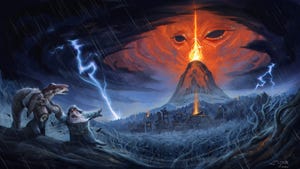
drawing for Drakan’s mountain world.
|
It
was not until early 1997 (when VIE began cutting projects just prior
to closing its doors) that Surreal sold the Drakan concept to
Psygnosis. Psygnosis saw the strength in our team and gave us complete
freedom to perfect the design. We wanted more of an RPG feel, but as
a dragon, the player was limited in what he or she could carry or interact
with. Adding a human rider was the best solution, and a female character
was the natural choice since she would be the ideal personality to offset
the dragon’s immense size and power. With an increased budget under
Psygnosis, we hired more team members and increased the art and game-play
content to a level that the press called “ambitious” at our public debut
at E3 in 1998.
The
production under Psygnosis allowed us to expand the technology as well.
We added real-time lighting effects and expanded the simple height-field
landscape engine into our seamless indoor/outdoor layer technology.
Critical to this technology was Psygnosis’s willingness to drop support
for software rendering (a risky marketing decision at the time). This
allowed us unprecedented freedom. We switched over to true-color textures,
increased the polygon counts throughout the game, and built arbitrary
geometry for our worlds. The downside to relying on 3D hardware was
that we faced serious compatibility challenges — the game would have
to run on almost every 3D card. This also meant battling Direct3D driver
bugs, and the possibility that we would be inundated with technical
support calls, since people would not have software rendering to fall
back on if the 3D hardware failed to work correctly.
|