Our Properties: Gamasutra GameCareerGuide IndieGames Indie Royale GDC IGF Game Developer Magazine GAO
My Message close
Contents
Real-Time Soft-Object Animation Using Free-Form Deformation
 
 
Printer-Friendly VersionPrinter-Friendly Version
 
Latest News
spacer View All spacer
 
February 9, 2012
 
DICE 2012: Culture, pride lead to success at Skyrim maker Bethesda [3]
 
DICE 2012: Is the publishing model broken? [13]
 
Double Fine launches $400K Kickstarter for Schafer-led adventure game [5]
spacer
Latest Jobs
spacer View All     Post a Job     RSS spacer
 
February 9, 2012
 
2K Marin
FX Artist - XCOM
 
Visual Concepts
Senior Producer, VC China (Shanghai)
 
Visual Concepts
Software Engineer, VC China (Shanghai)
 
Zindagi Games
Presentation/Game Programmer
 
Visceral Games Redwood Shores
Sr. Gameplay Engineer-Visceral Games
 
Visceral Games Redwood Shores
Sr. Audio Artist-Visceral Games
spacer
Latest Features
spacer View All spacer
 
February 9, 2012
 
arrow Postmortem: CyberConnect 2's Solatorobo: Red the Hunter
 
arrow Jerked Around by the Magic Circle - Clearing the Air Ten Years Later [32]
 
arrow Building the World of Reckoning [4]
 
arrow SPONSORED FEATURE: TwitchTV - How to Build Community Around Your Game in 2012 [13]
 
arrow Happy Action, Happy Developer: Tim Schafer on Reimagining Double Fine [9]
 
arrow Building an iOS Hit: Phase 1 [11]
 
arrow Postmortem: Appy Entertainment's SpellCraft School of Magic [5]
 
arrow Talking Copycats with Zynga's Design Chief [82]
spacer
Latest Blogs
spacer View All     Post     RSS spacer
 
February 9, 2012
 
The Devil Is in the Details of Action RPGs - Part One: The Logistics of Loot [2]
 
Xbox LIVE Indie Games at it Again
 
Merging Waterfall and SCRUM [3]
 
Business Post Mortem: Wolf Toss: Pre-launch Planning & Blended CAC
 
Minmaxing - Is turn-based fun anymore? [53]
spacer
About
spacer Editor-In-Chief/News Director:
Kris Graft
Features Director:
Christian Nutt
Senior Contributing Editor:
Brandon Sheffield
News Editors:
Frank Cifaldi, Tom Curtis, Mike Rose, Eric Caoili, Kris Graft
Editors-At-Large:
Leigh Alexander, Chris Morris
Advertising:
Jennifer Sulik
Recruitment:
Gina Gross
 
Feature Submissions
 
Comment Guidelines
Sponsor
Features
  Real-Time Soft-Object Animation Using Free-Form Deformation
by Alex Ferrier [Programming]
Post A Comment Share on Twitter Share on Facebook RSS
 
 
August 27, 1999 Article Start Page 1 of 7 Next
 

Geometry in today’s games tends to be static. It's common to see animated characters composed of a hierarchy of meshes moving relative to each other, but it's rare to see the animation of individual vertices within a mesh.

Animating hierarchies of meshes (the common method) is a fine way to portray an object's movement, but does little to portray character or situation. In fields other than computer graphics, animators traditionally have exaggerated parts of a character to convey expressions. With current animation techniques, such exaggeration isn't possible. An object generally remains the same shape throughout the game.


Deforming the vertices within a mesh (the rare method) is the domain of soft-object animation. Until recently, this process was simply too expensive to consider in real-time. Soft-object animation is becoming computationally affordable, however, and can greatly enhance your animation.

There are many situations where a technique for deforming meshes could be applied in games:

  • In cartoon-like animation, it can be used to personality to an object’s animation sequence. For instance, a character that is jumping will squat down first, and an angry character might pulse with rage. This is an example of a global deformation – the whole object is controlled by one deformation.
  • During a crash in a car racing game, the area where the impact occurred could be deformed, and remain so afterwards. This gives a convincing look of damage and saves the need for having multiple models of each car. This is an example of local deformation – you don’t want the whole car to deform just because the front bumper is bent.
  • A hierarchy of deformations can animate characters with more convincing muscle tone than hierarchies of objects are capable of portraying. This is an example of hierarchical deformation, and the deformations would overlap. For instance, at the joints of a bone how the flesh looked would be dependent on the position of both bones.
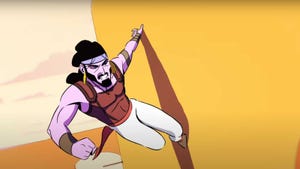
We’re going to examine one of the simpler forms of soft-object animation - Free-form Deformation, commonly known as FFD. The technique has been around for some time, and was first documented in a SIGGRAPH paper by Sederburg and Parry in 1986. Programs such as 3D Studio Max have supported FFD both as a modeling and animation technique for some time, but it is only recently that the technique has become practical in real-time game engines.

At its heart, FFD is the metamorphosis of an object from its originally modeled appearance - known as the object’s rest state - to its deformed state. This is accomplished by deforming the object’s coordinate system in the following three steps:

  1. The object to be deformed is embedded in a regular coordinate system defined by three mutually perpendicular axes - the standard (X, Y, Z) axes we’re all used to dealing with.
  2. The coordinate system is deformed, allowing its previously straight axes to become curves. Areas of the coordinate system can collapse inwards or expand outwards.
  3. The positions of the object’s vertices in the old (regular) coordinate system are updated to match where they ended up after the coordinate system was deformed.

This procedure will result in an object deformed in so that it is "intuitively consistent" with how we deformed the coordinate system. The term "intuitively consistent" is very popular in research papers on these subjects, but in practice it means that the deformed object looks like you hoped it would look. This allows artists to have confidence when using the technique in games.

 
Article Start Page 1 of 7 Next
 
Comments


none
 
Comment:


UBM Techweb
Game Network
Game Developers Conference | GDC Europe | GDC Online | GDC China | Gamasutra | Game Developer Magazine | Game Advertising Online
Game Career Guide | Independent Games Festival | Indie Royale | IndieGames

Other UBM TechWeb Networks
Business Technology | Business Technology Events | Telecommunications & Communications Providers

Privacy Policy | Terms of Service | Contact Us | Copyright © UBM TechWeb, All Rights Reserved.