My Message close
GAME JOBS
Contents
The Watery Pachinko Machine of Doom: Project Horseshoe's Thoughts On Story
 
 
Printer-Friendly VersionPrinter-Friendly Version
 
Latest Jobs
spacer View All     Post a Job     RSS spacer
 
May 18, 2013
 
Sony Computer Entertainment America LLC
Sr. Network Systems Engineer
 
Amazon Game Studios
Sr. Game Designer
 
Amazon Game Studios
Quality Assurance Manager
 
Treyarch / Activision
Technical Animator
 
Amazon Game Studios
Game Development Engineer
 
Amazon Game Studios
Game Graphics Engineer
spacer
Latest Blogs
spacer View All     Post     RSS spacer
 
May 18, 2013
 
All You Need is Love [2]
 
Students: Tips for Learning Game Development Over the Summer [1]
 
All Your Nintendo Let's Plays Are Belong To Nintendo? [76]
 
Even Further Down the Curation Rabbithole [11]
 
Systems of Control in F2P [23]
spacer
About
spacer Editor-In-Chief:
Kris Graft
Blog Director:
Christian Nutt
Senior Contributing Editor:
Brandon Sheffield
News Editors:
Mike Rose, Kris Ligman
Editors-At-Large:
Leigh Alexander, Chris Morris
Advertising:
Jennifer Sulik
Recruitment:
Gina Gross
Education:
Gillian Crowley
 
Contact Gamasutra
 
Report a Problem
 
Submit News
 
Comment Guidelines
Sponsor
Features
  The Watery Pachinko Machine of Doom: Project Horseshoe's Thoughts On Story
by Daniel Cook [Design]
Post A Comment Share on Twitter Share on Facebook RSS
 
 
January 17, 2008 Article Start Previous Page 2 of 7 Next
 

The Watery Pachinko Machine of Doom

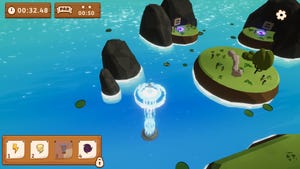
Throughout our discussion, the one key visual that resonated with all the experienced designers in the room was the "Watery Pachinko Machine of Doom." In a pachinko machine, dozens of ball fall on pegs and bounce about in a chaotic motion until they finally reach the hole at the bottom of the machine. When you add thousands of balls, to the point where balls are like individual water molecules, the patterns of where the balls flow throughout the system becomes more apparent. You see currents and waves of motion.

Each of those balls is a player, moving on their unique path. As designers, we build the machine and analyze broad patterns of motion through the system. Instead of the pachinko physics of collision, we calculate the physics of human psychology.


The meaty center

There are a broad range of tools and systems that can be used to create the successful mediated experiences. Many are well known and we've included a list of currently used support techniques/tools in the appendix of this report.

However, with such a diverse and experienced group of people present, we soon turned towards exploring new methods of creating mediated experiences. Games range from 40-cutscene choose-your-own-adventure games to sandbox game where all you get is a sternly worded command from your mother, "Go out and play!" We are interested in the meaty mediated center of the spectrum.

Your browser may not support display of this image.

The three pillars

With the vague and divisive word "story" focused into a more palatable discussion of "the meaty center of mediated experiences", we spent the rest of our time on three topics:

  1. Examples that play outside the current rules of the game industry: What are examples from that wild that we can study to give us practical insight into how mediate experience can be built?
  2. Models for supporting player emotions & experiences: What are some conceptual models that we can adopt that helps us understand mediated system at a more fundamental level?
  3. Vexing problems: What are the big problems that still need to be discussed further?
 
Article Start Previous Page 2 of 7 Next
 
Top Stories

image
The laws behind Nintendo's Let's Play crackdown
image
New layoffs reach Trion
image
How developers mess up immersion (you might be doing it wrong)
image
Steam Trading Cards: The next-gen of achievements?
Comments


none
 
Comment:


UBM Tech