Contents
Valve's Writers And The Creative Process
 
 
Printer-Friendly VersionPrinter-Friendly Version
 
Latest News
spacer View All spacer
 
November 22, 2009
 
Video Game Watchdog National Institute On Media And The Family Shutting Down [11]
 
Modern Warfare 2 Infinity Ward's 'Most Successful PC Version' Yet [13]
 
New Tech, Design Details Of Project Natal To Emerge At Gamefest In February
spacer
Latest Jobs
spacer View All     Post a Job     RSS spacer
 
November 22, 2009
 
Trion Redwood City
Sr. Environment Artist
 
Trion Redwood City
Sr. Evnironment Modeler
 
Sucker Punch Productions
3D Environment Artist
 
Sucker Punch Productions
Network Programmer
 
Sucker Punch Productions
Texture Artist
 
Sucker Punch Productions
Character Artist
 
Crystal Dynamics
Sr. Level Designer
 
Monolith Productions
Sr. Software Engineer, Engine - Monolith Productions - #113767
spacer
Latest Features
spacer View All spacer
 
November 22, 2009
 
arrow Upping The Craft: Susan O'Connor On Games Writing [6]
 
arrow Small Developers: Minimizing Risks in Large Productions - Part II [7]
 
arrow iPhone Piracy: The Inside Story [50]
 
arrow And Yet It Grows: Analyzing the Size and Growth of the European Game Market [5]
 
arrow NPD: Behind the Numbers, October 2009 [13]
 
arrow Reflecting On Uncharted 2: How They Did It [5]
 
arrow Sponsored Feature: Rasterization on Larrabee -- Adaptive Rasterization Helps Boost Efficiency
 
arrow Postmortem: Wadjet Eye's The Blackwell Convergence [2]
spacer
Latest Blogs
spacer View All     Post     RSS spacer
 
November 22, 2009
 
Time Fcuk - A Postmortem [2]
 
Accepting the Inherent Value of Games
 
Planckogenesis, Part II: Song Structure & Gravy Train [1]
spacer
About
spacer News Director:
Leigh Alexander
Features Director:
Christian Nutt
Editor At Large:
Chris Remo
Advertising:
John 'Malik' Watson
Recruitment/Education:
Gina Gross
 
Features
  Valve's Writers And The Creative Process
by Kris Graft
12 comments
Share RSS
 
 
November 2, 2009 Article Start Page 1 of 5 Next
 

[In a rare interview, Valve writing lynchpins Marc Laidlaw and Eric Wolpaw talk in-depth on the narrative structure and pithy quips behind critically feted games like Half-Life 2, Portal, and Left 4 Dead 2.]

Valve has developed a particularly strong reputation for story in its games, recently, and much of that credit can be laid at the feet of its in-house writing team. Whether it's the seamless character development in Left 4 Dead, the engrossing dystopian sci-fi of Half-Life 2, the pithy quips of Team Fortress 2, or, of course, the wickedly demented GLADoS in Portal.

Advertisement

Marc Laidlaw has been with the company since before the release of the original Half-Life in 1998; he started his writing career with well-received cyberpunk and sci-fi novels but moved into games once he discovered the narrative possibilities.

On the other hand, Eric Wolpaw made his name in games journalism -- both for GameSpot and, perhaps even more famously, with the satirical review site Old Man Murray; he worked at Double Fine Productions on Psychonauts before finding a home at Valve.

Here, following a well-received GDC Austin lecture, the two discuss writing process, inspiration, and mindset; and some of the creative happenstances that lead to the memorable and beloved stories and characters in Half-Life 2 and Portal.

It was interesting to hear you talk about the creative process and how difficult it is. You joked around about not doing anything for six months, during the incubation period. Do you find that that's typical for you, in writing for games -- just sitting on it for a while?

Erik Wolpaw: Yeah. I'm kind of an inveterate procrastinator, but sometimes that procrastination panic can inspire good stuff. There's a certain process of grinding through something, but then there's also those flashes of inspiration. I honestly don't know what the process is. Some connection just gets made in your brain, and you hope it keeps happening and doesn't stop.

Then, another part of the process filtering through that is that you look at something or read something, and some connection gets made. You think, "Ooh, I can apply this to whatever I'm working on."

Part of that is setting up this filter in your brain that's like, "I'm working on this thing now." So, everything I read, everything I look at, and everything everybody says to me is put through this filter of the project I'm working on. "Is this useful?" Everything you're telling me right now is first going through a filter of, "Is there something in there that I can use on the project that I'm working on?" and then it passes through and I answer you.

Marc Laidlaw: I don't know if this is true for all [creators], but it's a writing thing. If I were working on a story, and I just have a bunch of pieces floating around in my head, everything that I'm experiencing, like walking down the street, or reading, is filtered through that. Usually, that's where the missing pieces come from.

So the difference in applying that -- putting in a writer and working on a game -- is that you've got a writer who is applying that filter to the game. I don't know if anyone else working on the game necessarily thinks in terms of that, although you do have people coming in and saying, "I saw this movie last night! We should do this scene in our game!"

EW: It's not so constant. When you're really in that mode, it takes a lot of energy to keep that filter up. It's there, and you don't really notice it, but you notice it when you're not thinking about it anymore. When I'm done thinking about this thing, it's a relief, and I can start thinking about the next thing.

And you guys are obviously part of a team as well, so that filter you're talking about will also be processing stuff that other people are talking about.

EW: Absolutely. When they're talking in a room, you'll just hear a snippet of conversation and be like, "Oh my God! Can we do this? This totally fits."

Can you think of any specific instances where a snippet snowballed?

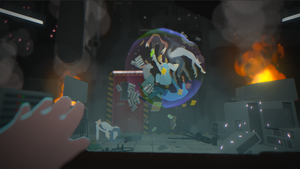
EW: One instance where the connection was made was with Portal, where we had the boss battle designed. It involved you burning up those spheres. At some point, we were sitting around talking about it, and somebody said, "Well, we never trained anyone that you can burn things in these incinerators. We're just springing this on you right there."


Note: Pictured cube unsuitable for companionship. 

There was a connection that was made right there, because we had this part in the game where you had the level with the Companion Cube. At that point, at the end of that level, you just left the Companion Cube. You just abandoned it because it couldn't go any further.

There was this connection made, like, "Holy mackerel, this can be way stronger if they force you to kill the Companion Cube, and we're also going to train you that incinerators burn things in this world." That was this moment of insight that just came from design arguments that were happening, and all of a sudden we hit on this perfect thing.

 
Article Start Page 1 of 5 Next
 
Comments

Dave Blanpied
profile image
Insightful article. Lots to think about. Thank you all.

Snake Link Sonic
profile image
She's [Alyx] the courier for emotion; ironic when considering her origins eh?

I do think it's true how gamers are quick to take for granted something like the dialouge between two characters. Especially considering how new it is, it does tend to engage effectively when the proper context is established; something I think writers carry the burden for more than any one. The fact that he was there to 'enable' the design process shows that his craft is being introduced much earlier. Definitely a plus when compared to the mindset to simply build the game and slap writing on top of it. That filter statement that Wolpaw also mentioned is definitely indicative in terms of how such titles are built now. Good news to say the least.

Glenn Storm
profile image
What a great interview, packed with wisdom. These are consummate professionals. Thank you all x2!

Zach Wilson
profile image
The thing he mentions on page 2, about text-to-speech being comical to everyone but the person doing it is a problem I've encountered on the project I'm working on right now. I love it because there's zero dependencies and it's super fast - I can get a new sound cue in less than 5 minutes. Unfortunately I haven't been able to sell any of the other people on my team that this idea has merit.

I had never considered making the characters robots, maybe that can be our third act twist.

Matt Haigh
profile image
Very good interview. Great job!

Andrew Dobbs
profile image
A note on intention, meaning, etc...I agree it can be disastrous to worry about your "theme" while drafting the story. Whenever people are attached to a particular message, the writing that follows tends to be pedantic and Ayn Randian. Following your intuition is essential for a writer.

That said, once the story is complete, examine it. Think about the meaning, ask other people what they think, and use that insight to revise the story into something more powerful than a typical video game story.

Portal does have one of the best game stories ever told, but there's room for more with everything they've done and intuition usually leads you only part of the way. Portal is funny and sometimes moving but lacks much insight. You may only change one scene, one sentence, or one word, but that one change could help someone look at life in a new way.

Stephen Northcott
profile image
Cool article. The very first question and answer sets the scene for a great interview, and I found myself nodding and agreeing with a lot that was said - particularly that first answer. :)

Grey None
profile image
You'd have to change a lot to make Portal change someone's life. It may be a well integrated story, though I'd challenge that point too considering it's all conveyed through a monologue on a speaker system that blares as you shoot and platform across various levels (really, how hard is it to make the interaction itself - not the writing on the walls or the audiotapes you pick up and play - meaningful), but I wouldn't say it's one of the best. It's more of a backdrop that sort of ties into the setting but not the game mechanics, which is what Valve is good at providing for their customers. I generally like what they've done, but to say that there's room for improvement is a gross understatement.

I think their design is far far better than their writing. The look of their characters and world are commendable.

John Smith
profile image
The story in Halflife 2 was made from canned clichés with a bit of children's humour that seemed to drag on forever.

As for Portal, I couldn't hear what the warbled voice was saying, but I read online that it was something about a cake and that it was funny.

John Smith
profile image
I must add that I loved Halflife 1 though - most of all maybe because it didn't really have much story line apart from towards the very end of the game. And no voice dialogue either.

Arjen Meijer
profile image
cool story, also good to hear that I'm doing about the same in coming up with new stuff for games.

Nathan Frost
profile image
RE: Andrew Dobbs: “Whenever people are attached to a particular message, the writing that follows tends to be pedantic and Ayn Randian “

I'm not convinced of this; I bet some of your favorite writers who deal with message subtly and thematically do in fact begin with a message and craft most aspects of the story around that message. I suspect that one of my favorite writers, Alan Moore, did exactly that# with “The Watchmen”, which has received some critical acclaim.

Further, while I haven't read Rand, you're not the only one who's told me that her stories take a pedantic, narrative-as-philosophical-exposition approach. This isn't necessarily a bad thing, though; her books have sold millions* of copies and have influenced many peoples' worldviews.

RE: Grey None: “really, how hard is it to make the interaction itself [in a game like Portal] meaningful?”

I argue that the interaction of Portal is intrinsically meaningful. I view the game as an exploration of a relationship with someone with narcissistic personality disorder$. To fulfill GLaDOS's self-centered, narcissistic desire to toy with another consciousness, the player is trapped in the Enrichment Center with the portal gun and is manipulated into performing tricks for the AI. But when the player grows skilled enough to start breaking out of the confines GLaDOS would keep the player, GLaDOS's secure amusement in the player's behavior gradually gives way to a histrionic, bipolar deportment.

This parallels how a real-life narcissist might attempt to secure the constant admiration of another by seeking to empower that person in some ways while simultaneously restricting that person's freedom in others. This works out great for the narcissist until the very empowerment he provides to the other allows that other person to begin sustaining her own thoughts and ideas, many of which may not be what the narcissist wants to hear. In fact, a good friend of mine experienced an intense 12-year relationship very much like this, and years later still feels that relationship's impact on her life.

I'm not claiming that we shouldn't strive to improve game writing further; we should. But crafting any form of narrative around a message is a perfectly valid way of going about it, and part of Portal's resonance is derived from the fact that using the GLaDOS-given portal gun to escape GLaDOS's prison is a cogent metaphor for escaping an intimate relationship with someone diagnosably narcissistic.


#"I didn’t know Rorschach was going to die at the end of Watchmen until issue four – that was the only major detail that I hadn’t sorted out right from the beginning"
http://www.johncoulthart.com/feuilleton/2006/02/20/alan-moore-interview-1988/
“we tried to...give [“The Watchmen”] a truly...crystalline structure, where it's like [a] jewel with hundreds and hundreds of facets and almost each of the facets is commenting on all of the other facets and you can...look at the jewel through any of the facets and still get a coherent reading.”
http://www.blather.net/articles/amoore/watchmen3.html

*“The Fountainhead” [alone has] sold over 6.5 million copies.”
http://en.wikipedia.org/wiki/Ayn_Rand

$wikipedia's definition
http://en.wikipedia.org/wiki/Narcissistic_personality_disorder


none
 
Comment:


Submit Comment