|
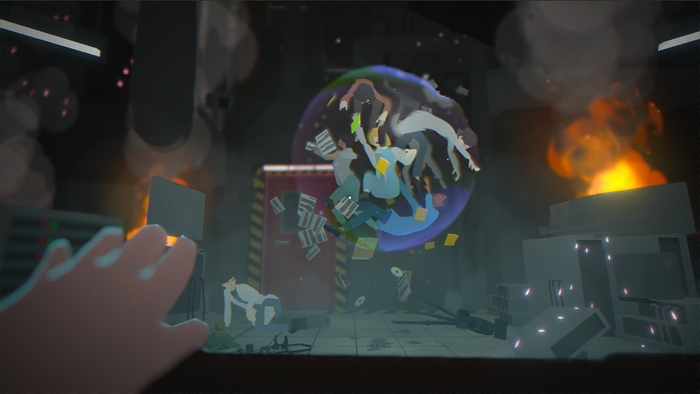
[In this sponsored feature, part of Intel's Visual Computing site, former Monolith head Jace Hall discusses Chadam, a new Unreal Engine-powered animated series using the engine for surreal, intriguing -- and initially non-interactive -- means.]
Although the term "convergence" has been
bandied about for years, the advances in video game engines today are finally
opening new doors for Hollywood creators. Epic Games' ubiquitous Unreal Engine
3, which powers everything from Gears of War 2 to the upcoming BioShock 2, is
now making the migration to Hollywood through Chadam.
Based on the cutting-edge
paintings of acclaimed California surreal artist Alex Pardee, HDFilms is
creating a 10-episode, 50-minute Web series that Warner Bros. Television Group
will distribute. The franchise will debut as a computer-generated Internet
series and evolve into television and video games. Because the entire project
is being created within a game engine, it will allow for a near-seamless
crossover from linear to interactive entertainment.
And that's not the only convergence that's going on with
this project. HDFilms, the digital production house creating Chadam, was
founded by Jace Hall, the former head of game developer Monolith Studios. Hall
oversaw the development of a diverse slate of games, such as Blood, TRON 2.0:
Killer App, Condemned 1 and 2, and F.E.A.R. 1 and 2. During his game
development days, Hall was competing with Epic Games' technology, as well as id
Software's Quake engine, as his studio licensed out its Lithtech engine to
game developers.
"In order to do my job correctly, I had to understand
exactly the entire feature sets of all of the engines at all times and their
rate of progress and how they worked," explained Hall. "In terms of using the
Unreal Engine personally, I've never had to do that because I've always had my
own technology. But I understand how Unreal works, where it's strengths and
weaknesses are; that was my job of the day for many, many years. As we looked
at this project, I was able to easily evaluate what technology makes the most
sense for what we were trying to do and Unreal Engine 3 was the clear winner."
What HDFilms is trying to do -- and they're close to
completing the job -- is build a digital pipeline utilizing video-game engine
technology that will allow this team to create stories using computer-generated
imagery for the Web, television, and movies.
"This is an amazing development," said Tim Sweeney,
founder and CEO of Epic Games, and the man who created the Unreal Engine
technology. "For decades, non-real-time graphics packages evolved to meet the
needs of cinematographers, while real-time game engines grew up independently
to serve gaming. We've now reached a tipping point where the two come together,
and the workflow of the real-time tools is so effective that digital artists
can create better results more quickly in a game engine than in an off-line rendering
solution."
Marti Resteghini, vice president of HDFilms, said the
tools of Unreal were designed for storytelling. After all, video games, as a
medium, are essentially highly interactive stories.
"It's only recently with the huge upswing in video games
as a creative pool for feature films, that Hollywood has become aware of this,"
said Resteghini. "But the truth is, from Pitfall! to BioShock, games have long
been focusing on heroes (or anti-heroes) and their journeys, which is what
movies are about. With added software like Unreal Matinee, Unreal has become a
hybrid of game engine and traditional rendering software that creates a virtual
environment similar to a Hollywood sound stage, complete with moving
characters, lighting, camera, lenses and sets."
HDFilms found that one of the key advantages of using
video game technology was that it kept the costs down and allowed a core team
of three to create the bulk of the work over an 18-month development cycle. At
the height of production, when the team was heavily animating content, that
team number rose to 12, including some outsourced work. Like Hall, everyone on
the production team came from the video game industry. In fact, one of Chadam's
storyboard artists, Jon Mayshak, worked at Epic Games on Gears of War in the
same capacity using the same Unreal technology.
"Chadam's creator, Alex Pardee, and our editor, Stephen
Reedy, did not come from the game space and often needed to coordinate with our
director, Landon Pascual (also our lead designer), for the final episode
renders," said Resteghini. "However, the Unreal Engine and its
filmmaker-friendly tools have made it very easy for all of them to communicate
between the mediums."
The team also took advantage of Intel hardware for this
project. They used an Intel Core 2 Quad processor Q9550, with a 2.93 GHz
render station with 8 GB RAM and 64-bit Microsoft Windows Vista. In addition,
they had four Intel Core 2 Quad processors Q6600, with a 2.40 GHz workstation
with 4 GB RAM and 32-bit Windows Vista. Even the team's editor used an Apple
Mac with an Intel processor to piece the story together.
"Our lead designer found Intel -- economically, technically,
and support-wise -- by far the leader on the market," said Resteghini. "We built
all of our computers from individual parts paying close attention to the specs
of each piece and how their function played into this project -- knowing we were
going to demand a lot from UE3, Intel was our immediate choice."
Resteghini said that since the Chadam models were made in
Asia, the Intel standard made the technical conversation between the team's
modelers, designers, and animators much simpler, especially during the more
complicated stages of production, such as key-framing and the cleanup of the
motion capture.
|