Our Properties: Gamasutra GameCareerGuide IndieGames Indie Royale GDC IGF Game Developer Magazine GAO
My Message close
Contents
Two Halves, Together: Patrick Gilmore On Double Helix
 
 
Printer-Friendly VersionPrinter-Friendly Version
 
Latest News
spacer View All spacer
 
February 10, 2012
 
Road to the IGF: Lucky Frame's Pugs Luv Beats
 
Analyst questions validity of unusual January NPD results [4]
 
Strong Tales of Xillia sales help Namco Bandai to Q3 profits
spacer
Latest Jobs
spacer View All     Post a Job     RSS spacer
 
February 10, 2012
 
Beachhead / Activision
Senior Operations Engineer
 
Sony Computer Entertainment America LLC
Manager Quality Assurance
 
Beachhead / Activision
Senior Front End Web Engineer
 
Beachhead / Activision
Senior Back End Web Engineer
 
Beachhead / Activision
User Experience Lead
 
Sony Computer Entertainment America LLC
Senior Software Engineer
spacer
Latest Features
spacer View All spacer
 
February 10, 2012
 
arrow Principles of an Indie Game Bottom Feeder [20]
 
arrow Postmortem: CyberConnect 2's Solatorobo: Red the Hunter [1]
 
arrow Jerked Around by the Magic Circle - Clearing the Air Ten Years Later [40]
 
arrow Building the World of Reckoning [4]
 
arrow SPONSORED FEATURE: TwitchTV - How to Build Community Around Your Game in 2012 [13]
 
arrow Happy Action, Happy Developer: Tim Schafer on Reimagining Double Fine [9]
 
arrow Building an iOS Hit: Phase 1 [11]
 
arrow Postmortem: Appy Entertainment's SpellCraft School of Magic [5]
spacer
Latest Blogs
spacer View All     Post     RSS spacer
 
February 10, 2012
 
Audio Passes: Success Through Layering
 
What the current RPG can learn from Diablo 1
 
Double Fine's Kickstarter Windfall: Will Patronage Supplant Traditional Game Publishing? [5]
 
The Principles of Game Monetization
 
Did DoubleFine Just break the publishing model for good? [14]
spacer
About
spacer Editor-In-Chief/News Director:
Kris Graft
Features Director:
Christian Nutt
Senior Contributing Editor:
Brandon Sheffield
News Editors:
Frank Cifaldi, Tom Curtis, Mike Rose, Eric Caoili, Kris Graft
Editors-At-Large:
Leigh Alexander, Chris Morris
Advertising:
Jennifer Sulik
Recruitment:
Gina Gross
 
Feature Submissions
 
Comment Guidelines
Sponsor
Features
  Two Halves, Together: Patrick Gilmore On Double Helix
by Christian Nutt [Business, Game Design, Production, Interview]
1 comments Share on Twitter Share on Facebook RSS
 
 
February 8, 2010 Article Start Page 1 of 5 Next
 

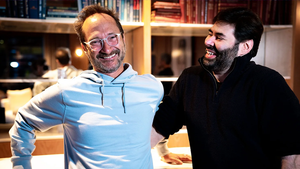
In December, Patrick Gilmore took over as head of Foundation 9's Double Helix Studio -- which is currently working on two current-generation projects: Front Mission Evolved, for Square Enix, and an unannounced game for another major publisher.

Formed from the combination of formerly Atari-owned studio Shiny (MDK) and The Collective (Marc Ecko's Getting Up), the studio is just one piece of the Foundation 9 puzzle -- the largest independent development organization in the West, comprised of studios in North America and Europe.


Heading up a large team of 110 developers, Gilmore -- whose background includes running the Medal of Honor team at EALA -- must figure out how to leverage the strengths of a work-for-hire studio that is looking to expand its reach with original concepts and more polished execution.

Here, Gilmore discusses the state of the studio, its projects, and the creative direction he sees the industry going toward -- more cinematic games, not less; a trend built on the back of the games that have come out in the last several months and which will continue to be released through 2010.

What did you come to the studio to do?

PG: Why was I hired, or what were my personal reasons for being here?

Those are both good questions, actually.

PG: The studio's part of Foundation 9, and they have their headquarters here in the same offices as the Double Helix studio. We're actually in separate spaces, but we share the same building. James North-Hearn, who is the CEO of all of Foundation 9, has had a very active role in managing Double Helix for the past few months. But I think they've been taking the time to find the right person and find the key direction for the studio.

I've been talking to them for quite a while, and I finally came in to basically take over the studio, to engage the people, and organize around quality and creativity. I think that Foundation 9 and Double Helix have been work-for-hire for a long time, and that company has been focused on growth, but last year, as 2009 was winding down, we were a little bit less focused on growth and now focused a lot more on taking the talent that's here and building the quality.

And what attracted you on a personal level to the studio?

PG: Shiny was around for 17 years, and The Collective was around for 12 years. So I'd been aware of the constituents of Double Helix for a long time, and I've always been interested in them as high-quality independent developers.

When I was at EA, I ran the Medal of Honor team, which sometimes got to be around 120 people. It felt like a right-size fit for me to come in and engage in some place that had amazing executional ability. These have been talented developers that have been able to offer low risk, and have been great in getting projects done in time to publishers. They've got a great track record for shipping complicated projects with large numbers of SKUs. Building on that foundation to focus on a lot more quality and creativity was something that was hugely attractive to me.


Front Mission Evolved

Front Mission has been going for a while, now, and development obviously precedes your arrival for quite some time.

PG: Yes. I can say that it looks amazing. I think the team has done a fantastic job. It's a mech game, and there's certain expectations that come with delivering a mech game, including customization and a strategic aspect.

The heritage of Front Mission has been turn-based strategy, so their whole focus has been "How do we look at IPs and imagine them in a more contemporary context?" So the first thing they wanted to do was move out of the turn-based strategy and into something that was a little more real-time and action-based, while retaining the spirit of Front Mission. I think they've done a phenomenal job of doing that.

Square Enix hasn't worked with a Western studio before. Do you have any thoughts about what it's like to work with them, compared to other studios you've worked with?

PG: I can say that they've been a fantastic partner. The last game the Front Mission team did before this one was Silent Hill [Homecoming], which we did with Konami. The team has adapted themselves to working with Japanese publishers, as much as that can be considered a specialty. They're very comfortable with the Eastern way of development -- lots of focus on quality and detail -- and they have what I would consider an extraordinary relationship with Square.

Square comes with a pretty incredible pedigree, and Hashimoto-san, the producer we're working with, has done some spectacular games, including Kingdom Hearts for Disney, and a few other products. There's a little bit of an intimidation factor, but the team is committed to rising to the occasion and delivering the vision.

 
Article Start Page 1 of 5 Next
 
Comments

Glenn Storm
profile image
This is a great interview that hit all the points I was wondering; particularly the comparison to the EA culture and climate. This is a guy who knows how to weave a large number of creative people with a range of skills into a cohesive fabric. Thanks, Christian! /me waves to Patrick

"I've been looking at trends in the industry, and I haven't seen many people writing about this, but there has been an absolute explosion in cinematic quality in games released through last year and this year. ... The level of cinematic execution, the level of storytelling, the level of experience... it's not just the core mechanics of the game, it's the core mechanics of the game woven into a setting that is rich and emotional and has a very, very high set of stakes."

There's a golden nugget of truth here that could be missed: the stakes. Once the audience is invested character, you can press with conflict to raise the stakes, making the circumstances of that character become the imperative question the player feels compelled to answer through action. Easier said than done, of course, but this is coming from someone who understands the power cinema has had to effect audiences in precisely this way; well, except for the fact that the audience acts vicariously in cinema. One of the best story pitches I heard given to a development team was delivered (multiple times, consistently well) by Patrick. It's no surprise to me that he would lead the way in efforts to unify a large multi-faceted group like Foundation 9, both technically and creatively, via solid communication. This is his strength.


none
 
Comment:


UBM Techweb
Game Network
Game Developers Conference | GDC Europe | GDC Online | GDC China | Gamasutra | Game Developer Magazine | Game Advertising Online
Game Career Guide | Independent Games Festival | Indie Royale | IndieGames

Other UBM TechWeb Networks
Business Technology | Business Technology Events | Telecommunications & Communications Providers

Privacy Policy | Terms of Service | Contact Us | Copyright © UBM TechWeb, All Rights Reserved.