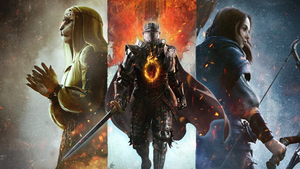
In a new Gamasutra feature on the realities of why and how violence occurred during history, historian Christoph Kaindel takes a look at how open world games handle it and how that contrasts with reality.
"Ironically, game advertisements as well as critics of excessive game violence place a lot of emphasis on the purportedly 'realistic' depiction of violence in games," writes Kaindel. "Player motivation in most games is quite simple. The player character often is a soldier just doing her duty fighting hordes of single-mindedly aggressive opponents."
The truth of the matter is, in history, people fought in many different ways and to many different purposes. The violence in games is generally not realistic, he writes, in the sense that it does not hew to realistic motivations or forms.
"As a player, I immensely enjoy playing open world games. I love the sense of freedom, of discovery, of unexpected things happening; as a historian, however, I can't help comparing game worlds to real societies. Even though I realize that game worlds need to be simplified, I feel that many games could benefit from a little extra complexity, inspired by the structure of real societies," he writes.
For example, in Medieval European cities, "Men usually fought in defense of their personal honor, defined as the ability to protect one's personal space, reputation, family, home, possessions, rights and privileges. Insults in public escalated to brawls or knife fights. The goal was not to kill, but only to publicly defeat the other person," writes Kaindel.
There were also, he writes, "tournaments, fencing schools and exhibitions, stage fights, wrestling contests, judicial combat and, later, duels."
All of these, he argues, could be successfully interpreted as game mechanics. He also offers critiques of several open world games, such as Saints Row 2, Grand Theft Auto IV, Red Dead Redemption, and Bully, taking a look at how they use violence and whether it stacks up against real world motivations.
The full feature is live now on Gamasutra.
|
In all seriousness, I understand what Christoph may be saying here, and off the top of my head I can name Way of the Samurai for a game that handles that combat somewhat..."historically"? This article seems like common knowledge though, we're mostly aware combat and violence is unrealistic in Video Games, it's part of the appeal. Indeed, I think the major issue that's age old and still hot right now is that it's getting TOO bloody and realistic.
Hmm, feel like I ostracized that point by making the point that there were no reanimated skeletons in recorded history, let alone constantly plaguing humanity. Is it not a valid argument that a lot of games where "unrealistic motivations" are present do not also include "unrealistic situations"?
But thank you for reiterating my point?
Violence has a place, but it needs to have meaning, context, and consequence.
I am hopeful that the indie game scene will be able to run with these kinds of ideas. By accepting a lower graphical fidelity, it leaves more of the development budget for simulating characters and relationships and societies, and new, more orthogonal fundamental mechanics. But because I'm cynical about the tastes of the gaming mass market, I doubt richer open world games will ever be seriously interesting to triple-A game developers.