My Message close
GAME JOBS
Latest Blogs
spacer View All     Post     RSS spacer
 
May 21, 2013
 
Let’s produce HTML5 games with a serious approach.
 
An Object Of Lust
 
Gamasutra Blog Guidelines - Updated and open for discussion [9]
 
Postmortem: ROBLOX Mobile
 
Fingle marketing effort and numbers [1]
spacer
Latest Jobs
spacer View All     Post a Job     RSS spacer
 
May 21, 2013
 
Treyarch / Activision
Sr. UX Designer
 
Vicarious Visions / Activision
Senior UI Artist-Vicarious Visions
 
Tarsier Studios
Design Director
 
Trendy Entertainment
Marketing Producer
 
Visual Concepts
Game Build Engineer - 2K Sports
 
The Workshop
Character Artist
spacer
Latest Press Releases
spacer View All     RSS spacer
 
May 21, 2013
 
GB Video Games Quiz - Are
you a true 8-bit...
 
Psychsoftpc Responds to
the Cry That Windows 8...
 
FINAL CALL TO ARMS!
 
Aardman, Sony Music and
BinWeevils.com Launch...
 
Born Ready Games
erweitert das Strike
Suit...
spacer
About
spacer Editor-In-Chief:
Kris Graft
Blog Director:
Christian Nutt
Senior Contributing Editor:
Brandon Sheffield
News Editors:
Mike Rose, Kris Ligman
Editors-At-Large:
Leigh Alexander, Chris Morris
Advertising:
Jennifer Sulik
Recruitment:
Gina Gross
Education:
Gillian Crowley
 
Contact Gamasutra
 
Report a Problem
 
Submit News
 
Comment Guidelines
Sponsor

 
Avoiding 'false choices' and giving your players real trade-offs
 

August 15, 2012   |   By Mike Rose

Comments 9 comments

More: Console/PC, Design, GDC Europe


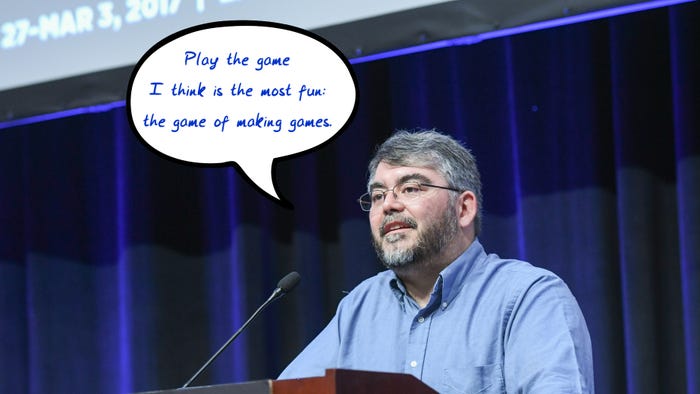
James Russell, lead designer at Creative Assembly, is a big fan of player choices and trade-offs in video games -- an obvious sentiment for those who have dabbled in his company's Total War franchise.

However, he noted during his GDC Europe session this week that these choices actually have to be interesting and cause the player to really think, otherwise they become meaningless and won't do anything to immerse the player in your game's universe.

"When a decision is put to the player which has an obvious right answer, it's not really a decision," he argued, calling these types of situations "false choices."

Through his work on Total War, Russell has seen first-hand how this can affect your game. In Rome: Total War, for instance, players could simply set the highest tax rate possible on settlements without townspeople rioting, and that was always the best solution to earning the most money. It was obvious that setting taxes low had very little upside to it, and hence this wasn't a real choice.

However, with Empire: Total War, Creative Assembly mixed things up a little, providing long-term benefits if you did decide to go with lower taxes. This meant that players now had a real choice and could really immerse themselves in the decision making process.

Russell also discussed the pros and cons of real-world simulation, providing examples from the Total War series that demonstrated how giving players accurate depictions of real-life war can lead to either great experiences, or poor balancing.

One particularly striking example involved cannonball trajectory -- the team realized that cannonballs fired from ships that were further away did more damage to enemy ships than those fired at point blank.

It quickly came to light that the trajectory of point blank shots would go straight through an enemy ship, while shots fired from far away would arc and then plough through into the base of the enemy ship, potentially sinking it from beneath.

Hence, it was necessary to alter the cannonball trajectory model such that it conformed with what players would believe is the best tactic -- getting close up to enemies -- rather than what was actually occuring via real-life based trajectory physics.

Gamasutra is in Cologne, Germany this week covering GDC Europe and Gamescom. For more coverage, visit our official event page. (UBM TechWeb is parent to both Gamasutra and GDC events.)
 
 
Top Stories

image
Unity's mobile licenses are now free
image
Market's ready for new consoles, but old-gen surprisingly viable
image
The next Xbox: What Microsoft needs to reveal this week
image
Practical ways to deal with problematic player behavior


Comments

Dave Kay
profile image
Interesting stuff. I think, when you think about it, it's a pretty 'obvious' principle... but it's clear from looking at a lot of games that when you're in the middle of development it can sometimes be easy to forget about simple stuff like this.

One thing makes me a little sad, though:
"Hence, it was necessary to alter the cannonball trajectory model such that it conformed with what players would believe is the best tactic -- getting close up to enemies -- rather than what was actually occurring via real-life based trajectory physics."

I understand games are about entertainment, and sometimes reality needs to take a backseat to fun... but part of me wishes they would have introduced something that would teach the players that long-range was better, and the reasoning behind it, instead of kludging the physics. The best 'education' games are ones that you don't even realize are educating you.

Kareem Merhej
profile image
Tactical education has always lacked in these games. I too wish they would try to impart some real knowledge to the player, like why he might want to flank vs draw out the enemy, and how to read terrain.

Javier Arevalo
profile image
If you tie the point about simulation with the point about real choices having pros and cons, long-range can left to be more effective as long as its accuracy suffers a lot. Teach this to the player and you open the system to scenarios like a losing player choosing to go for the risk of long range, hoping to be saved by a lucky shot.

Maria Jayne
profile image
This is false, I'm playing Rome: Total War now and there certainly is a choice with settlement taxes.

If you lower taxes, your population grows faster due to more settlers being attracted to your city and your people being able to afford more children. However the downside to this is your population grows faster than you can build improvements within the city and you end up with high squalor ratings causing riots and eventually the townsfolk kick you out and the territory becomes rebel.

Now if you Raise taxes, your townsfolk become unhappy unless you have a significant garrison of soliders within the city to maintain order. of course a garrison costs money so it's a false economy somewhat. However the townsfolk still end up rioting as the population grows and eventualy they kick you out and it turns rebel.

There is a choice to be made in both instances, the outcome remains the same but when the outcome happens can be delayed by adjusting tax rates to slow down population growth or slow down the point at which the city turns rebel. The choice is more money and quicker rioting or less money and longer periods of happiness.

The only issue is that no matter what, I end up slaughtering my townsfolk for rebelling because at larger city sizes thats the only way to bring the city back into order that lasts for any length of time.

Joshua Darlington
profile image
I think you know you've hit the sweet spot when choices start to make people slightly uneasy, or perplexed. If the choices are not upsetting the player, then the stakes are not high enough (or not clearly communicated) or there is an obvious winning move.

Joe Cain
profile image
"However, with Empire: Total War, Creative Assembly mixed things up a little, providing long-term benefits if you did decide to go with lower taxes. This meant that players now had a real choice and could really immerse themselves in the decision making process."

Not to play Devil's Advocate, but is this really a shining example of "real" choice? If the outcome of a player's action is obvious (especially in a moral context), it ends up feeling like players are being guided toward the "right" solution to avoid a negative (or at least, less-than-ideal) outcome because that's what they're "supposed" to do. It's like asking someone if they want to eat the poisoned apple or the delicious apple - how many people are going to pick the poisoned apple unless it has a potentially "good" outcome, even if only every so often or only under certain circumstances?

To be clear, I do think that the ideas mentioned in this article are moving in the right direction, but only on a surface level. To be truly meaningful, a player's actions should have a range of different outcomes depending on the context of the situation, thereby creating a dynamic system that doesn't readily lend itself to one obvious "best" solution. That's not to say you can't put an obvious situation in front of a player and be accused of not giving players a meaningful choice - you would obviously use a hammer to smash an enemy - but in those cases, putting multiple enemies in front of the player along with some other objects that the hammer can also smash and providing various outcomes depending on which item the player chooses to use the hammer on would provide the kind of framework necessary to give a player the opportunity to make a "real" choice.

Charles Geringer
profile image
To me it is clearly a real choice.

You have the possibility of raising taxes to get more money at the cost of your population's happiness.

Or you can lower taxes, to keep your population happy, at the cost of lower income.

You have two choices with a pro and a con each. as oposed, to the original "false" choice where the low tax option had no pro whatsoever.

Toby Grierson
profile image
A missing component both here and in the comments is -context-.

To properly engage, a choice can't exist in isolation; it has to be judged against the rest of the game state.

In a tactical game I wrote, the AI would run into situations where, for example, unit A can attack unit X.

It could see that if it killed unit X and took its position (P), than it would end the turn in spot P and could judge the value or danger of that spot in light of who ELSE could attack position P.

Or, if it would fail to kill the unit and take the position, it would end the turn just short of position P, in spot Q... And in turn judge the risk of being in spot Q, with injured unit X right next to it.

Then we can factor in goals, current health, other teammates and so forth, and there we have an engaging decision making process.

It's never always the case that doing one thing is better than an other because the appropriate move depends on a variety of other -transient- factors.

As long as the player has to think to assess a situation and weigh choices, than you have an engaging game and interesting decisions.

Your task is to create decisions that must be judged in light of a variety of other factors, ones that change and change in light of your decisions and your opponent's.

Kris Havlak
profile image
I agree with the general message of the article. If one choice is obvious then it is not really that much of a choice. BioWare games (though I love them) have a bit of this problem... once you've picked lightside/paragon or darkside/renegade, your choices are pretty much made up for you.

I love the Total War games, but with taxes I find the only real option is to set them at maximum value that keeps province morale positive. Not much of a choice.

A much more exciting choice is whether to peacefully occupy vs. loot a captured town. You have to decide what your short and long-term needs are and how it fits into your overall strategy. Very simple but very meaningful.


none
 
Comment:


UBM Tech