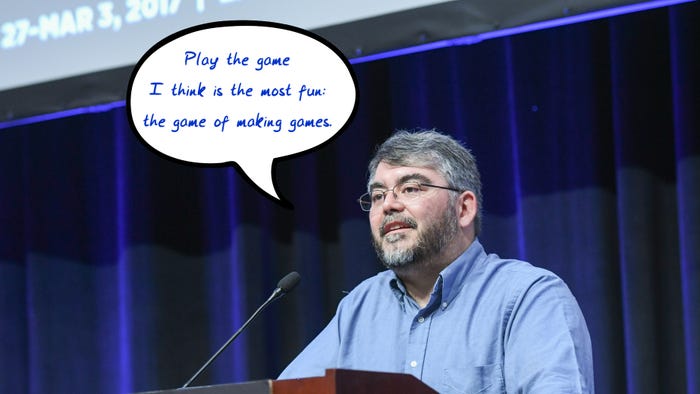
In his incredibly animated talk at GDC Europe on Wednesday, Frictional Games co-founder Thomas Grip (Amnesia: The Dark Descent, Penumbra) discussed horror and storytelling in games, explaining his personal theory of what's vital in telling game stories.
His prime thesis is that in games, "story is not just the plot." In fact, regarding what's important in interactive storytelling, Grip postulated: "We want the player to play through the story, not just sit through it."
In a complex talk, Grip suggested that similar games separated by 20 years like Uncharted and Another World have, in the end, relatively similar types of gameplay and storytelling combined.
In that case, both titles have things like running, followed by jumping and cutscenes -- Grip argued: "This is weird… why haven't we advanced?" He suggests: "The main culprit is how most of these games are designed."
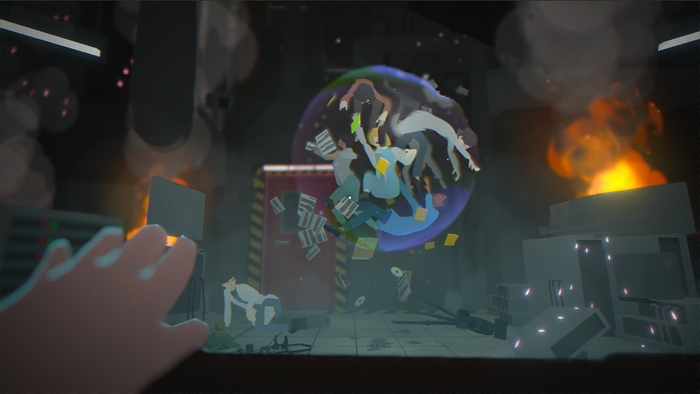
Using his own games as examples, Grip expressed his thesis: "Tell stories where you play all the way through the games, not just the bits where the designers tell you to."
Overall, Grip is definitely an explicit game story minimalist -- he suggests that the key to success is to keep systems simple, and rely on the player's imagination. And multiple game design elements will enhance the story and coherence of the universe.
In particular, a couple of those game design elements include the concept of a consistent world ("what you do somewhere should work somewhere else"), and that of "agreeable outcome" (buttons doing perhaps not exactly what the player wanted to do, but doing something that feels right to them). Designers should also avoid failsafes -- "herding" players into particular didactic cutscenes and other forced explanations.
Grip concluded of his passions: "Don't try to beat the game, try to live the game" -- and said that Frictional Games is "trying to push this as far as we possibly can" with its next, as-yet-unannounced game.
|
"We want the player to play through the story, not just sit through it."
The best game stories are the ones where the player feels involved and not being punished by sitting through story beats.
The fun of story driven games (which everybody seems to be forgetting) is seeing how the story plays out if you're making the choices. For example, how would a movie like Seven be different if you're playing as Morgan Freeman? Maybe you decide you don't care about the case and want to retire. The rest of the game, you can only read about whats going on in the paper. Maybe you decide spying on library records is immoral? The story goes in a new direction.
"explicit game story minimalist -- he suggests that the key to success is to keep systems simple, and rely on the player's imagination."
For horror, one of the main techniques is to lower thresholds of the senses. So I could see how story could disrupt immersion. However, story could also be used for limbic tagging, shaping emotional space, directing attention and inattention. -Which could also be powerful tools for horror.
For other genres: Research suggests that boredom and daydreaming/imagination are linked. So I would suggest being careful about using minimalism. Some people have better imagination than others (like game designers). Some people could have multiple reactions to getting bored, like griefing or ignoring quests while they keep searching for some game content that is actually interesting. -Or changing to another game. Sometimes less is more, some times more is more (a three ring circus can be better than a single ring circus).
BTW Cut scenes can act as bridges between ANYTHING. Like curtains that fall between acts of a play, with the right cut scene, you can jump in time, space, characters, genre, game mechanics ANYTHING.
The reason story hasn't developed is because 99% of games developers put programming and technology first. They don't want to hire writers. They want to hire people who can write and do X, Y and Z also. Having a robust full-time writing staff is, to put it nicely, a joke to some companies. Being an amazing writer just isn't valued. The only "pure" writers (off the top of my head) at the top of games studios are Ken Levine and Amy Hennig (funny how those games are amazing, huh?). It'd be great to know of more. While I'm at it, how often do you see a writing position up for grabs on Gamasutra? Twice a year?
Game dev tools for writers (and "cinematographers") are weak. We expect games writers to be able to understand technology at an unrealistic degree for people who are already specialized in another field (words!). There are a million Shakespeares out there waiting to write games but there's such a barrier to entry.
We've seen at a very small scale more basic tools like GameSalad and Stencyl opening the field up to the uninitiated but we're still a long, long way from seeing changes on the "pro" side. What we have right now is a whole bunch of people with tech skills and ideas writing games. Not writers writing games. In some cases we have TV or Hollywood writers. These are also not ideal writers.
There are kids out there whose first literature is games and they will write the masterpieces of our future, but it won't happen if we keep undervaluing writing and telling them to learn "practical" skills.
Developers: HIRE WRITERS! Train them yourself if you have to, but get them for the quality of their words, not experience with this tool or that tool that you probably don't even use yourself. Trust me, it's worth it.
Coding knowledge is awesome! Coding is what defines the medium. So I find it puzzling that any game writer would advocate ignorance in the area.
RE: The only "pure" writers...
I assume that most, if not all the writers in the industry have talent, skills, drive and etc. However, they face various balancing issues and work flow issues.
But you can pick up coding. You can learn to code while being employed. Nobody "picks up writing". Like everything else it can be developed and honed but really great writing is far more rare than good, working code.
I'm trying to say that we're keeping out really good writers!
Coding is one part of the medium, I think what defines it are all the very different disciplines that come together to make a game. Many of those disciplines have code poking around somewhere, but a master 3D Artist isn't necessarily a great programmer, and an amazing Sound Designer might not be able to script at all outside of opening the line which matters to him and pasting in the sound.
I'm not advocating ignorance at all. I'm advocating high quality writing in games. If you want games writing to be amazing, get people who are amazing at writing.
Your dentist isn't good at acupuncture. Your cinematographer isn't good at marketing. Why should games writers be good at anything other than writing games?
...
ARE
YOU
KIDDING
ME!
Have you checked out Biowares rooster? There is no shortage of English Lits and cinematographers.
And look how that turned out.
Writing and cinematography have now become the proverbial hammer and everything looks like the proverbial nail.
Not sure if you are trying to blame an outcome on too many "english lits" and "cinematographers" or if you are saying they cant help much? Either way I'm not sure you made a convincing case.
"Writing and cinematography have now become the proverbial hammer and everything looks like the proverbial nail." that seems like an odd statement please elaborate.
Kareem seems to have a highbrow lit bias - which would seem to be a better match for IF than AAA RPG. Not sure why he discounts coding and most game writing. Perhaps he's using some personal criteria. I do agree that better tech tools would be awesome.
I dont think that programmers and writers or cinematographers need to have anything like an adversarial relationship. For game design they seem to have complimentary skill sets.
You have Coders, Designers and Artists...and writing were divided from the designers/creative directors into their own team(not gonna swear by this but its how i see it).
Teams were small back then and often the lead developer and designer was the same, but they still had dedicated positions for that.
Especially for RPGs who had a many game designers from the PnP/Tabletop industry writing content and levels.
No one can claim they wrote on Hamsuns level, but they setup, designed and wrote encounters and NPC while still taking into acount the overall rules and setting.
The prose wasn't much, but RPG writers tends to produce eccentric flavour in their writing that proved memorable on their own, without a strong storyline.
It was exposition that was enjoyable, while telling the player what he had to do in terms of gameplay and progression.
Now...its QUALITY in the story is everything, its what they are trying to pitch instead of game mechanics.
And...I..Have NEVER! seen a story in a game...I'd pay...(BE PAID) to see in a cinema or read in a book.
The worst thing they can happen is with the forced exposition with full voice acting and cinematic is aggravate the HELL out of me! Without interesting gameplay to make up for it. This has been true for me since DA1.
It produced the trend of these AAA monstrosities as the only viable market.
@Joshua Darlington: Mass Effect. I don't think we can blame English majors on the bad writing of that game. ME is a weird series. The science writing can be strong: entries for planets and technology are interesting, but the dialogue, often, is awful. Worse still are your preview options which constantly do a very poor job of telling you what Shepard is about to say. EVEN WORSE STILL: the design of the game only allows for two very arbitrary, stilted Shepards (pussy vs. douche, excuse my language). Is this really the fault of English its? I also find it hard to believe anybody who operated a real camera worked on the game, as all the blocking seems very pre-generated, uninteresting, unexciting and makes basically zero use of basic film principles. Bioware has made leaps and strides when it comes to this but their conversations are still largely two people standing in one spot repeating canned animations. Again, not the fault of English lits.