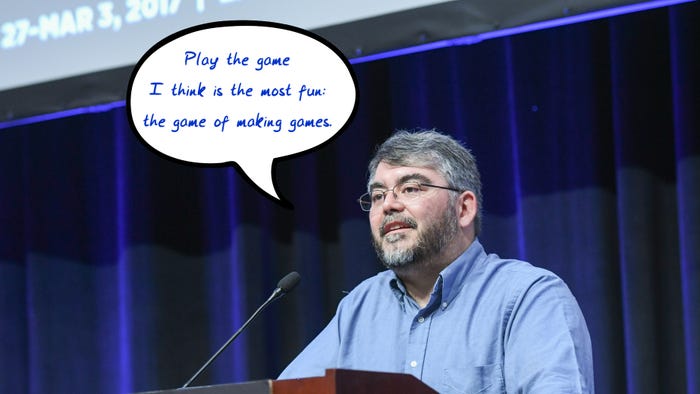
"[Telecom operators] are kind of holding us back in many respects... We have to worry about broadband when we should be thinking about making better games."
Whether you're developing a single player game or a large scale MMO, Livingstone noted that broadband speeds are becoming an increasingly problematic bottleneck for game development.
Download speeds might be increasing worldwide, but file sizes for digital games are growing even faster. It takes quite a long time to download most digital games, and Livingstone believes home consoles haven't been able to embrace a digital-only model for that very reason.
And of course there's the ever-present problem of online latency. Until broadband speeds improve, developers will have to go out of their way to compensate for lag in their online games.
"The message is: build bigger pipes and we'll try not to fill them," Livngstone said. "ISPs, please do not rest on your laurels."
Except what is the real motivation for an ISP to build a bigger pipe. They're not gonna be able to charge more for it, most people have a set price they're willing to spend on internet, and will buy accordingly.
Couldn't this argument work for any hardware component in general? I'm afraid there are some times in which you just have to work with what you're given.
In this case it's not technology holding us back. With current available technology we could theoretically achieve speeds in the terrabits, yet we're stuck with speeds of mere 25 mbps. The new system being installed in Australia by the government will support up to 1 gbps at initial roll out but can theoretically go as fast as terrabit speed in the future. If left to private interests however we'd be stuck with the abysmal aforementioned 25 mbps max. (edit: 25 mbps approx....I'm not sure the exact speeds and couldn't be bothered looking it up ;)
Agreed. When we had dialup, games progressively grew and started pushing the limits, then we got broadband. Once we had broadband, developers realised that they could push more down the line and started thinking bigger and better until now they've started hitting the limits again.
Yep. The moment those pipes will open, developers will just ship the .exe and players will just stream assets down from the cloud like it was on their harddrive. That pipe will fill up in a weekend.
But at the moment things that should be able to be easily solved are not. I think that's the difference. For instance an average dvd (say 4 gigabytes) with readily available technology (say 1gbit/s optic fibre) should be able to be downloaded in about 30 seconds. Instead it would take hours to download this, which is really unacceptable for a mass market who wants everything right now. That doesn't mean developers won't invent things to fill the gap but the vast majority of entertainment would be significantly improved with better bandwidth.
Scientists have already created quantum teleportation in a laboratory so this should solve the speed of light problem eventually one would imagine. I don't claim to understand it completely but I imagine teleportation would eventually create a situation where there is 0 latency.
People always trying to bring up "the speed of light" to sound clever but it's really not accurate. The speed of light gives us a lower limit of ~70ms from one side of the world to the other. As John Carmack famously mentioned some months ago, this latency is comparable to the current cost of pushing a pixel from a computer to our eyes through a TV. It's measurable and significant, but it's far below the practical latencies we see sending packets today. And most data can be replicated or hosted much closer to the destination than literally the other side of the planet.

"The speed of light" is not what's holding up latency. Look rather at bufferbloat, poorly-engineered consumer networking hardware and software, organically grown network topologies, the rise of lossier and hoppier wireless networks, and frankly, shitty networking code in the games themselves.
quantum tangling requires you to send normal data too to work, quantum tangling works by changing one quantum, sending the data of how it was changed, and measuring in the other side, so quantum tangling also has the speed of light.
If we ever manage to somehow use it to teleportation, it allows huge bandwidth, but not 0 latancy (ie: 70ms is the latency to the other side of the planet, thus teleporting a person to the other side of the planet will always take at least 70ms)
I think forcing developers to work within limitations is the greatest means to creating better games. When you can be lazy and just let brute force do all the work why would you bother refining your code to be as efficient as possible?
@Maria Jayne: "I think forcing developers to work within limitations is the greatest means to creating better games."
Ok then, you can work within the limitations of a dial up connection with a 16Mb Pentium and a 3DFX graphics card and we can all have 1TByte networks, 1 million CPU cores, 10 Petabytes of memory and 1 billion cores in our DirectX 20 graphics cards ;) ... lets see how far you get with pushing those "limitations" then ;)
As someone who has been coding within those "limitations" for over 30 years, I can't tell you enough how much I want bigger, faster, more more more ... and I want it now! :)
Its all very well trying to squeeze what we can out of the existing technology, and its a wonderful sentiment, but that is a road to diminishing returns over time and there is so much more we developers can think of doing, if only newer technology allowed us to do even more.
Having worked on some very limited systems in the past, I don't miss being forced to waste hundreds of hours trying to 'trick' the hardware into doing what I need it to do.
Don't get me wrong, I love writing efficient code, but some of the lamest games have been built on excellent code. On the other hand, plenty of great games would never have been released if we were still fighting with past limitations.
Why do I have to download the complete game before I can start playing anyway? Just package the game in a way so that later content is downloaded in the background.
I would love to be able to make my game only run on high end video cards with 8k textures and 8 GB of ram. But the number of people with that kind of configuration will be small, so I make it using only 2k textures and 1 GB of ram.
Know the limitations and work within them, if what you want to do doesn't work within the limitations, wait 10 years and try again.
Sure you won't.
The moment new boundaries are given, there will be a mad rush to push against them too.
"The speed of light" is not what's holding up latency. Look rather at bufferbloat, poorly-engineered consumer networking hardware and software, organically grown network topologies, the rise of lossier and hoppier wireless networks, and frankly, shitty networking code in the games themselves.
quantum tangling requires you to send normal data too to work, quantum tangling works by changing one quantum, sending the data of how it was changed, and measuring in the other side, so quantum tangling also has the speed of light.
If we ever manage to somehow use it to teleportation, it allows huge bandwidth, but not 0 latancy (ie: 70ms is the latency to the other side of the planet, thus teleporting a person to the other side of the planet will always take at least 70ms)
"Good enough" isn't.
Ok then, you can work within the limitations of a dial up connection with a 16Mb Pentium and a 3DFX graphics card and we can all have 1TByte networks, 1 million CPU cores, 10 Petabytes of memory and 1 billion cores in our DirectX 20 graphics cards ;) ... lets see how far you get with pushing those "limitations" then ;)
As someone who has been coding within those "limitations" for over 30 years, I can't tell you enough how much I want bigger, faster, more more more ... and I want it now! :)
Its all very well trying to squeeze what we can out of the existing technology, and its a wonderful sentiment, but that is a road to diminishing returns over time and there is so much more we developers can think of doing, if only newer technology allowed us to do even more.
Don't get me wrong, I love writing efficient code, but some of the lamest games have been built on excellent code. On the other hand, plenty of great games would never have been released if we were still fighting with past limitations.
I would love to be able to make my game only run on high end video cards with 8k textures and 8 GB of ram. But the number of people with that kind of configuration will be small, so I make it using only 2k textures and 1 GB of ram.
Know the limitations and work within them, if what you want to do doesn't work within the limitations, wait 10 years and try again.
Eidos is still making games, they're just pointing out some of the limits they're running into.
If nobody complains it doesn't matter how long you wait, nothing will change.