|

|
 |

| |
MechWarrior Creator Weisman On IP Rights: 'Don't Sell 'Em'
by Chris Remo [PC, Console/PC, Exclusive]
|
|
| |
|
August 21, 2009
|
| |
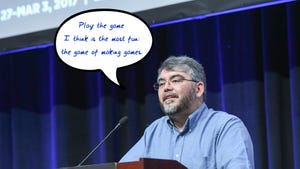
FASA founder Jordan Weisman, co-creator of BattleTech/Mechwarrior, Shadowrun, and Crimson Skies -- and one of the game industry's perpetual entrepreneurs -- has learned a lot over his long career about managing intellectual property.
He now licenses the game rights to those franchises back from owner Microsoft at his latest venture, the cross-media company Smith & Tinker, which also fully owns the ambitious children's franchise Nanovor.
So what exactly has Weisman learned about property rights? "Don't sell 'em," he told Gamasutra flatly in a recent interview.
Starting with pen-and-paper games and moving into a number of different entertainment segments, the now-defunct FASA Corporation and FASA Interactive once managed an impressive array of fictional universes, most of which are now tied up in a convoluted ownership mess.
"You know, for twenty years, or a little less, we carefully managed those properties MechWarrior and Shadowrun," Weisman said. "We made sure all the video games, the novels, the games were all really woven together. It was all..."
He trailed off, then started to lay out the state of FASA's former assets: "We ended up selling both companies off to two different people. WizKids bought FASA, and then Topps bought WizKids, and then [Michael] Eisner bought Topps."
"Now, sort of, Eisner owns the movie rights, and all the story rights for MechWarrior, and Microsoft has the video games. And then I license the video game rights back from Microsoft."
Weisman added that this didn't just add complexity to the legal state of the properties, it had a direct negative effect on the brands. "Once that ownership got a little fractured, it became really difficult to manage cohesively," he said," and I think the property suffered."
Still, the recent announcement of a new MechWarrior title -- and unconfirmed rumors about some other classic FASA properties making a return -- indicates Weisman has no intention of letting the worlds he helped conceive fall into disrepair, even if he no longer owns them.
"One of the motivations on licensing it back was to get it back on track and create a more cohensive home for it," Weisman explained, "so I'm working with Eisner and his people, and with Microsoft, and we're trying to do this in a much more cohesive fashion again."
|
| |
|
|
Crimson Skies II for 360? Please?
You don't have to sell IP to a company you control if you own the company itself. If you own the company, and it's a private company, there is no way for you to lose control of it without your consent. Weisman made the choice to sell FASA -- it wasn't forced from his grip -- and he apparently regrets it.
just thought you should know...
MechWarrior 4 was a happy time in my life, I'm gonna start watching battlemech.com for that free download. I can't wait to see what you guys do next too.
I still love giant robots...
Wizards+rocket launchers == win;
I know Jordan personally. His abilities as a game designer are not limited by his current IP woes. He's probably the most imaginative person I know.
Now you have Game X. But you have to make Game X2. But Game X2 isn't a new game. It's just the same IP, with some more content and features. It isn't a new game.
Plus, since you are a studio - instead of a free agent - you gotta pay the overhead. That means you can't take time off and think of something new; no you have to get onto the next project - which is usually a sequel. So whatever idea you had for a different IP - a non-Game X2 - you have to put on the backburner for some distant time. You're too busy managing the studio you made.
I think the guys who did Age of Empires recently ran into this issue. They cranked out so many sequels that now they can't do anything but RTS games. They want to do something new, something other than an RTS, but they're stuck - the publishers only think of them as RTS-makers now. So I heard.
I suppose this is a good situation for some people though - who only want to design one game, then crank out millions of sequels for it. But if you see all kinds of possibilities to design a wide range of games, it's constraining.