| David Crooks |
|
My reaction to playing the game: "Nothing's happening...nothing's happening...nothing's happening....heh, I went to work in my underpants...nothing's happening...huh, that cemetary scene was weird...wait, that's the ending? WHAT THE HELL KIND OF ARTY CRAP IS THIS PIECE OF..RRGGGGHH!!"
Seriously, I can stand artiness, or pretentiousness, or whatever, but at least do something INTERESTING with it. Having a relatively out-of-the-ordinary art style doesn't mean you can do whatever you want and make something that is bereft of (perceived) content and then have a bunch of people in berets snap their fingers in applause. |
|
|
| Timmy GILBERT |
|
|
I have yet to play the game but i find this insightful!
Let me summerize this to increase the range of the article. In a short from narrative terms: THIS game succeed at having introduction IN gameplay terms rather than cinematics, and cleverly embed THE CALL TO ADVENTURE in PLAYER ACTION. IN gameplay term: There is a fake "gameplay loop" that the player have to break in order to reach the real gameplay and start the adventure. It imply for the player "disruptive boundaries" actions. This mecanics can be enhance with a "leap of faith" to shatter boundaries to heigten emotional involvement. Generally game start right after the call to adventure, we only play development and never introduction. The first time i thought about it, it was in english class, we were reading Lady chaterley beginning. It was a huge painful wall of text that subtly lay down thématics. Functionnaly i thought that was an awesome and powerful way to prepare the reader and thought "how can we make this in game?". The problem was there was no action per se, and in game you need to DO, that's wahy generally it is cinematics. In movie generally we have the huge Pan/travelling shoot with générics before we get to the character. It's not a new problem and many game have try to tackle it. In half life the player is set on "rail" and is led blindly from action to action, but it is still the game that direct him. In another world from eric chahi the last part of the introduction push the player around through threat and let him have some leap of faith, narrative is essentially driven by a "movement-collision" scheme. But still the player does not commit the leap of faith on a decision of his own which is the massive improvement brought by this article. I think "Movement - collision" (let's called it moco) is an important concept to grasp for narration in game. Game today use a simple implementation we call "scripted sequence", you move and trigger a "thing happen" scene, but it's rare that moco is use to actually enhance the sense of agency like the article describe. To be effective moco must move around the "stake space" of the narrative, for exemple a female shoes that suddenly broke is not important... unless the character who wear the shoes is chase by a killer or is a model on podium, it may have even greater signifiance in the whole narrative stake (think sarah connor vs random props girls). By letting player ACT the moco by using clever hint "bounderies shattering" it may move game story telling to new interactive levels. Now maybe i over stepped the real thing that happen in the game (i have yet to play it), but the reflexion behind the article still shine ! Great article Leigh! (edited) |
|
|
| Leonardo Ferreira |
|
|
I think the set-up for the message was pretty much ruined for me as the very first thing I did was to arrive at the office in my underwear, and be promptly fired by the evil boss.In the next day, everything was right again.Since the game allowed my to do that, it kinda worked against the overall message, which is quite interesting...
|
|
|
| Bruno Dion |
|
|
@Leonardo Ferreira
Or even worse, you could interpret it has: whatever you do, however much you push the boundaries, in makes no difference in the end. It's a pretty tragic game when you look at it this way. |
|
|
| Joe Cooper |
|
|
Ironically, the message was pretty canned and shows no independent thought whatsoever.
Maybe that's part of it? Should I picture a thousand faceless artists in cubicles making the same dystopian piece in different mediums? |
|
|
| Russell Carroll |
|
|
Very thoughtful and thought-provoking, I enjoyed the game immensely. Thanks for talking about it, I wouldn't have likely known about it otherwise.
|
|
|
| Sean Currie |
|
@ David Crooks
From your comment I think you stopped playing halfway through. The game has a definite narrative arc (and a definite ending) but you have to play around a little. It's pretty fantastic. Although, like all art games I love, it has invariably killed my love for whatever big budget game I'm playing. I agree with Joe, the message is pretty standard - it kind of reminds me of Pleasantville but the act of engaging a very typical narrative trope in such an atypical framework was refreshing. I love it not only when games prove themselves worthy of the "art" moniker, but also when they make fools out of disbelievers. This does both very, very well. :) |
|
|
| Timmy GILBERT |
|
|
Art can be silly too, does not have to be always EPIC :)
|
|
|
| Michael Samyn |
|
|
I find the format quite interesting. But isn't it about time to move on to discussing content now?
I find the retro graphics well chosen because the narrative of the piece seems incredibly dated. Do real people still have lives like this? Where they wake up in the morning and go to work in a cubicle and all that? Seems a bit like the artist is trying to make fun of people who don't live a bohemian life while in reality everybody does. Or can all of this be included in complexity of the piece? I'm not dismissing the game at all. Just trying to elevate the discussion a bit. The design of the game is interesting and appropriate. We can discuss that too. But the barbarian comments about whether or not this is art or how art is rubbish are boring me about as much as The Graveyard bores the 1337 h4xorz. |

|
|
| Joe Cooper |
|
|
@Samyn
I agree; obviously this art. People 'round here have decided that if its art, its better, so when people don't like something, they declare it "not art" when it is, or insist "games are art" when they aren't, and so on... Moving on... The narrative seemed dated to me. As in, this has to be the eleventy dozenth time I've seen it. I wasn't sure if it was meant to be dated though. The visual obviously was, but I think the art style was chosen because its strongly associated with modernism - even if the audience doesn't know the word "modernism", they'll still get the right associations. There seems to be an effort to paint the world through shit tinted glasses and I don't think it rings true. I suspect its just regurgitating some hipster culture cliches - which I suppose is actually good enough if you're doing some presentation experiment like this. It does demonstrate well enough using interactive media as a medium for expression. Its art. However, it is all about the presentation, style and use of technology, with a canned narrative, and you'd sum up Transformers 2 the same way. However however, I enjoyed Transformers 2. And this was kinda neat. |
|
|
| Michael Jungbluth |
|
|
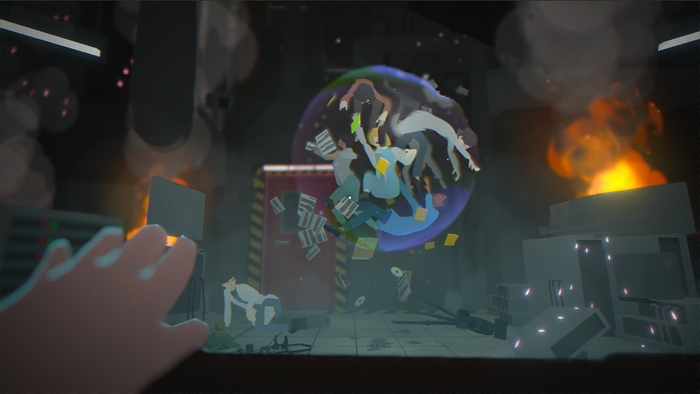
The way the screen is framed and the camera choices made are genius. Walking through the office, in either direction, builds so much dread or anticipation, that is shows how powerful a simple camera decision can be. The art direction as a whole is sublime and fits in perfectly with the late 50's, early 60's dystopian view of the man's daily grind.
|
|
|
More: Console/PC, Indie, Exclusive