|

|
 |

| |
Interview: Reynolds Pioneers For Zynga With New FrontierVille
by Leigh Alexander [PC, Console/PC, Exclusive]
|
|
| |
|
June 9, 2010
|
| |
When veteran strategy game designer Brian Reynolds left Big Huge Games for social gaming giant Zynga, it made waves -- the Rise of Nations and Civ II designer wanted to make Facebook games?
Now, a year later, Zynga -- which has 215 million monthly unique players over all of its Facebook titles, and is struggling with declines in some of its top titles like Farmville -- is rolling out the fruits of Reynolds' efforts later today.
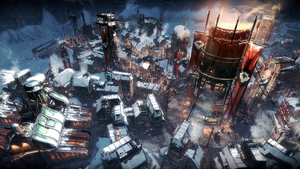
The new title is FrontierVille, a Facebook-based Wild West strategy, resource management and family life sim that the company proudly trumpets as containing several "firsts".
These include more persistence in the game world, the ability for a user to create a family, and numerous game systems aimed at increasing social depth in a way more complex than simple (and recently somewhat curtailed) notifications to friends lists.
Reynolds dearly hopes that with FrontierVille, he can show other designers that it's possible to build Facebook games with depth. "I came into this out of a very different industry, out of the traditional game industry," he says.
"And the reason I came was because like all the other kinds of games I've gotten into making, this was the kind of game I was playing at the time."
The social aspect was what fascinated him most -- "but at the same time, how can we make these games more social than they are, more useful to players socially and interactively?"
"The game we came up with is FrontierVille," he says. That the game is launching at a time when Wild West fandom is at a fever pitch thanks to the novelty of Rockstar's Red Dead Redemption is a sheer coincidence, says Reynolds -- "but if you wanted to build a conspiracy theory, you could note one of my designers from Big Huge Games went out to join the Red Dead Redemption team about the same time I joined Zynga," he jokes.
The frontier theme was chosen not only because it was a relatively under-explored setting in games -- a reason cited for the interest in Red Dead -- but because Zynga's player surveys found that men and women alike found it exciting. "Both men and women really responded to the frontier theme," says Reynolds. "The men would think about the adventure, and the women were interested into the aspects of raising a family on the frontier, thinking back to Little House on the Prairie."
Reynolds discusses his work with an energy and enthusiasm rarely seen from the traditional design space regarding social games, but he is pragmatic about the need to appeal to a mainstream audience: "Zynga is a mass-market company, so we need that," he states.
And appealing to a wider spectrum of different people makes a game more interesting, as the player ecosystem develops with a lot of variety. Some players will be interested in the home elements of the frontier life -- the game allows you to eventually create a virtual spouse and even have virtual children, and communicate with them when "away" on quests.
Others will enjoy the persistent universe, what Reynolds calls a "living world": "For the first time, the world doesn't just kind of sit there and wait for you to come back... weeds grow, little trees start turning into big trees which drop seeds and make new trees... it's got this sense of the wilderness kind of pushing back as you carve out your pioneer track."
One of the primary criticisms of social games is that they aren't really "social" -- gameplay focuses on flaunting achievements on a Facebook page, or by insistently notifying friends about opportunities to play together whether they're interested or not. But it was important to Reynolds to encourage genuine, improved social aspects.
He notes: "Most games let you go visit your friend, but now what we have is you can tend their homestead, un-wither their crops, feed their chickens." Doing things for friends levels up a player's reputation score, a stat new to Zynga games that aims to go beyond a simple leaderboard, and encourages a more positive social ecosystem
Reynolds is clearly targeting the development of a meaningful experience in Facebook gaming, and he hopes traditional designers will be able to see the merit in his approach -- he's not on board with the sort of comments made at investor conferences that social games don't need to be "good", and that only user numbers matter.
"I think the thing that social gaming can't be is really complicated and scary," he says. "And what you learn in a whole career in game design is that making a fun game isn't about making it really complicated and scary. It's actually about having little simple parts."
"If you're good at it, you can have the simple parts kind of subtly interact in deep ways," he continues. "There's nothing about FrontierVille that's complicated -- you click, and stuff starts happening, and it's pretty. We give you this open world and you start playing around in your fantasy frontier sandbox, and the more you do, the more you express yourself."
A choice for a player between choosing whether to build reputation and level up, accrue resources or maintain the aesthetics of a cabin, may not be particularly obviously-deep choices, Reynolds says, but balancing all of a player's different options can be very engaging.
"It's not overwhelming, it's just fun. Game developers who think there's no game in [Facebook gaming] haven't looked closely enough," concludes design veteran Reynolds. "Investors that say they don't need to be fun -- I hope I'll prove them wrong really soon."
|
| |
|
|
"The frontier theme was chosen not only because it was a relatively under-explored setting in games -- a reason cited for the interest in Red Dead -- but because Zynga's player surveys found that men and women alike found it exciting. "Both men and women really responded to the frontier theme," says Reynolds. "The men would think about the adventure, and the women were interested into the aspects of raising a family on the frontier, thinking back to Little House on the Prairie."
Jesus. Sounds like someone has been listening too much to the men in suits. What utter nonsense.
Personally, I've never had any appeal towards the frontier setting, but I'm not exactly their prime market in any sense of the term so I'm sure that doesn't concern them.
I think that the idea of a frontier setting is actually a bit ingenious - his point about it being a setting that's appealing both in terms of adventure and in terms of "nurturing"/family-building seems pretty perceptive...
But I wonder whether the feeling of that setting could really be maintained in a Farmville-style game. Can I fail to provide food for my family and watch as they starve to death? Can my daughter die of cholera? Can I meet a bear in the woods and be eaten by him?
Probably not - I would doubt there's any real danger or losses that can occur... and it seems like this lack of danger will dilute the frontier atmosphere of the game. The feel of the frontier is defined by danger, and a design that ignores this will never get that feel right. The Oregon Trail is an example of a game that did that right.
But of course, people will start playing because the setting is appealing, and probably keep playing because of "stickiness" and/or addictive gameplay, and the failure of the setting to fully deliver on its promise will probably be forgotten, or forgiven. It's interesting how setting and theme in games is simultaneously incredibly important and incredibly unimportant.
FrontierVille will probably be both a financial success and a pretty good game at the same time IF it really does bring the mentioned depth of gameplay that wasn't quite there for FarmVille.
Am I the only one out there that is actually excited to see Zynga making these games?
As far as the frontier theme popularity, it's not hard for this company to spend $50K on focus/concept testing to understand what its customers want in a game. Your statements are representative of how far off the beaten path console game devs. have really gotten. Most of us are in denial unfortunately.
This announcement today is fairly significant in the eye of Zynga's shrinking user base IMO. If Zynga can balance these new games with actual game play for more advanced gamers, but keep them accessible to the mass market casual gamer, they may see continued success as a top FB publisher. If not, and consumers continue to (rightfully) question whether their games are actual games, Zynga's ship may not come back in.
"Flaming comments incoming"
Oh, and I don't see 7.5 million players ditching AAA games.
Um, farmville already has those 'features'.
"Regarding Frontierville, it's mostly just going to split their playerbase. They would be better off just expanding Farmville rather than trying to migrate those users over to a new game."
IMO getting them hooked on new games is exactly the right thing to do. You can only play the same game for so long with the 'depth' of gameplay that current games like farmville have before you basically finish everything you could possibly do or you just get tired of it. They'll be 'moving on' to another game, so it's in Zynga's best interest to make sure it's one of theirs, which they've been doing a pretty good job of with the cross promotions they've done like 'play a few levels in mafia wars to get a tractor in farmville'.
I'd imagine they also have numbers that show how many players keep playing (and paying for) the older games when they start on newer ones. If the numbers showed it was best to focus everything into retaining players in farmville, they'd probably be doing that instead of constantly adding and promoting newer games.
Regarding that 'danger'-topic that was mentioned, obviously you can't die, but every now and then a snake or a bear appears, that you have to take care of, which uses up some energy, which you could otherwise use for getting resources or whatever.
I'm not sure if the average "gamer" finds into the game easily, as there's alot more to do in the beginning than there is in Farmville, but the average user probably has played Farmville before, so they might be used to some basic concepts already.
Even though I'm not a big Zynga fan, i gotta say that this is clearly an improvement, compared to Farmville.
Unfortunately for me though, this one is quite similar to the game I am currently working on, so this will probably make life harder for me.