The Entertainment Software Association (ESA) has issued a warning over a "flawed" soon-to-be-published study that alleges a link between video games and mental health problems in children.
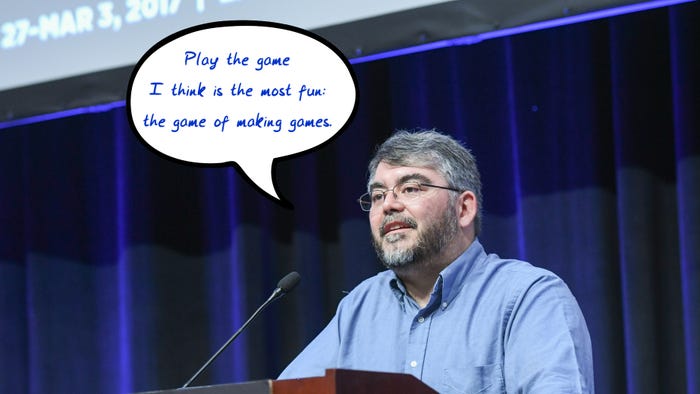
The study was authored by Douglas Gentile (pictured), who runs the Media Research Lab at Iowa State University, a researcher who has been criticized in the past for exaggerating the purported harmful effects of video games.
Richard Taylor, SVP for communications and industry affairs said in statement: "We commend credible, independent, and verifiable research about computer and video games. However, this research is just more of the same questionable findings by the same author in his campaign against video games."
"There simply is no concrete evidence that computer and video games cause harm. In fact, a wide body of research has shown the many ways games are being used to improve our lives through education, health and business applications."
Taylor went on to specifically attack the methodology in Gentile's forthcoming study. "Its definition of 'pathological gaming' is neither scientifically nor medically accepted and the type of measure used has been criticized by other scholars," he said.
"Other outcomes are also measured using dubious instruments when well-validated tools are readily available. In addition, because the effect sizes of the outcomes are mainly trivial, it leaves open the possibility the author is simply interpreting things as negatively as possible."
But Gentile told Gamasutra in an email that it's "surprising" to him that the ESA would characterize him as "anti-game," as he claims himself to be a gamer, and has written studies supporting the positive effects of games.
"Although the ESA claim that this study is flawed, they give no credible evidence of significant flaws," he said. "Furthermore, the article was subjected to peer-review by independent experts in a top medical journal, experts whose interest is in evaluating the quality of science."
"In addition, the ESA statement includes inaccurate statements," said Gentile. "For example, their claim that the prior study had a mistake in methodology is incorrect; there was a mistake in using the word "representative" to describe the sample."
"The sampling method was, in fact, an industry standard approach used by Harris Interactive," he said. "Regardless of the details, the statement by the ESA is evidence of them doing their job to try to protect the interests of the video game industry."
"My position is and always has been that games are powerful, and that they can have many effects. Some effects are beneficial, others can be harmful," Gentile continued. "The various effects depend upon many different features, upon amount of time spent with the games, and possibly upon characteristics of the player. By being aware of both the potential benefits and potential problems, families can maximize the benefits while minimizing the harms."
Here's a direct link to the 2010(?) study (PDF) "Television and Video Game Exposure and the Development of Attention Problems" - Authors: Edward L. Swing, Douglas A. Gentile, Craig A. Anderson, & David A. Walsh
When a game can hold you in front of the screen for hours I doubt there is any strong evidence linking ADD with games. Quite the opposite, maybe the daily drudgery needs to be addressed in a way so that games stop being the compelling escape.
People keep analyzing effects instead going to the root of the problem. And that's true for almost all walks of life. Mainly because it's easy to find excuses rather than do the hard work that benefits everybody in the long term.
This was my first thought when I read through the article--maybe they need to find more compelling ways to teach and grab kids attention--I played games and watched plenty of TV all throughout my life and did quite well in schooling..in fact I'm still doing quite well--and I would attribute a lot of that to family upbringing opposed to blaming games and tV
[edit: some part of the comment is no longer relevant after the post's update]
@Alex Covic: That is a different study, as the forthcoming one uses participants from Singapore according to GI.biz. Then again, all the Anderson, Bushman and Gentile studies tend to look the same and do not include family environment variables in detail. Christopher Ferguson's studies which do view the human as a non-passive sponge that automatically processes media violence into overt behavior, as well as his rebuttals to the fearmongering methodologies, are highly recommended.
You can ignore the TGDaily link as it only referred to when the post previously had a bad link. Read this overview of the violent games debate instead if you're interested: http://www.tamiu.edu/~CFERGUSON/videometa2.pdf
It's not entirely relevant to this one, but Gentile is one of a group of researchers known for their video game violence studies in the past.
Really? My nephew was playing Halo 1 and asked "what does that say, what do they want me to do?" My sister replied to him, "maybe you need to learn how to read." He huffed "ok I'm going to learn to read so I play this game without you..."
Guess what, he was 4. Now he's in 3rd grade plays games avidly and scored top 5% in California's aptitude testing.
Here's the catch. IF video games can teach good, they can also teach the bad. The human mind can be conditioned from any experience, made more evident by the triggering of the emotional response (which is a primary factor regarding immersion). It need not be games, it can include movies, real life experiences. audio clips... anything. A good speech can positively or negatively move a body of people. Games are no exception. At the end of the day, video games no more negatively impact (which they can, not always do) a child than movies, cartoons, parenting, school life.... anything that contributes to their experiences, emotions and over all conditioning through stimuli and their environment.
I like how he says, "The various effects depend upon many different features...possibly upon characteristics of the player." "Possibly?" How about using "solely" instead?
I was able to access Gentile's article. The first two bogus bulleted premises on the upper left were enough to convince me that I need read no farther. My I suggest that before investigating the subject of ADD/ADHD, persons like Gentile review genuine researchers in the field like Dr. Russell Barkley, et. al..
I have studied and worked in clinical practice with ADD/ADHD children for some 20 years and such conclusions are without merit. Let me give Gentile a hint: Children are born with attentional deficits; one does not develop them through environmental factors.
A major source of learning how to read and write for my 5-year old daughter are games such as Animal Crossing and Barbie Girls. Both require lots of reading, so I sit and play with her - she is so curious about all of the written words onscreen, we read them together, I write down words and she copes them. In addition to reading books, drawing, and writing words, our family has found that computer games are a major source of learning - the big difference is that she does not know she is learning because she is simply playing and having fun. This is really causing me to re-think the very didactic way I was taught back in the 70's, early 80's, which was mostly incredibly boring and tedious. It seems likely that kids will retain more if learning is enjoyable (not just memorize, take tests, demonstrate knowledge so you can remove irritants) and use what the child is interested in for teaching materials? You can start just about anywhere and delve into art, science, math, history, reading, writing, philosophy, sports, etc.
You know... there are a slew of other sources of mental health issues in children, I have a feeling that games are one of the least influential culprits.
ADHD should never be blamed on technology. If anyone has ever met an ADHD child, a true ADHD child, not one of the ones that's touted as ADHD without a clinical diagnosis, you understand the energy level and inability to focus on even the simplest tasks that actually occurs with these disabilities.
Sensationalism sells... and gets your research published.
It's great that people have personal stories and opinions about how games have positively influenced their life. But these do nothing to dispute or disprove this study. If you want to criticize the study, you need to read it objectively and consider the methods that lead to his findings.
Otherwise we sound like folks who say stuff like, "Global warming is bogus, because it was cold in Michigan last year."
I honestly believe they always try to 'blame' media for problems that exist in children. In the early days it was books blamed, then music, then movies then video games. These are mediums of escape that children and adults enjoy. I have one add son and one without it and both enjoy gaming. The add boy can focus on things he enjoys and has a harder time focusing on things he dislikes. He takes medicine to help because it is a chemical balance that helps him focus.
Same bs about gun laws and that guns cause murder. People murder, guns are only one medium used and with gun laws you get guns out of the hands of legal owners.
Interesting. As I recall the last study that got mentioned here (a month or two ago) which showed a dubious link between gaming and negative effects on children came from the same journal....
For my critique...
I'm not familiar with one of those statistical tests they used but the blindingly obvious problem is that this is just yet another inappropriately narrowly focused correlational study.
Factors other than the ones measured could be responsible for the correlation - as has been shown in more comprehensive studies like the one that was recently reported here on gamasutra.
http://www.drdouglas.org/drdpdfs/SGAW2010.pdf
@Alex Covic: That is a different study, as the forthcoming one uses participants from Singapore according to GI.biz. Then again, all the Anderson, Bushman and Gentile studies tend to look the same and do not include family environment variables in detail. Christopher Ferguson's studies which do view the human as a non-passive sponge that automatically processes media violence into overt behavior, as well as his rebuttals to the fearmongering methodologies, are highly recommended.
A game should be a joy to play, not a time-vampire that consumes your life.
It's not entirely relevant to this one, but Gentile is one of a group of researchers known for their video game violence studies in the past.
Guess what, he was 4. Now he's in 3rd grade plays games avidly and scored top 5% in California's aptitude testing.
Personally, games kept me off the street...
For instance, listening to Fallout 3 got me into a completely new genre of music.
I have studied and worked in clinical practice with ADD/ADHD children for some 20 years and such conclusions are without merit. Let me give Gentile a hint: Children are born with attentional deficits; one does not develop them through environmental factors.
ADHD should never be blamed on technology. If anyone has ever met an ADHD child, a true ADHD child, not one of the ones that's touted as ADHD without a clinical diagnosis, you understand the energy level and inability to focus on even the simplest tasks that actually occurs with these disabilities.
Sensationalism sells... and gets your research published.
Otherwise we sound like folks who say stuff like, "Global warming is bogus, because it was cold in Michigan last year."
Same bs about gun laws and that guns cause murder. People murder, guns are only one medium used and with gun laws you get guns out of the hands of legal owners.
For my critique...
I'm not familiar with one of those statistical tests they used but the blindingly obvious problem is that this is just yet another inappropriately narrowly focused correlational study.
Factors other than the ones measured could be responsible for the correlation - as has been shown in more comprehensive studies like the one that was recently reported here on gamasutra.
http://www.science20.com/news_articles/violent_video_games_not_cause_aggession_k
ids_study
This particular study contributes little to this debate.